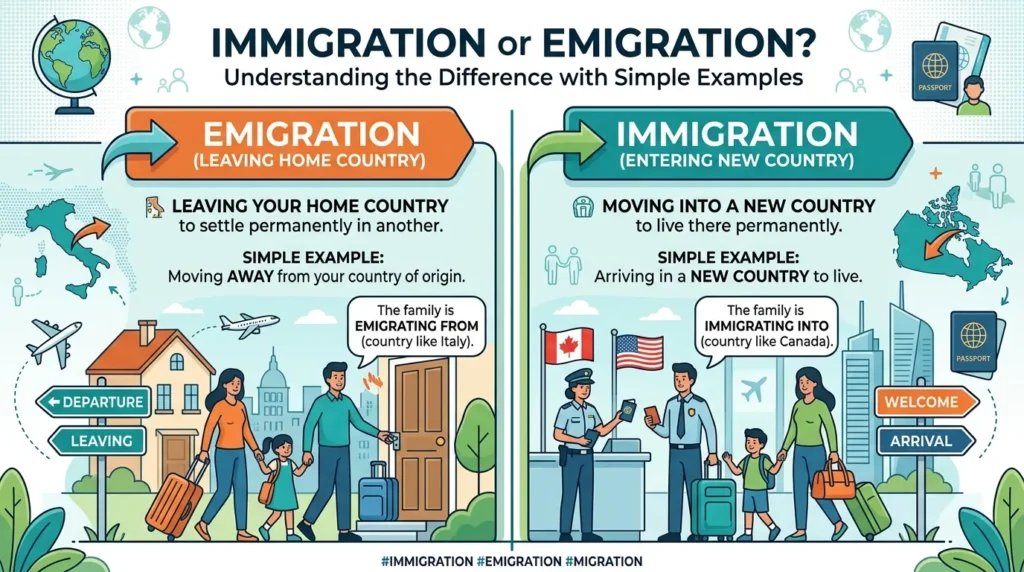
Many people get confused by the words immigration and emigration. They look similar, sound similar, and are often used when discussing moving from one country to another. Because of this, students, travelers, job seekers, writers, and professionals frequently search for “immigration or emigration” to understand which word is correct in a particular situation.
The confusion usually comes from the direction of movement. Is a person entering a country or leaving a country? The answer determines whether you should use immigration or emigration. While the two words describe the same journey, they focus on different viewpoints.
This guide explains the difference between immigration and emigration in simple language. You’ll learn their meanings, origins, usage examples, common mistakes, and how they are used in everyday writing. By the end of this article, you will be able to use both words confidently in conversations, emails, news articles, and professional documents.
Immigration or Emigration – Quick Answer
The quick answer is:
- Immigration means moving into a country to live there.
- Emigration means moving out of a country to live somewhere else.
Simple Examples
- Maria moved from Mexico to Canada.
- She emigrated from Mexico.
- She immigrated to Canada.
- John left the UK and moved to Australia.
- He emigrated from the UK.
- He immigrated to Australia.
Easy Memory Trick
- Immigration = Into
- Emigration = Exit
Think of the letter “I” in immigration as “into.”
Think of the letter “E” in emigration as “exit.”
The Origin of Immigration or Emigration
Both words come from Latin.
Origin of Immigration
The word immigration comes from the Latin word immigrare, which means “to move into.”
It entered English centuries ago and became the standard term for people entering a new country to settle permanently or temporarily.
Origin of Emigration
The word emigration comes from the Latin word emigrare, meaning “to move away” or “to depart.”
It refers to leaving one’s homeland to live elsewhere.
Why Are They So Similar?
The words share the same Latin root related to movement. The only difference is the prefix:
| Prefix | Meaning |
|---|---|
| Im- | Into |
| E- | Out of |
This small change completely alters the meaning.
British English vs American English Spelling
Unlike words such as “organize” and “organise,” there is no major spelling difference between British and American English for these terms.
Both English varieties use:
- Immigration
- Emigration
Examples
American English
- Immigration policies affect millions of people.
- Emigration rates increased last year.
British English
- Immigration remains a major topic.
- Emigration has influenced population growth.
Comparison Table
| Feature | Immigration | Emigration |
|---|---|---|
| British English | Same spelling | Same spelling |
| American English | Same spelling | Same spelling |
| Meaning | Entering a country | Leaving a country |
| Pronunciation | Similar worldwide | Similar worldwide |
| Official Usage | Yes | Yes |
Which Spelling Should You Use?
Since both British and American English use the same spellings, the question is not about spelling but about choosing the correct word.
Use Immigration When
You are talking about someone entering a country.
Examples:
- Immigration to the United States increased.
- Canada welcomes skilled immigration.
Use Emigration When
You are talking about someone leaving a country.
Examples:
- Emigration from Ireland increased in the past.
- Economic issues can encourage emigration.
For Global Audiences
The same rule applies everywhere:
- Entering = Immigration
- Leaving = Emigration
Common Mistakes with Immigration or Emigration
These words are often mixed up.
Mistake 1: Using Immigration Instead of Emigration
❌ He immigrated from India.
✅ He emigrated from India.
Mistake 2: Using Emigration Instead of Immigration
❌ She emigrated to Canada.
✅ She immigrated to Canada.
Mistake 3: Forgetting the Point of View
❌ Immigration from Australia increased.
✅ Emigration from Australia increased.
Mistake 4: Treating Them as Synonyms
❌ Immigration and emigration mean exactly the same thing.
✅ They describe the same movement from different perspectives.
Immigration or Emigration in Everyday Examples
In Emails
The company assists employees with immigration paperwork.
The family considered emigration due to job opportunities abroad.
In News Articles
Immigration levels rose this year.
Emigration rates fell after economic improvements.
On Social Media
Thinking about immigration to New Zealand.
My grandparents’ emigration story is inspiring.
In Academic Writing
Researchers studied immigration patterns.
The report examined emigration trends across Europe.
In Government Documents
Immigration applications must meet legal requirements.
Emigration statistics help measure population changes.
Immigration or Emigration – Google Trends & Usage Data
Search interest varies depending on context and country.
Immigration Searches
The term immigration is searched more frequently because people often look for:
- Visa requirements
- Residency programs
- Citizenship processes
- Immigration laws
Countries with high search volumes include:
- United States
- Canada
- Australia
- United Kingdom
Emigration Searches
The term emigration is often searched in:
- Academic research
- Population studies
- Historical discussions
- Economic migration reports
Why Immigration Is More Popular Online
Most people search for information about moving to a new country rather than leaving one. As a result, immigration-related searches are generally higher worldwide.
Immigration vs Emigration Comparison Table
| Feature | Immigration | Emigration |
|---|---|---|
| Meaning | Moving into a country | Moving out of a country |
| Focus | Destination country | Origin country |
| Prefix Meaning | Into | Out |
| Example | Immigration to Canada | Emigration from India |
| Government Use | Visa and residency processes | Population movement data |
| Common Search Volume | Higher | Lower |
| Correct English Word | Yes | Yes |
FAQs
What Is the Difference Between Immigration and Emigration?
Immigration means entering a country, while emigration means leaving a country.
Immigration and emigration both refer to moving from one country to another, but the difference is based on perspective.
| Immigration | Emigration |
|---|---|
| Entering a foreign country to live, work, or study. | Leaving your home country to live, work, or study in another country. |
| Focuses on the country a person is moving into. | Focuses on the country a person is moving out of. |
| Example: A person moving to Canada from India is an immigrant in Canada. | Example: The same person is an emigrant from India. |
Simple Example
If Ahmed leaves Pakistan and moves to Australia:
- Ahmed emigrates from Pakistan.
- Ahmed immigrates to Australia.
Easy Way to Remember
- Immigration = In (moving into a country)
- Emigration = Exit (moving out of a country)
The main difference between immigration and emigration is the direction of movement. Immigration refers to entering a new country, while emigration refers to leaving one’s home country to settle elsewhere.
2. Can a person be both an immigrant and an emigrant?
Yes. Someone who leaves one country and moves to another is both an emigrant and an immigrant.
Yes, a person can be both an immigrant and an emigrant at the same time. The terms describe the same movement but from different perspectives.
- A person is an emigrant from the country they leave.
- The same person is an immigrant in the country they enter.
Example
Suppose a person moves from Mexico to Canada:
- The person emigrates from Mexico and is called an emigrant in Mexico.
- The person immigrates to Canada and is called an immigrant in Canada.
Why Does This Happen?
The difference is simply based on the viewpoint:
| Country of Departure | Country of Arrival |
|---|---|
| The person is an emigrant. | The person is an immigrant. |
Easy Way to Remember
- Emigration = Leaving a country.
- Immigration = Entering a country.
A person who moves from one country to another is both an emigrant and an immigrant. They are an emigrant from their home country and an immigrant in their new country. This distinction helps governments and researchers track population movement accurately.
3. Which word is more commonly used?
Immigration is generally used more often because people frequently discuss moving into countries.
Both immigration and emigration are important terms, but immigration is generally used more frequently in everyday conversations, news reports, government policies, and public discussions.
Why Is Immigration More Common?
Most countries focus on people entering their borders rather than leaving them. As a result, topics such as:
- Immigration laws
- Immigration policies
- Immigration visas
- Immigration services
- Immigration statistics
are discussed more often than emigration-related topics.
Example
When someone moves from India to Australia:
- India views the person as an emigrant.
- Australia views the person as an immigrant.
In news and public discussions, people are more likely to say, “Australia has a growing immigration program” than “India has a high emigration rate.”
Comparison
| Term | Usage Frequency |
|---|---|
| Immigration | More commonly used |
| Emigration | Less commonly used |
Although both words describe international migration, immigration is the more commonly used term because governments, media, and society often focus on people entering a country rather than those leaving it.
4. Are immigration and emigration opposites?
Yes. They describe opposite directions of migration.
5. Is there a spelling difference between British and American English?
No. Both use the same spellings: immigration and emigration.
6. How can I remember the difference?
Think:
- Immigration = Into
- Emigration = Exit
7. What is migration?
Migration is the general term for moving from one place to another. Immigration and emigration are specific types of migration.
Conclusion
Understanding the difference between immigration or emigration is easier than it first appears. Both words describe the movement of people between countries, but they focus on different directions. Immigration refers to entering a country to live there, while emigration refers to leaving a country to settle elsewhere. The person making the journey is often both an emigrant from one country and an immigrant in another.
Unlike many English word pairs, there is no British versus American spelling difference here. The spellings remain the same worldwide. The key is choosing the word that matches the perspective you are describing. If you are discussing arrival, use immigration. If you are discussing departure, use emigration.
By remembering the simple rule of “Immigration = Into” and “Emigration = Exit,” you can avoid common mistakes and communicate clearly in academic, professional, and everyday writing. This understanding will help you use these important terms correctly in any context.