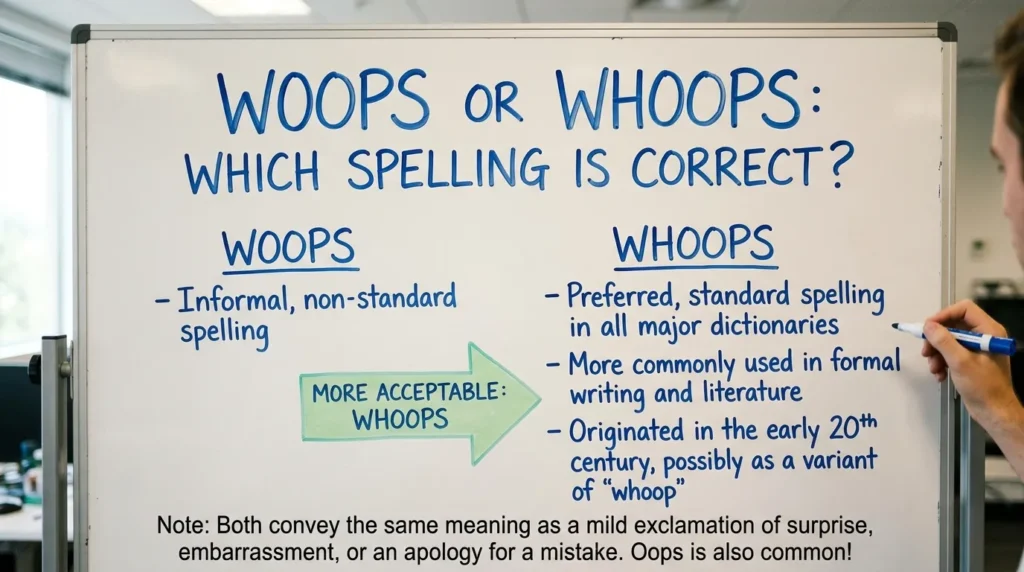
Have you ever typed “woops” and wondered whether the correct spelling is “whoops”? You are not alone. These two spellings look and sound very similar, so it is easy to wonder which one is correct. The confusion is especially common in text messages, social media posts, emails, and everyday writing.
Whoops is the standard and more widely used spelling. It is an interjection used to acknowledge a small mistake, accident, or unexpected situation. Woops is also used as a variant spelling, especially in informal communication, but it is less common in standard edited writing.
Knowing the difference between woops and whoops can help you choose the spelling that best fits your audience and situation. In professional, academic, and edited writing, whoops is generally the safer choice, while woops may appear in casual or conversational contexts.
In this guide, you’ll learn the meaning of whoops and woops, the difference between the two spellings, their usage, common mistakes, examples, and which form to choose in formal and informal writing. By the end, you’ll know when to use whoops and when woops may be appropriate.
Woops vs Whoops: Usage Trends, Popularity, and Real-World Examples
The debate over woops vs whoops has existed for many years because both spellings are widely recognized and used in everyday English. While they generally have the same meaning, their popularity and acceptance vary depending on the context, audience, and style of writing.
Linguists and language experts generally agree that whoops is the traditional spelling and remains the preferred form in most dictionaries, style guides, books, and professional publications. However, woops has gained popularity over time because it closely matches how many people pronounce the word in casual conversation.
Understanding how these spellings are used can help writers choose the most appropriate option for their audience.
Which Spelling Is More Popular?
When comparing usage data from books, newspapers, magazines, websites, and search engines, whoops consistently appears more frequently than woops. This higher usage rate has helped establish whoops as the standard spelling in modern English.
Editors, publishers, teachers, and professional writers typically favor whoops because it has a longer history and is more widely recognized. As a result, readers are more likely to encounter whoops in formal publications than woops.
For example, you are far more likely to see:
- Whoops! A technical issue interrupted the broadcast.
- Whoops! The company accidentally released the wrong information.
than:
- Woops! A technical issue interrupted the broadcast.
- Woops! The company accidentally released the wrong information.
Although both versions are understandable, the first examples appear more polished and professional.
How Search Engines and Online Content Use the Words
A large percentage of websites, blogs, news articles, and educational resources use whoops rather than woops. Search engine results also tend to favor whoops, which reinforces its position as the dominant spelling.
This popularity matters for content creators because readers often trust spellings that appear more frequently in reputable publications. Using whoops can therefore improve readability and help content feel more authoritative.
However, because many people search for both spellings online, writers sometimes include both terms in articles discussing grammar, spelling differences, and language usage.
Countries Where “Whoops” Is Most Common
The spelling whoops is commonly used throughout the English-speaking world. It appears frequently in:
- United States
- United Kingdom
- Canada
- Australia
- New Zealand
- Ireland
In these countries, dictionaries and style guides generally list whoops as the primary spelling, while woops is often presented as a variant form.
Because English is used globally, choosing whoops helps ensure that readers from different regions immediately recognize the word.
Why Does “Woops” Continue to Be Popular?
Despite the dominance of whoops, the alternative spelling woops remains surprisingly common. One major reason is pronunciation.
In everyday speech, many people pronounce whoops without a strong “h” sound. The word often sounds closer to:
“woops”
than:
“whoops”
As a result, writers naturally spell the word according to how they hear it. This phonetic spelling has helped woops remain popular in informal communication, especially on social media, text messages, forums, and online discussions.
For example:
- Woops! Sent that message to the wrong person.
- Woops! Forgot to save my work.
- Woops! I missed the meeting.
These examples feel casual and conversational, which is why many internet users continue to prefer the shorter spelling.
Usage in Books, Newspapers, and Professional Publications
Professional publications overwhelmingly favor whoops. Journalists, editors, and publishers generally choose the traditional spelling because it aligns with established editorial standards.
You may find whoops in:
- Newspapers
- Magazines
- Academic publications
- Business reports
- Educational materials
- Professional blogs
Using whoops in these contexts helps maintain consistency and credibility.
Usage on Social Media and Informal Platforms
Social media platforms are much more flexible regarding spelling choices. Users frequently switch between whoops and woops depending on personal preference.
Examples include:
- Whoops! That did not go as planned.
- Woops! Accidentally liked a post from five years ago.
- Whoops! Wrong group chat.
- Woops! My phone slipped into the pool.
Because social media emphasizes quick and casual communication, either spelling is usually accepted without criticism.
Does the Choice Affect Meaning?
One important fact is that woops and whoops do not typically change the meaning of a sentence. Both words are interjections used to express:
- Surprise
- Embarrassment
- Recognition of a mistake
- A playful reaction to an accident
- Mild shock
For example:
- Whoops! I dropped my coffee.
- Woops! I dropped my coffee.
The message remains exactly the same. The difference is primarily stylistic rather than grammatical.
Which Spelling Should Modern Writers Choose?
For most writers, whoops is the safest and most professional option. It is:
- More widely recognized
- Preferred by dictionaries
- Common in published writing
- Suitable for formal communication
- Easily understood worldwide
Woops can still be used effectively in informal settings where a conversational tone is desired. However, if your goal is professionalism, consistency, and broad audience acceptance, whoops remains the recommended choice.
Final Verdict on Popularity and Usage
Both woops and whoops are accepted spellings in modern English, but whoops clearly dominates in professional writing, publishing, education, and online content. The continued popularity of woops comes largely from pronunciation and casual internet usage. If you are writing for a general audience and want to avoid any doubt, whoops is the spelling most language experts and editors recommend.
Woops or Whoops – Quick Answer
Whoops is the standard and more widely used spelling. It is an informal interjection used when someone makes a small mistake, has a minor accident, or realizes that something unexpected has happened.
Woops is also used as a variant spelling of whoops, particularly in casual writing and online communication. However, it is less common in standard edited English.
Examples
- Whoops, I forgot to send the email.
- Whoops! I dropped my phone.
- Woops, I made a small mistake.
If you are unsure which spelling to use, choose whoops. It is the safer choice for general, professional, and edited writing.
Quick rule:
Whoops = standard and more common
Woops = informal variant
Comparison Table
| Usage | British English | American English |
|---|---|---|
| Preferred spelling | Whoops | Whoops |
| Informal variant | Woops | Woops |
| Formal writing | Whoops | Whoops |
| Casual writing | Both accepted | Both accepted |
Examples
British English:
Woops vs Whoops in British and American English
Many people wonder whether woops and whoops are used differently in British English and American English. In reality, both spellings are recognized on both sides of the Atlantic. However, whoops remains the more traditional and widely accepted spelling in dictionaries, books, newspapers, and professional publications.
British English Usage
In British English, whoops is commonly used to express a minor mistake, surprise, or embarrassment.
Examples:
- Whoops! I missed the train.
- Whoops! I sent the email to the wrong person.
- Whoops! That was not supposed to happen.
British writers generally prefer whoops in both formal and informal contexts.
American English Usage
American English also favors whoops, although woops appears occasionally in casual speech, text messages, and online conversations.
Examples:
- Whoops! I forgot my keys.
- Whoops! I clicked the wrong link.
- Whoops! I made a typo in the report.
In most professional American writing, whoops is still the preferred choice.
Is There a Regional Difference?
Unlike many spelling differences between British and American English, there is no major regional distinction between woops and whoops. Both countries understand and use the same words, but whoops is generally considered the standard spelling worldwide.
What Does Whoops Mean?
Whoops is an informal interjection used to acknowledge a small mistake, accident, or unexpected situation. It often expresses mild surprise, embarrassment, or an apology without sounding too serious.
The word is commonly used in everyday conversations, text messages, emails, social media posts, and other informal communication.
Examples of Whoops
- Whoops, I sent the message to the wrong person.
- Whoops! I forgot my keys.
- Whoops, I made a mistake on the form.
- Whoops! That was not what I intended.
In these examples, whoops signals that the speaker has noticed a minor error or unexpected event.
Is Whoops Formal or Informal?
Whoops is generally informal. It is perfectly natural in conversations and casual writing, but it may not be appropriate for highly formal documents or academic writing.
For professional communication, you may want to use a more direct expression such as “I apologize,” “I made an error,” or “Please excuse the mistake,” depending on the situation.
Whoops as an Expression of Surprise
Whoops can also be used when something happens unexpectedly:
Whoops! I didn’t expect that to happen.
The exact meaning depends on the context, but the expression usually refers to a minor mistake, accident, or unexpected event.
Which Spelling Should You Use?
Choosing between woops and whoops depends largely on your audience and the level of formality required.
Use Whoops for Professional Writing
If you are writing for work, education, publishing, or business purposes, whoops is the recommended spelling.
Common examples include:
- Business emails
- Academic assignments
- Professional reports
- News articles
- Website content
- Corporate communication
Example:
- Whoops! An incorrect file was attached to the email.
Because it is more widely accepted, whoops helps maintain a professional tone.
Use Either Spelling for Casual Writing
In informal situations, both spellings are generally acceptable.
Examples include:
- Text messages
- Social media posts
- Online chats
- Personal blogs
- Friendly emails
Example:
- Woops! Forgot to reply to your message.
In these contexts, readers are unlikely to notice or care which version you choose.
Best Choice for International Audiences
If your content is intended for readers from different countries, whoops is usually the safest option. It is more recognizable and appears more frequently in international publications.
Quick Recommendation
If you are ever uncertain, choose whoops. It is the most common, traditional, and professionally accepted spelling.
What Does Woops Mean?
Woops is a variant spelling of whoops, an informal interjection used to acknowledge a small mistake, accident, or unexpected situation.
You may see woops in text messages, social media posts, online conversations, and other casual forms of communication. Although people use it with the same basic meaning as whoops, it is less common in standard edited English.
Examples of Woops
- Woops, I forgot to attach the file.
- Woops! I dropped the glass.
- Woops, I entered the wrong number.
- Woops! I didn’t mean to do that.
In each example, woops expresses a reaction to a minor mistake or unexpected event.
Is Woops Correct?
Woops is used in English, but whoops is the more widely accepted and commonly used spelling. If you are writing for a professional, academic, or general audience and want the safest choice, use whoops.
In casual communication, woops may still be understood easily because it has the same basic meaning as whoops.
Woops vs. Whoops
The main difference is spelling rather than meaning:
- Whoops — standard and more widely used
- Woops — less common variant spelling
- Both can express a reaction to a minor mistake or unexpected situation
For most writing situations, whoops is the better choice.
Common Mistakes When Using Woops or Whoops
Although the two spellings have similar meanings, writers often misunderstand how they should be used.
Mistake 1: Believing Woops Is Incorrect
Many people assume that woops is simply a misspelling.
Incorrect belief:
- Woops is not a real word.
Correct understanding:
- Woops is a legitimate variant spelling recognized by major dictionaries.
Mistake 2: Using Woops in Formal Documents
While not technically wrong, woops can appear overly casual in professional writing.
Less preferred:
- Woops, there was an error in the report.
Preferred:
- Whoops, there was an error in the report.
For formal communication, whoops is generally the better choice.
Mistake 3: Assuming They Have Different Meanings
Some writers think woops and whoops express different emotions.
Incorrect:
- Woops and whoops have different definitions.
Correct:
- Both words typically express surprise, embarrassment, or recognition of a small mistake.
Mistake 4: Overusing Either Word
Repeatedly using interjections such as whoops or woops can make writing sound unprofessional.
Instead of:
- Whoops! We made a serious accounting mistake.
A better alternative might be:
- An error was identified in the accounting records.
Formal situations often require more precise language.
Real-Life Examples of Woops and Whoops
Understanding how these words appear in everyday communication can help writers choose the appropriate spelling.
Email Example
Informal email:
“Whoops! I attached the wrong document. Please find the correct file attached.”
News and Media Example
Headline:
“Whoops Moment During Live Broadcast Quickly Goes Viral Online”
Media organizations generally prefer whoops because it is more widely recognized.
Social Media Example
Casual post:
“Woops! Just spilled coffee all over my desk before the meeting.”
Social platforms often feature both spellings.
Formal Writing Example
Professional documents typically avoid conversational exclamations.
Instead of:
- Whoops! The data was incorrect.
A stronger alternative is:
- The data contained an error and was subsequently corrected.
Everyday Conversation Examples
People commonly use both spellings in speech:
- Whoops, my mistake.
- Whoops, I forgot your birthday.
- Woops, I dropped my phone.
- Woops, I clicked the wrong button.
In spoken English, the difference is usually unnoticeable.
Woops vs Whoops: Popularity and Usage Trends
Search data and publishing trends show that both spellings remain active, but one is clearly more dominant.
Which Spelling Is More Popular?
Across books, newspapers, websites, and online searches, whoops consistently appears more often than woops.
This makes whoops the preferred choice for writers who want maximum clarity and acceptance.
Countries Where Whoops Is Most Common
The spelling whoops is especially popular in:
- United States
- United Kingdom
- Canada
- Australia
- New Zealand
It is widely understood throughout the English-speaking world.
Why Does Woops Continue to Be Popular?
The popularity of woops is largely based on pronunciation. Many people pronounce whoops without emphasizing the “h” sound, causing the word to sound similar to “woops.”
As a result, writers often spell the word exactly as they hear it, leading to the continued use of woops in casual communication.
Final Verdict
While both spellings are correct, whoops remains the standard, traditional, and more widely accepted form. Woops is an acceptable alternative, especially in informal writing, but whoops is usually the best choice for professional and international audiences.
Common Contexts
| Word | Common Context |
|---|---|
| Whoops | Professional writing |
| Whoops | News articles |
| Whoops | Books |
| Woops | Text messages |
| Woops | Social media |
| Woops | Informal blogs |
Comparison Table: Woops vs Whoops
| Feature | Whoops | Woops |
|---|---|---|
| Original spelling | Yes | No |
| Dictionary recognized | Yes | Yes |
| Formal writing | Preferred | Less preferred |
| Informal writing | Common | Common |
| Same meaning | Yes | Yes |
| Professional use | Recommended | Usually avoided |
| Global recognition | Higher | Lower |
Frequently Asked Questions About Woops vs Whoops
1. Is It Woops or Whoops?
Both woops and whoops are accepted spellings used to express surprise, embarrassment, or acknowledgment of a small mistake. However, whoops is the traditional spelling and is generally considered the standard form in modern English. Most style guides, dictionaries, and professional publications prefer whoops, making it the safer choice for formal writing.
2. Which Spelling Is More Common: Woops or Whoops?
Whoops is significantly more common than woops in books, newspapers, magazines, and online articles. It has been widely used for many years and appears more frequently in professional and academic writing. While woops is recognized as a valid variant, whoops remains the preferred spelling for most writers and editors.
3. Is Woops a Real Word?
Yes, woops is a real word and is recognized by many major English dictionaries. It is considered an alternative spelling of whoops rather than a completely different word. Although some people mistakenly think woops is incorrect, it is widely accepted in informal communication and casual writing.
4. Do Woops and Whoops Have Different Meanings?
No, woops and whoops generally have the same meaning. Both words are used as interjections to express:
- A minor mistake
- Surprise or shock
- Embarrassment
- A playful reaction to an accident
For example:
- “Whoops, I dropped my phone.”
- “Woops, I clicked the wrong button.”
In both sentences, the meaning remains exactly the same.
5. Which Spelling Should I Use in an Email?
For professional emails, business communication, academic writing, and formal documents, whoops is usually the better choice. Since it is the more widely accepted spelling, it appears more polished and professional. In casual emails to friends or family, either spelling can be used without causing confusion.
6. Is Woops Considered Informal?
Yes, woops is often viewed as a more informal and conversational spelling. It commonly appears in text messages, social media posts, online chats, and casual conversations. Although it is not incorrect, many writers prefer whoops when writing for a broader or more professional audience.
7. Do British English and American English Use Different Spellings?
No, there is no major difference between British English and American English regarding these spellings. Both regions recognize whoops and woops. However, whoops is generally the preferred spelling in both varieties of English and is more commonly found in published writing.
8. Why Do Some People Spell It Woops Instead of Whoops?
The spelling woops likely developed because it reflects how many people pronounce the word in everyday speech. Over time, the alternative spelling became common enough to be accepted by dictionaries. Even so, whoops remains the traditional and more widely recommended version.
9. Can I Use Woops in Professional Writing?
While woops is technically correct, most editors and style guides recommend using whoops in professional, academic, or business writing. Choosing whoops helps ensure consistency and avoids any perception that the word has been misspelled.
10. Which Spelling Should Writers Choose?
If you want the safest and most universally accepted option, choose whoops. It is more common, more traditional, and preferred in formal contexts. Use woops only if you are aiming for a casual, conversational tone or reflecting informal speech.
Conclusion
The debate over woops or whoops is simpler than many people think. Both spellings are accepted in modern English and carry the same meaning. They are commonly used to express a small mistake, surprise, accident, or moment of embarrassment. However, whoops is the original and more widely accepted spelling, especially in formal, professional, and published writing.
The spelling woops developed as a natural variation based on pronunciation. It appears frequently in text messages, social media posts, online conversations, and other informal settings. Most readers understand it immediately, but some style guides still prefer whoops.
For students, professionals, bloggers, and business writers, choosing whoops is usually the safest option. It looks more polished and is accepted worldwide. In casual communication, either spelling works well. Understanding the difference allows you to match your word choice to your audience and writing style, helping you communicate more clearly and confidently.