Have you ever seen someone write “ques” when they actually meant “cues”? This confusion is very common online, especially in text messages, social media posts, subtitles, and casual writing. Many people search for “ques or cues” because the two words sound similar when spoken quickly, but they have very different meanings and uses in English.
The confusion becomes even bigger for beginners, non-native English speakers, students, and content writers. Some people think “ques” is the correct spelling for signals or prompts, while others use “cues” in the wrong way. In reality, “cues” is a real English word with several meanings, while “ques” is usually either a typo, shorthand, or an abbreviation for “questions.”
In this article, you will learn the real difference between ques and cues, their meanings, origins, spelling rules, and correct usage in daily writing. You will also see practical examples, common mistakes, comparison tables, FAQs, and professional advice on which spelling you should use in different situations.
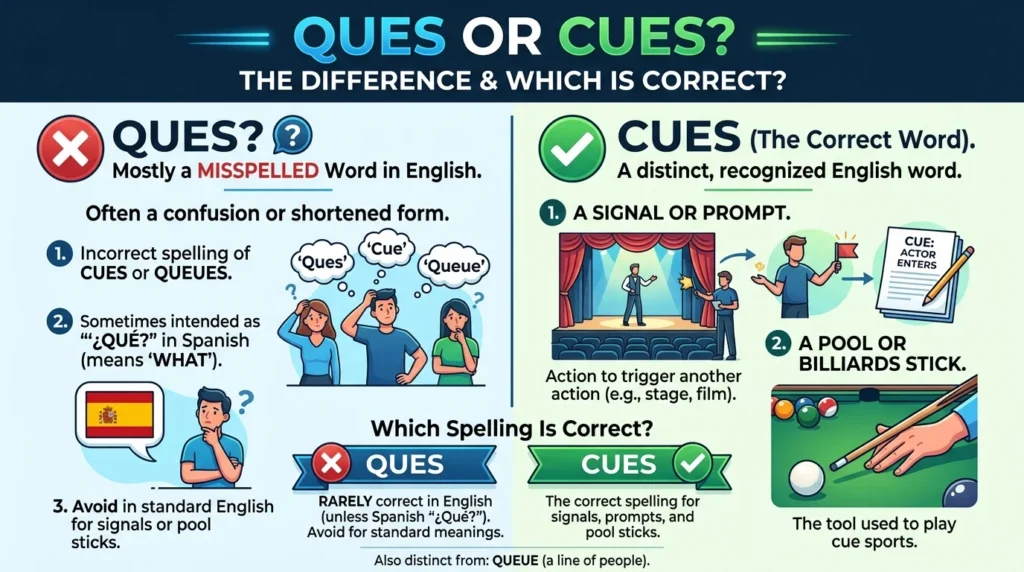
Ques or Cues – Quick Answer
The correct English word in most situations is “cues.”
“Cues” means signals, hints, prompts, or indications that help someone know what to do next.
Examples of “Cues”
- The actor waited for his cues before speaking.
- Body language gives social cues.
- The teacher gave visual cues to students.
On the other hand, “ques” is not commonly accepted as a standard English word. It is usually:
- A short form of “questions”
- A typo of “cues”
- Informal internet slang in some regions
Examples of “Ques”
- Send me the exam ques.
- I have some math ques.
In formal English writing, “questions” should be written instead of “ques.”
Read More Desert vs Dessert: Meaning, Difference, Spelling, Examples, and Correct Usage
The Origin of Ques or Cues
Origin of “Cues”
The word “cue” has a long history connected to theater and acting. It originally referred to a signal telling actors when to enter the stage or speak their lines. Over time, the meaning expanded into sports, communication, psychology, and daily conversation.
Today, “cues” can mean:
- Signals
- Hints
- Prompts
- Instructions
- Behavioral indicators
Origin of “Ques”
“Ques” does not have a strong historical place in formal English dictionaries. It is mostly used informally as an abbreviation for “questions.”
Students often write:
- Important ques
- Exam ques
- Interview ques
This style is common in texting or notes but not recommended in professional writing.
Why the Spelling Difference Exists
The confusion happens because:
- “Cue” and “queue” sound similar
- “Ques” is used casually online
- Fast typing creates spelling mistakes
- Pronunciation differs by accent
Many users accidentally type “ques” instead of “cues.”
British English vs American English Spelling
Interestingly, “cue” is spelled the same way in both British and American English. However, usage style may vary slightly.
British English Usage
British English often uses “cue” in theater, social behavior, and formal communication.
Example:
- She missed the social cues during the meeting.
American English Usage
American English also uses “cue” in entertainment, sports, psychology, and media.
Example:
- The music cue started the performance.
Spelling Comparison Table
| Word | Meaning | Correct Usage | Common Region |
| Cue | Signal or prompt | Formal English | UK & USA |
| Cues | Plural of cue | Formal English | Worldwide |
| Ques | Short for questions | Informal only | Internet slang |
| Queue | A line of people | Formal English | UK/Commonwealth |
Which Spelling Should You Use?
Choosing between ques or cues depends on your audience and purpose.
Use “Cues” When:
- Writing formal English
- Writing blogs or articles
- Sending professional emails
- Discussing signals or prompts
- Writing academic content
Use “Questions” Instead of “Ques” When:
- Writing school assignments
- Writing professional documents
- Publishing content online
- Creating business communication
Audience-Based Advice
| Audience | Best Word to Use |
| American readers | Cues |
| British readers | Cues |
| Global audience | Cues |
| Informal student chats | Ques (sometimes acceptable) |
| Professional writing | Questions or Cues |
Common Mistakes with Ques or Cues
The words “ques,” “cue,” “cues,” and “queue” are often confused because some of them sound similar or appear in similar online contexts. However, they have different meanings and should not be used interchangeably.
The most important distinction is that “cues” means signals or prompts, while “questions” is the correct standard word for things that people ask. “Ques” may appear as an informal abbreviation for “questions,” but it is generally unsuitable for formal writing. Meanwhile, “queue” means a line of people or things waiting for their turn.
Learning these differences can help you avoid common spelling and grammar mistakes in emails, assignments, blogs, social media posts, and professional communication.
Mistake 1: Using “Ques” Instead of “Cues”
This mistake usually occurs when someone wants to describe signals, instructions, or prompts.
❌ Incorrect: He followed the ques from the coach.
✅ Correct: He followed the cues from the coach.
In the correct sentence, cues means signals or instructions given by the coach.
Another example:
❌ The actor waited for his ques.
✅ The actor waited for his cues.
Here, “cues” refers to signals that tell the actor when to speak or act.
Mistake 2: Using “Cue” for Questions
The word cue does not mean a question.
❌ Incorrect: I solved five cue yesterday.
✅ Correct: I solved five questions yesterday.
If you are referring to something that requires an answer, use question or questions.
For example:
- The teacher asked an interesting question.
- We answered ten questions.
- I have a few questions about the assignment.
Using “cue” in these sentences changes the meaning and makes the sentence incorrect.
Mistake 3: Confusing “Cue” and “Queue”
Cue and queue are pronounced alike in standard English, but they have completely different meanings.
Cue means a signal or prompt.
The director gave the actor a cue to enter the stage.
Queue means a line of people or things waiting for their turn.
We stood in the queue outside the store.
Therefore:
❌ Incorrect: Please stand in the cue.
✅ Correct: Please stand in the queue.
A useful memory trick is:
Cue = Signal
Queue = Line
Mistake 4: Using “Ques” in Formal Writing
Although “ques” may be understood as a shortened form of “questions,” it is better to avoid it in professional or academic writing.
❌ Informal: Interview ques are difficult.
✅ Professional: Interview questions are difficult.
This distinction is particularly important when writing:
- Blog articles
- Academic assignments
- Business emails
- Resumes
- Cover letters
- Reports
- School projects
- Professional documents
Using complete words makes your writing clearer and more polished.
Mistake 5: Assuming “Ques” and “Cues” Are Alternative Spellings
Another common misunderstanding is thinking that ques and cues are simply two spellings of the same word.
They are not.
Cues is the plural of cue and refers to signals or prompts.
The players responded to the coach’s cues.
Ques is generally an informal abbreviation for questions.
I need to answer these ques.
For standard English, the second sentence should be written as:
I need to answer these questions.
Read More Gray vs Grey: What Is the Difference and Which Spelling Should You Use?
Ques or Cues in Everyday Examples
Real-world examples make the difference between these words easier to understand. The correct word depends on what you are trying to communicate.
Ques or Cues in Emails
Professional emails should use standard English rather than informal abbreviations.
Correct:
Please watch for the visual cues during the presentation.
Here, “cues” means signals or indications.
Another example:
I have several questions about the project.
Avoid replacing “questions” with “ques” in a professional email.
Ques or Cues in News Articles
News articles generally follow standard English conventions, so writers should use cues when referring to signals.
Correct:
The player missed the coach’s cues during the match.
However, if the article discusses things that someone asked, use questions.
Correct:
Reporters asked several questions after the match.
Using “ques” would make the article look informal and less polished.
Ques or Cues on Social Media
Social media is one place where informal abbreviations such as “ques” may appear.
For example:
Anyone have exam ques?
The intended meaning is clear to many readers, but this is informal.
A more standard version is:
Does anyone have the exam questions?
There is nothing wrong with using abbreviations in casual conversations when the audience understands them. However, if the content is intended to be professional, educational, or published publicly, the full word questions is preferable.
Ques or Cues in Formal Writing
Formal writing should clearly distinguish between questions and cues.
Correct:
Nonverbal cues can improve communication.
Here, cues means facial expressions, gestures, eye contact, tone, or other signals.
Correct:
Students were encouraged to ask questions during the lecture.
Here, questions means things students wanted to ask.
These two words cannot be substituted for each other because they describe completely different ideas.
Ques or Cues in Movies and Acting
The word cue is especially common in movies, theater, television, and acting.
Actors often receive cues that tell them when to speak, move, enter, exit, or perform an action.
Examples include:
- Actors wait for their cues before speaking.
- The director gave the actor a cue to enter.
- Music cues help control the timing of a scene.
- Lighting changes can provide visual cues for performers.
In this context, cue always relates to a signal or prompt.
Ques or Cues in Sports
Sports provide another common example of the word cue.
Players constantly respond to signals from coaches and teammates. These signals may be verbal, visual, or physical.
Examples:
- The midfielder watched for defensive cues from his teammates.
- The coach gave the players several tactical cues.
- A player’s body position can provide a cue about their next movement.
- Athletes learn to recognize visual cues during training.
However, when talking about things a coach or journalist asks, use questions:
The coach asked the players several questions after the match.
Ques or Cues in Psychology
In psychology and behavioral science, cue is often used to describe a signal or stimulus that can influence a person’s response or behavior.
Examples:
- Social cues help people understand conversations.
- Visual cues can influence attention.
- Emotional cues help people recognize how others feel.
- Environmental cues can influence habits and behavior.
For example:
Facial expressions provide important social cues during conversations.
In this sentence, “cues” means signals that provide information.
Ques or Cues in Education
Both questions and cues are common in education, but they have different meanings.
A question asks for information or requires an answer:
The teacher asked the students five questions.
A cue provides a signal or reminder:
The teacher gave the students a visual cue to help them remember the answer.
This distinction is useful for students because both words can appear in the same classroom situation.
Ques or Cues in Daily Conversation
In everyday English, context usually makes the meaning clear.
For example:
That was my cue to leave.
This means something happened that signaled it was time to leave.
But:
I have a question for you.
This means the speaker wants to ask something.
You would not normally say:
I have a cue for you.
unless you actually mean a signal or prompt.
Quick Rule to Remember Ques, Cue, Cues, and Queue
If you are still confused, remember these four simple meanings:
- Question = something you ask or need to answer
- Ques = informal abbreviation sometimes used for “questions”
- Cue = a signal, prompt, or indication
- Cues = more than one signal or prompt
- Queue = a line of people or things waiting
Easy Examples
I have three questions.
The actor received three cues.
The coach gave me a cue.
We waited in the queue.
This simple distinction will help you choose the right word in most situations.
Ques or Cues – Google Trends and Usage Context
The confusion between “ques” and “cues” usually comes from pronunciation and informal online writing. Both forms can appear in search queries, but they do not have the same meaning or grammatical status.
The word “cues” is the standard plural form of “cue.” It refers to signals, prompts, hints, or indications that tell someone what to do or when to do it. For example, an actor may wait for a cue before speaking, or a football player may use visual cues from teammates to decide where to move.
On the other hand, “ques” is commonly used informally as a shortened version of “questions,” particularly in student notes, messaging, online discussions, and casual communication. It should not normally replace the full word “questions” in formal English.
Countries and Regions Where “Ques” May Appear More Often
The informal abbreviation “ques” can be encountered more frequently in regions where students commonly use shortened English in notes and digital communication. This includes countries such as:
- India
- Pakistan
- Bangladesh
- Philippines
However, the presence of a search query does not necessarily mean that “ques” is standard English. Search behavior often reflects informal language, spelling mistakes, abbreviations, and common learner confusion.
Where “Cues” Is Commonly Used
The word “cues” is standard English and appears in many different contexts, including:
- Theater and acting
- Sports
- Communication
- Psychology
- Education
- Public speaking
- Music and performance
- Everyday instructions
For example:
The coach gave the players visual cues during the training session.
The actor waited for his cues before entering the stage.
Children often respond to social cues from adults.
Online Usage of Ques and Cues
Online communication has made abbreviations much more common. Students and internet users often shorten long words to type faster. “Ques” can therefore appear in search queries, social media posts, messages, and study notes.
This does not automatically make it appropriate for formal writing.
If you are writing an academic assignment, business email, website article, resume, or professional document, it is better to write “questions” rather than “ques.”
| Word | Meaning | Common Context | Formal Usage |
|---|---|---|---|
| Cue | A signal or prompt | Acting, sports, communication | Standard |
| Cues | More than one signal or prompt | Communication, theater, sports | Standard |
| Ques | Informal abbreviation of questions | Notes, chats, texting | Informal |
| Questions | Things asked to obtain information | Education, business, conversations | Standard |
Comparison Table: Ques vs Cues
The easiest way to understand ques vs cues is to compare their meanings, spelling, and usage.
| Feature | Ques | Cues |
|---|---|---|
| Standard English word | No, generally an abbreviation | Yes |
| Meaning | Informal short form of “questions” | Signals, prompts, or indications |
| Formal writing | Generally avoid | Correct |
| Common use | Notes, chats, informal communication | Acting, sports, education, communication |
| Grammar status | Informal abbreviation | Plural noun or verb form of “cue” |
| Pronunciation | Usually intended to sound like “questions” abbreviation | Sounds like “queues” |
| Suitable for academic writing | No | Yes |
| Suitable for business writing | No | Yes |
| Example | “Answer these ques.” | “Watch for the visual cues.” |
An Important Point About “Ques”
It is important not to treat “ques” and “cues” as two alternative spellings of the same word.
They have different functions.
Ques is generally an informal shortening of questions, while cues is the plural form of cue.
For example:
Please answer all the questions.
Here, “questions” should not be replaced by “cues.”
But:
The players received several cues from their coach.
Here, “cues” means signals or instructions.
Read More Chose vs Choose: Meaning, Difference, Examples, and Easy Usage Guide
Why Do People Confuse Ques and Cues?
There are several reasons why English learners and students may confuse these terms.
Similar Sound
One of the biggest reasons is pronunciation.
“Cues” sounds similar to “queues,” while people may also write “ques” when they are trying to shorten “questions.” In fast conversations, unfamiliar words can easily be misunderstood.
For example, someone might hear:
“Look for the cues.”
and incorrectly assume the speaker is referring to “ques.”
Understanding the meaning of the sentence usually makes the difference clear.
Informal Student Abbreviations
Students frequently create abbreviations while taking notes.
Instead of writing:
Questions 1–10
a student may write:
Ques. 1–10
This can be convenient when taking notes quickly. However, this abbreviation should not automatically be carried into formal writing.
For an academic assignment, use:
Questions 1–10
rather than:
Ques. 1–10
Texting and Social Media
Digital communication has encouraged people to shorten words.
Common examples include:
- info for information
- exam for examination
- app for application
- approx. for approximately
- ques for questions
Some abbreviations become widely recognized, while others remain informal. “Ques” generally belongs to the latter category.
Autocorrect and Typing Habits
Typing quickly on smartphones can also contribute to spelling confusion. People may type words based on how they sound rather than how they are correctly spelled.
Once an incorrect or informal form becomes a habit, users may continue using it without checking the standard spelling.
English Learners May Not Know “Cue”
Another reason for confusion is that some learners know “question” very well but are less familiar with “cue.”
When they encounter “cues,” they may assume it is another spelling of “questions.”
Learning the definition of cue helps solve this problem.
A cue is a signal that gives someone information about what to do next.
For example:
The teacher gave the students a cue to begin the activity.
Examples of “Cues” in Different Situations
The word cues is useful in many areas of English.
Cues in Sports
Coaches and players frequently use cues during games and training.
For example:
The midfielder watched for defensive cues from his teammates.
A coach might also give a player a verbal cue to change position.
Cues in Acting
Acting is one of the most common contexts for the word “cue.”
An actor may wait for another actor’s line, a sound, lighting change, or stage movement before performing.
The actor missed his cue and entered the stage late.
When there are multiple signals:
The performers followed their cues carefully.
Cues in Communication
People often respond to verbal and nonverbal cues.
These may include:
- Facial expressions
- Hand movements
- Tone of voice
- Eye contact
- Body language
For example:
She noticed the social cues and realized that the conversation was ending.
Cues in Education
Teachers can use cues to help students understand instructions.
The teacher used visual cues to help children remember the new vocabulary.
In this sentence, “cues” means helpful signals or reminders.
Cues in Psychology
The word can also describe signals that influence behavior or responses.
For example:
Environmental cues can influence a person’s habits.
Here, “cues” refers to signals or conditions that encourage a particular response.
Examples of “Ques” in Informal Writing
If you see “ques” online, it will often be intended as an abbreviation for questions.
For example:
Solve the following ques.
The intended meaning is:
Solve the following questions.
Another example:
I have some ques about the assignment.
The formal version would be:
I have some questions about the assignment.
While readers may understand “ques,” the complete word is clearer and more professional.
When Should You Use “Questions” Instead of “Ques”?
Use “questions” whenever you are writing something intended for a formal or professional audience.
This includes:
- School assignments
- College papers
- Blog posts
- Websites
- Business emails
- Job applications
- Reports
- Resumes
- Official documents
- Professional presentations
For example:
❌ Informal: Please answer the following ques.
✅ Standard: Please answer the following questions.
The second sentence is clearer and follows standard English usage.
When Should You Use “Cue” or “Cues”?
Use “cue” or “cues” when you mean a signal, prompt, hint, or indication.
Singular
The whistle was the cue to start the race.
Plural
The players watched for the coach’s cues.
Verb
“Cue” can also function as a verb.
The director cued the actors to begin.
This means the director gave them a signal to start.
Ques vs Cues: Easy Way to Remember
A simple memory trick can help you avoid the confusion.
Remember “Cue = Signal”
Think:
Cue → Signal
If something tells you when or how to act, it is a cue.
The music was my cue to begin.
Remember “Questions = Things You Ask”
If you are asking for information, use:
Questions
I have three questions for the teacher.
Do not use “cues” in this situation.
Remember “Ques = Informal Shortcut”
You may see ques as an informal abbreviation for “questions,” especially in student notes or online communication.
For formal writing, however, use the complete word:
Questions
Final Difference Between Ques and Cues
The difference between ques and cues becomes simple once you focus on meaning.
Cues is a standard English word and means signals, prompts, or indications. It is commonly used in acting, sports, education, communication, and everyday situations.
Ques is generally an informal abbreviation for questions. Although people may understand it in notes, chats, or online conversations, it is better to avoid it in formal and professional writing.
The safest rule is:
Use “cues” for signals and “questions” for things you ask.
This simple distinction will help you choose the correct word in articles, assignments, emails, and everyday English.
Professional Writing Advice for “Ques” and “Cues”
If you are writing for blogs, websites, businesses, academic assignments, or professional communication, use standard English words rather than informal abbreviations.
Best Practices for Using “Ques” and “Cues”
- Use “cues” when referring to signals, prompts, hints, or indications.
- Use “questions” instead of the informal abbreviation “ques” in formal writing.
- Avoid internet shorthand and texting abbreviations in professional or academic content.
- Always check spelling and word choice before publishing an article or submitting an assignment.
- Choose the correct word based on its meaning and context, not just its pronunciation.
Easy Memory Trick for Ques vs Cues
Remember these simple definitions:
- Cue = Signal or Prompt
- Question = Something you ask
- Ques = Informal abbreviation for Questions
For example:
The director gave the actor a cue to enter the stage.
The teacher answered all the students’ questions.
“Ques” may appear in informal notes, but “questions” is better for professional writing.
Frequently Asked Questions About Ques and Cues
Is “Ques” a Real English Word?
“Ques” is sometimes used informally as a shortened form of “questions.” However, it is not the standard word you should use in formal English writing. In articles, assignments, emails, and professional documents, write “questions” in full.
Is “Cues” the Correct Spelling?
Yes. “Cues” is the plural form of “cue.” It refers to signals, prompts, or indications that tell someone what to do or when to do something.
Example:
The actors waited for their cues before starting the scene.
Can I Use “Ques” in Professional Writing?
It is better to avoid “ques” in professional and academic writing. Although readers may understand it as an abbreviation for “questions,” the complete word “questions” is clearer and more appropriate.
What Does “Cue” Mean?
A cue is a signal, prompt, or indication that tells someone when to take an action.
Example:
The music was the cue for the dancers to begin.
The plural form is “cues.”
Why Do Students Write “Ques”?
Students may use “ques” as a quick abbreviation for “questions,” particularly when taking notes or communicating informally. It saves time, but it should generally be replaced with “questions” in formal writing.
Is “Cue” Used in Acting?
Yes. Cue is commonly used in acting and theater. An actor may receive a cue to speak, enter the stage, change position, or perform a particular action.
Example:
The actor missed his cue and entered the stage late.
What Is the Difference Between Cue and Queue?
Cue means a signal, prompt, or indication, while queue means a line of people or things waiting for their turn.
Examples:
- The director gave me a cue to start speaking.
- We stood in a queue outside the theater.
Although cue and queue sound alike, they have completely different meanings.
Conclusion
The confusion between ques or cues is very common, especially online and in casual communication. However, understanding the difference is simple once you know the meanings. “Cues” is the correct English word used for signals, prompts, hints, and indicators. It is widely accepted in professional writing, education, acting, psychology, sports, and communication. On the other hand, “ques” is usually just an informal shortcut for “questions” and should not be used in formal documents or published content.
If you are writing professionally, always use “cues” correctly and avoid abbreviations like “ques.” For academic or business writing, use the full word “questions” instead. Learning these small spelling differences improves grammar, communication, and writing confidence. Whether you are a student, blogger, teacher, or professional writer, using the correct word helps your message appear clearer and more trustworthy.