Have you ever typed “cancelation” and wondered if it should actually be “cancellation”? You are not alone. Many English learners, students, writers, and professionals search for this spelling question because both versions appear online. This creates confusion, especially when writing emails, business documents, travel policies, or academic papers.
The good news is simple: both spellings exist, but one is much more common and widely accepted. Knowing which version to use can help you avoid mistakes and write with confidence.
This guide explains the difference between cancelation or cancellation, where each spelling is used, and which one is best for your audience. You will also learn about the history of the word, British and American spelling patterns, common errors, real-life examples, and usage trends around the world.
By the end of this article, you will know exactly which spelling fits your writing situation.
Cancelation or Cancellation – Quick Answer
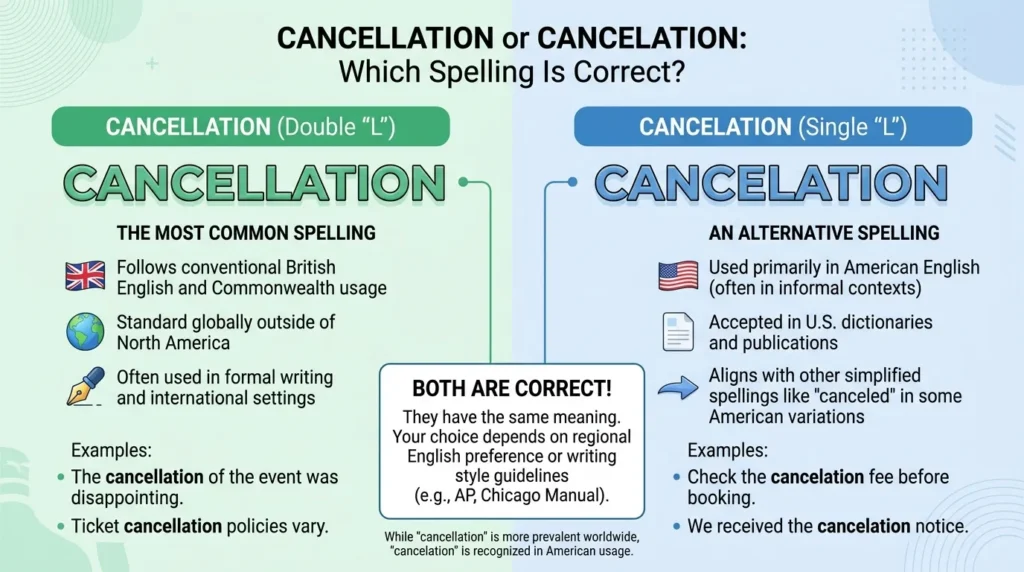
Quick answer: Both cancelation and cancellation are correct spellings of the noun form of cancel. However, cancellation is the standard and preferred spelling in both American and British English.
Examples
- ✔️ Your flight cancellation fee is non-refundable.
- ✔️ We received notice of the event cancellation.
- ✔️ The cancellation policy is listed on the website.
- ⚠️ Cancelation is accepted by some dictionaries but is far less common.
If you want the safest choice, use cancellation.
The Origin of Cancelation or Cancellation
The word comes from the Latin word “cancellare,” meaning “to cross out” or “to make invalid.” It entered English through French and developed into the verb cancel.
As English spelling evolved, people formed the noun in two ways:
- Cancelation with one “l”
- Cancellation with two “l”s
Over time, publishers, style guides, and dictionaries favored cancellation. This version became dominant in newspapers, books, schools, and business writing.
Today, cancelation still appears occasionally, but cancellation is considered the standard form.
British English vs American English Spelling
Unlike many spelling differences between British and American English, this word is unusual.
Both regions generally prefer cancellation.
Comparison Table
| Feature | British English | American English |
|---|---|---|
| Preferred spelling | Cancellation | Cancellation |
| Alternative spelling | Rarely cancelation | Occasionally cancelation |
| Formal writing | Cancellation | Cancellation |
| Business use | Cancellation | Cancellation |
| Academic writing | Cancellation | Cancellation |
Examples
British English
- The train cancellation caused delays.
American English
- The cancellation policy covers emergencies.
Although Americans sometimes use cancelation, most editors still recommend cancellation.
Which Spelling Should You Use?
Your audience should guide your choice.
If You Write for a US Audience
Use cancellation. It is the most recognized and accepted form.
If You Write for a UK or Commonwealth Audience
Choose cancellation. It is the expected spelling.
If You Write for a Global Audience
Always use cancellation. It avoids confusion and appears more professional.
Professional Advice
For websites, blogs, emails, contracts, academic papers, and business communication, cancellation is the safest option.
Common Mistakes with Cancelation or Cancellation
Many writers make small errors with this word.
| Incorrect Usage | Correct Usage |
|---|---|
| Cancallation | Cancellation |
| Canceltion | Cancellation |
| Cancelisation | Cancellation |
| The meeting faced cancelation. | The meeting faced cancellation. |
| Cancellations | Cancellations |
Tips to Remember
- Think of the verb cancel plus an extra “l” before -ation.
- Proofread formal documents carefully.
- Follow your organization’s style guide.
Cancelation or Cancellation in Everyday Examples
Emails
- We regret the cancellation of your appointment.
- Please review our cancellation policy before booking.
News Headlines
- Flight cancellation affects thousands of travelers.
- Event cancellation announced due to severe weather.
Social Media
- Sad about the concert cancellation tonight.
- Unexpected cancellation ruined our plans.
Formal Writing
- The contract allows cancellation within 30 days.
- Insurance covers trip cancellation expenses.
Cancelation or Cancellation – Google Trends & Usage Data
Search and publishing patterns show a clear winner.
Usage Trends
- Cancellation is overwhelmingly more popular worldwide.
- It dominates books, newspapers, websites, and official documents.
- Cancelation appears occasionally but represents only a small share of usage.
Popularity by Region
| Country/Region | Most Common Form |
|---|---|
| United States | Cancellation |
| United Kingdom | Cancellation |
| Canada | Cancellation |
| Australia | Cancellation |
| New Zealand | Cancellation |
| Global Business Writing | Cancellation |
The data suggests that writers increasingly prefer cancellation because it is familiar and widely accepted.
Comparison Table: Cancelation vs Cancellation
| Feature | Cancelation | Cancellation |
|---|---|---|
| Is it correct? | Yes | Yes |
| Common usage | Rare | Very common |
| Formal acceptance | Limited | Strong |
| Business writing | Not recommended | Recommended |
| Academic writing | Rarely used | Preferred |
| Global recognition | Lower | Higher |
| Best choice | Usually avoid | Use this form |
FAQs
1. Is cancelation a real word?
Yes. Some dictionaries recognize cancelation, but it is much less common than cancellation.
2. Which spelling is correct: cancelation or cancellation?
Both are correct, but cancellation is the preferred standard spelling.
3. Is cancellation British or American?
It is used and accepted in both British and American English.
4. Why does cancellation have two “l”s?
English usage evolved to favor the doubled “l” form, and publishers adopted it as the standard.
5. Should I use cancelation in formal writing?
It is better to use cancellation in professional and academic contexts.
6. Which spelling appears more often online?
Cancellation is far more common in search results, articles, and official documents.
7. Can using cancelation be considered a mistake?
Some readers may view it as unusual or incorrect because they expect cancellation.
Conclusion
The debate over cancelation or cancellation is easier to solve than many people think. While both spellings exist in dictionaries, cancellation has become the clear favorite across the English-speaking world. It appears more often in books, news articles, websites, contracts, and business communication. Because of this widespread acceptance, it is the safest and most professional choice.
If you write for American readers, British readers, or an international audience, choosing cancellation helps you avoid confusion and maintain credibility. The alternative spelling, cancelation, is not necessarily wrong, but it may look unfamiliar to many readers.
Whenever you face this spelling decision, remember one simple rule: if you want clarity, consistency, and broad acceptance, use cancellation. Doing so will strengthen your writing and ensure your message looks polished and professional in every setting.