Many people search for “bit or byte” because these two computer terms look similar but mean very different things. Students, beginners, gamers, internet users, and even office workers often get confused when they see internet speed written in Mbps and storage written in MB or GB. A small spelling difference between “bit” and “byte” can completely change the meaning of data size and speed.
For example, when downloading a movie, your internet provider may advertise 100 megabits per second, but your computer shows download speed in megabytes per second. This creates confusion for many users who want to understand how computers store and transfer information.
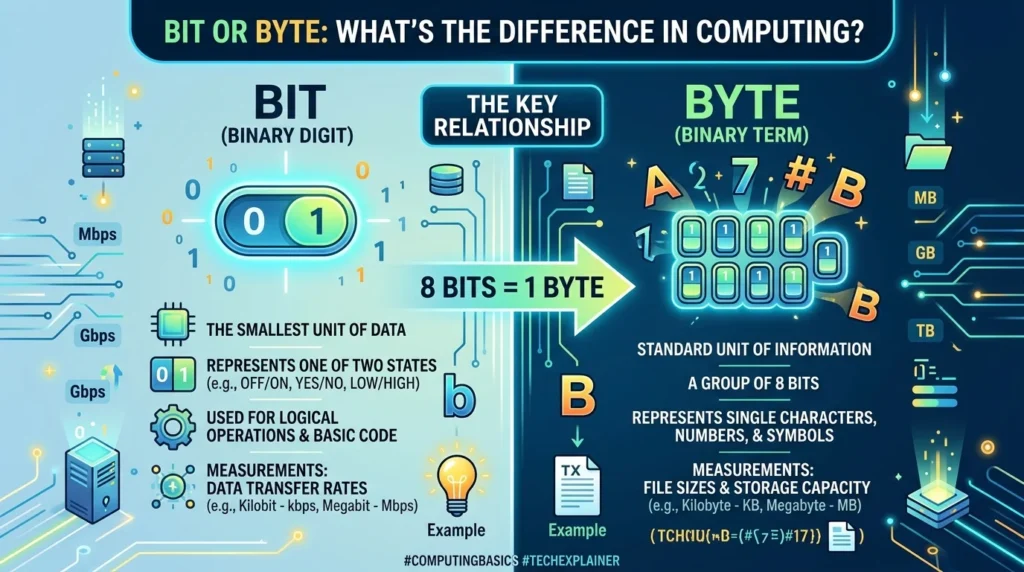
The good news is that the difference between bit and byte is simple once explained clearly. A bit is the smallest unit of digital data, while a byte is a group of eight bits. Understanding this difference helps in choosing internet plans, storage devices, cloud services, and computer hardware correctly.
In this article, you will learn the meaning of bit and byte, their origin, differences, practical examples, common mistakes, FAQs, and professional advice for using these terms correctly.
Bit or Byte – Quick Answer
The quick answer is simple:
- Bit = Smallest unit of digital data
- Byte = Group of 8 bits
Simple Example
| Unit | Meaning |
| 1 bit | Single 0 or 1 |
| 1 byte | 8 bits together |
Real-Life Example
- Internet speed is usually measured in bits
- File storage is usually measured in bytes
Example:
- 100 Mbps = 100 megabits per second
- 100 MB = 100 megabytes
These are not the same.
The Origin of Bit or Byte
Origin of “Bit”
The word “bit” comes from “binary digit.” Early computer scientists used it to describe the smallest possible data value in computing systems.
A bit can only contain:
- 0
- 1
These two values are the foundation of all digital technology.
Origin of “Byte”
The word “byte” was created later in computer history. It described a group of bits used to store characters and information.
Computer engineers selected 8 bits as the standard size for one byte.
Why the Spelling Difference Exists
The spelling difference helps users separate:
- Tiny data units (bits)
- Larger storage units (bytes)
Although the words sound similar, their meanings are very different.
British English vs American English Spelling
Unlike many English words, “bit” and “byte” use the same spelling in both British and American English.
British English Usage
Example:
- The file size is measured in bytes.
American English Usage
Example:
- Internet speed is measured in bits per second.
Comparison Table
| Term | British English | American English |
| Bit | Same spelling | Same spelling |
| Byte | Same spelling | Same spelling |
| Meaning | Same | Same |
There are no spelling differences between UK and US English for these computing terms.
Which Spelling Should You Use?
You should use “bit” or “byte” depending on the technical meaning.
Use “Bit” When Talking About:
- Internet speed
- Network transfer rates
- Binary computing
- Data transmission
Examples:
- Mbps
- Kbps
- Gbps
Use “Byte” When Talking About:
- File size
- Storage devices
- RAM
- Hard drives
Examples:
- MB
- GB
- TB
Audience-Based Advice
| Situation | Correct Term |
| Internet speed | Bit |
| File storage | Byte |
| Computer memory | Byte |
| Network communication | Bit |
| General computing | Both based on context |
Common Mistakes with Bit or Byte
Many beginners confuse these terms because the words are similar.
Mistake 1: Mixing Mbps and MBps
❌ Incorrect: Mbps and MBps are the same
✅ Correct: Mbps uses bits, MBps uses bytes
Mistake 2: Wrong Storage Understanding
❌ Incorrect: 1 byte = 1 bit
✅ Correct: 1 byte = 8 bits
Mistake 3: Confusing Capital Letters
- b = bit
- B = byte
Example:
- Mb = megabit
- MB = megabyte
Mistake 4: Comparing Internet Speed Incorrectly
People often think slower downloads mean internet problems, but the display unit may simply be different.
Bit or Byte in Everyday Examples
These terms appear daily in technology and communication.
In Internet Plans
- 200 Mbps internet connection
In Phone Storage
- 256 GB smartphone memory
In News Articles
- Data breaches exposed billions of bytes of information.
In Social Media
- My game download speed reached 50 MBps.
In Formal Writing
- Computer systems process data using bits and bytes.
Bit or Byte – Google Trends & Usage Data
Online searches show millions of users want to understand these terms clearly.
Countries Searching Most
- United States
- India
- United Kingdom
- Canada
- Australia
Popular Search Queries
People commonly search:
- Difference between bit and byte
- Mbps vs MBps
- What is a byte?
- Internet speed in bits or bytes
Usage Context
| Term | Common Context |
| Bit | Networking |
| Byte | Storage |
| Mbps | Internet speed |
| MB | File size |
Comparison Table: Bit vs Byte
| Feature | Bit | Byte |
| Full Form | Binary digit | Group of 8 bits |
| Symbol | b | B |
| Data Size | Smaller | Larger |
| Main Use | Data transfer | Data storage |
| Internet Speed | Yes | Rare |
| Storage Devices | No | Yes |
| Example | Mbps | MB |
Why People Confuse Bit and Byte
Several reasons cause confusion.
Similar Pronunciation
The words sound almost the same.
Capital Letter Difference
A single capital letter changes the meaning completely.
- Mb ≠ MB
Technology Marketing
Internet companies advertise speeds in bits, while devices display downloads in bytes.
Lack of Technical Knowledge
Beginners often do not learn the difference early.
Professional Advice for Students and Beginners
Understanding bit and byte improves technical knowledge.
Best Learning Tips
- Remember: 1 byte = 8 bits
- Small “b” means bit
- Capital “B” means byte
- Internet speed uses bits
- Storage uses bytes
Easy Memory Trick
- Bit = tiny unit
- Byte = bigger unit
Think of a byte as a small package containing 8 bits.
FAQs About Bit or Byte
What is a bit in computing?
A bit is the smallest digital data unit containing either 0 or 1.
What is a byte?
A byte is a group of 8 bits used to store data.
Which is bigger: bit or byte?
A byte is bigger because it contains 8 bits.
Why is internet speed measured in bits?
Network systems traditionally measure transmission speed using bits per second.
Why is storage measured in bytes?
Bytes are better for measuring files and memory sizes.
Is MB bigger than Mb?
Yes. MB means megabyte, while Mb means megabit.
How many bits are in one byte?
One byte contains exactly 8 bits.
Conclusion
Understanding the difference between bit or byte is very important in today’s digital world. Although the words look and sound similar, they have completely different meanings in computing and networking. A bit is the smallest unit of digital information, while a byte contains eight bits and is commonly used for file storage and memory measurement.
Most internet speeds are measured in bits, while computer storage is measured in bytes. This difference explains why download speeds sometimes appear smaller than advertised internet speeds. Learning the symbols, meanings, and practical usage of bits and bytes helps students, gamers, office workers, and technology users make smarter decisions when buying internet plans, storage devices, or computer hardware.
Whether you are a beginner or an advanced user, knowing when to use bit and byte correctly improves technical understanding and communication. Small details like lowercase “b” and uppercase “B” can make a huge difference in the world of technology.