Have you ever stopped while writing and wondered whether you should use latter or later? You’re not alone. These two words look almost identical, but they have completely different meanings. Because they differ by only one letter, many English learners, students, bloggers, and even native speakers confuse them.
Understanding the difference between latter and later helps you write more clearly and avoid common grammar mistakes. Whether you’re writing an email, an academic paper, a social media post, or a business report, choosing the correct word makes your message easier to understand.
This guide explains everything you need to know about latter or later in simple English. You’ll learn their meanings, origins, spelling differences, practical examples, common mistakes, and tips for remembering which one to use. By the end of this article, you’ll know exactly when to use latter and when later is the correct choice.
Latter or Later – Quick Answer
The words latter and later are not interchangeable.
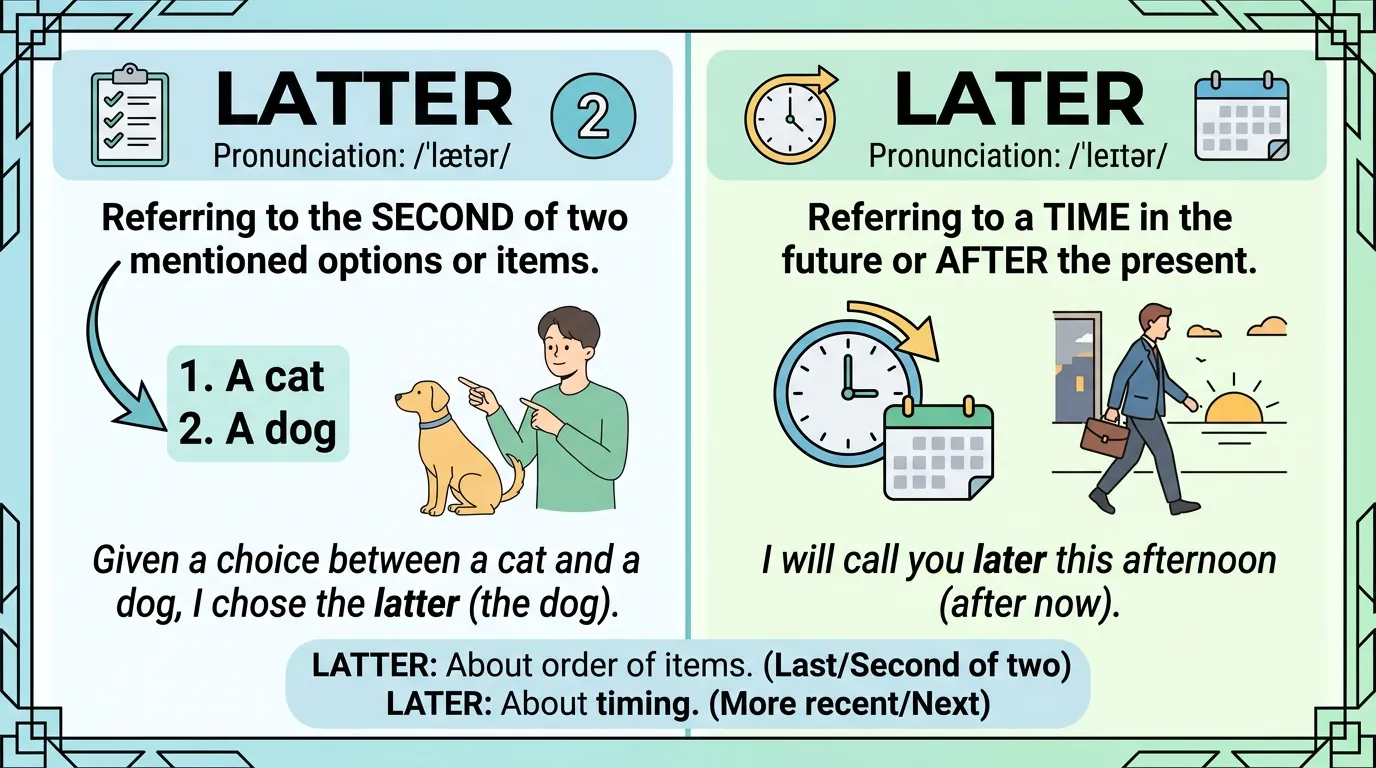
- Latter refers to the second of two people, things, or ideas that were mentioned.
- Later refers to time, meaning after the present or after another event.
Examples
Latter
- I like coffee and tea, but I prefer the latter.
- We visited Paris and Rome. The latter was my favorite.
Later
- I’ll call you later.
- The meeting starts later this afternoon.
- See you later!
Quick Comparison
| Word | Meaning | Example |
|---|---|---|
| Latter | The second of two things | I chose the latter option. |
| Later | At a future time | I’ll finish it later. |
The Origin of Latter or Later
Although these words look similar, they come from different meanings that developed over time.
Origin of “Later”
The word later comes from the Old English word meaning “slow” or “delayed.” Over centuries, it became the comparative form of late, meaning something happens after another time.
Example:
- We arrived later than expected.
Origin of “Latter”
The word latter also comes from Old English but developed to describe the second of two items or something closer to the end.
Example:
- Between science and history, I enjoyed the latter.
Their similar spellings often confuse writers, but their meanings have remained different for hundreds of years.
British English vs American English Spelling
Unlike many English words, latter and later are spelled the same in both British English and American English.
There is no spelling difference between the two varieties of English.
The only difference is how each word is used according to its meaning.
Comparison Table
| Feature | British English | American English |
|---|---|---|
| Later | ✅ Later | ✅ Later |
| Latter | ✅ Latter | ✅ Latter |
| Meaning Changes? | No | No |
| Pronunciation | Nearly the same | Nearly the same |
No matter where you write, the meanings remain exactly the same.
Which Spelling Should You Use?
The correct choice depends on what you want to say.
For US English
Use later when talking about time.
Use latter when referring to the second of two items.
For UK and Commonwealth English
The same rules apply.
There are no spelling changes between British and American English.
For Global Writing
Whether you’re writing for an international audience, website, business, or school, simply remember:
- Talking about time → later
- Talking about the second of two things → latter
This rule works everywhere.
Common Mistakes with Latter or Later
These words are often mixed up because they look alike.
Mistake 1
❌ I will reply latter.
✅ I will reply later.
Mistake 2
❌ Between tea and coffee, I prefer the later.
✅ Between tea and coffee, I prefer the latter.
Mistake 3
❌ See you latter!
✅ See you later!
Easy Memory Tip
Think of it this way:
- Later = Time
- Latter = Last of two choices
This simple trick helps you remember the difference quickly.
Latter or Later in Everyday Examples
Emails
“I’ll send the document later today.”
News
“The government announced more details later in the evening.”
Social Media
“See you later, everyone!”
Business Writing
“We considered two proposals. The latter offered better value.”
Academic Writing
“Two theories were examined. The latter explains the results more accurately.”
Latter or Later – Google Trends & Usage Data
Search interest in latter or later stays steady throughout the year because many people want to improve their English grammar.
People commonly search this keyword when:
- Writing school assignments
- Preparing for English exams
- Editing blog posts
- Writing business emails
- Learning English as a second language
Popular Countries
The keyword is frequently searched in:
- United States
- United Kingdom
- Canada
- Australia
- India
- Pakistan
- Philippines
Most searches come from students, professionals, writers, and English learners looking for quick grammar guidance.
Latter vs Later Comparison Table
| Feature | Latter | Later |
|---|---|---|
| Meaning | Second of two items | Future time |
| Part of Speech | Adjective or Pronoun | Adjective, Adverb |
| Refers To | Position | Time |
| Used After Mentioning Two Things | Yes | No |
| Used for Time | No | Yes |
| Example | I prefer the latter. | I’ll see you later. |
Frequently Asked Questions (FAQs)
1. What is the difference between latter and later?
Latter means the second of two choices, while later refers to a future time.
2. Is “see you latter” correct?
No. The correct phrase is “See you later.”
3. Can latter mean later?
No. They have different meanings and should not replace each other.
4. Is there a spelling difference in British and American English?
No. Both English varieties use the same spellings: latter and later.
5. How do I remember the difference?
Remember:
- Later = Time
- Latter = Second choice
6. Can latter refer to more than two items?
No. Latter is generally used only when referring to the second of two things.
7. Which word is more common?
Later is used much more often because people frequently talk about time. Latter appears mainly when comparing two choices.
Conclusion
Although latter and later differ by only one letter, they have completely different meanings. Later always relates to time and tells us that something will happen after the present or after another event. Latter, on the other hand, refers to the second of two people, ideas, or things already mentioned.
Using the correct word makes your writing clearer and more professional. A simple way to remember the difference is that later answers the question “When?” while latter answers the question “Which one?” When discussing future events, choose later. When selecting the second item from two options, choose latter.
Whether you’re writing emails, reports, blog posts, academic papers, or social media updates, understanding this small grammar rule helps you avoid mistakes and communicate with confidence. Keep practicing with real-life examples, and soon choosing between latter and later will become natural.