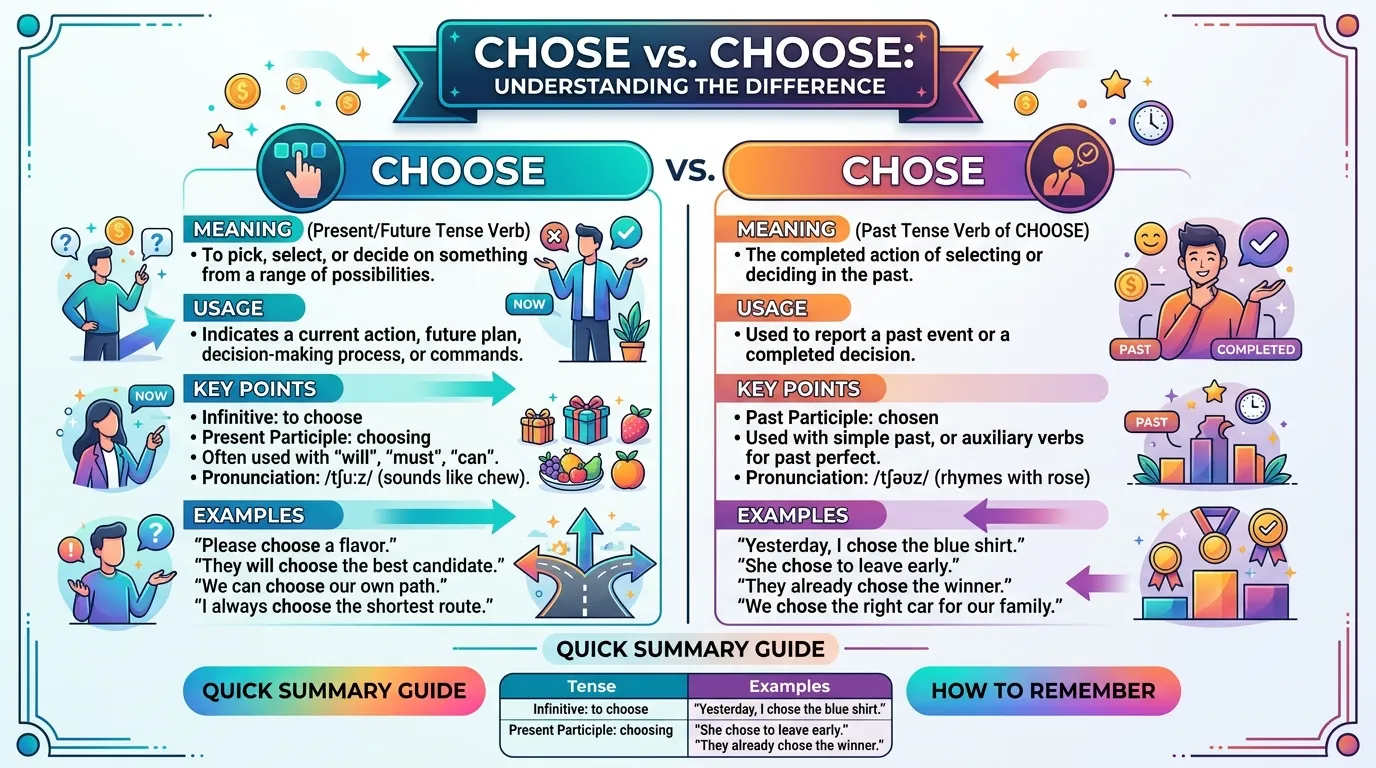
Chose vs choose is a common English grammar and spelling question. The two words look almost identical, but they are used at different times. The main difference is tense: choose is the present tense, while chose is the past tense.
For example, you can say, “I choose the blue shirt” when you are making the choice now. If the decision happened yesterday, you say, “I chose the blue shirt.” Understanding this small difference can make your writing much clearer.
People often search for chose vs choose because the words have similar spellings and meanings. English learners may also confuse them because the pronunciation changes. Choose has a long “oo” sound, while chose has a sound similar to “oh.”
This guide explains chose vs choose in simple English. You will learn their meanings, pronunciation, verb forms, common mistakes, everyday examples, and easy ways to remember which word to use. Whether you are writing an email, school assignment, resume, article, or social media post, this guide will help you choose the correct form.
Chose vs Choose – Quick Answer
The main difference is time:
- Choose = present tense or base form.
- Chose = simple past tense.
Choose Examples
I choose the blue car.
You can choose any seat.
We usually choose healthy food.
Please choose one option.
Use choose for something happening now, something that happens regularly, or an action after words such as will, can, should, or to.
Chose Examples
I chose the blue car yesterday.
She chose the red dress.
They chose a new manager last week.
Use chose when the choice happened in the past.
Easy Rule
Remember:
Choose = now
Chose = past
For example:
Today, I choose tea.
Yesterday, I chose coffee.
The Origin of Chose vs Choose
Choose and chose are two forms of the same English verb. The verb has very old Germanic roots.
Origin of Choose
The modern word choose developed from Old English forms related to cēosan, meaning to choose or select.
Over time, the spelling and pronunciation changed as English developed.
Today, choose is the basic form of the verb.
I choose my clothes carefully.
Origin of Chose
Chose developed as the past form of the same verb.
English has several irregular verbs where the vowel changes between the present and past forms.
For example:
- choose → chose
- speak → spoke
- break → broke
- drive → drove
Because choose is an irregular verb, we do not form its past tense by simply adding -ed.
Incorrect:
choose → choosed ❌
Correct:
choose → chose ✅
Why Are They Confused?
The words are closely related and differ by only one letter:
choose
chose
However, they represent different verb forms.
| Word | Tense | Example |
|---|---|---|
| Choose | Present/base form | I choose the blue one. |
| Chose | Past | I chose the blue one yesterday. |
British English vs American English Spelling
There is no major spelling difference between British and American English for choose and chose.
Both varieties use:
- choose for the present/base form
- chose for the simple past
Comparison Table
| Use | British English | American English | Example |
|---|---|---|---|
| Present | choose | choose | I choose this option. |
| Past | chose | chose | I chose this option yesterday. |
| Past participle | chosen | chosen | I have chosen this option. |
| Present participle | choosing | choosing | I am choosing an option. |
British English
I choose this one.
I chose this one yesterday.
American English
I choose this one.
I chose this one yesterday.
The spelling is the same in both forms of English.
Which Spelling Should You Use?
Your choice depends on the time of the action.
Use Choose for the Present
Use choose when the action happens now or regularly.
I choose the best option.
She always chooses healthy food.
We choose a different hotel every year.
Use Choose After Modal Verbs
After words such as will, can, should, may, might, and must, use choose.
I will choose later.
You can choose any color.
You should choose carefully.
Do not use chose after these modal verbs.
Incorrect:
I will chose later. ❌
Correct:
I will choose later. ✅
Use Choose After “To”
The infinitive form is:
to choose
Examples:
I need to choose a new phone.
She wants to choose the menu.
They decided to choose another option.
Use Chose for the Past
Use chose when the action happened in the past.
I chose the blue shirt yesterday.
She chose a different route.
They chose the cheaper option last week.
Use Chosen as the Past Participle
Do not confuse chose with chosen.
Use chosen with helping verbs such as have, has, and had.
I have chosen a new plan.
She has chosen her university.
They had chosen a different supplier.
Common Mistakes with Chose vs Choose
Mistake 1: “I Chose This Every Day”
Incorrect:
I chose this option every day.
If you mean a regular present action, use choose:
I choose this option every day.
If you mean a past habit, chose can be correct with a clear past context:
I chose this option every day last year.
Mistake 2: “I Will Chose”
Incorrect:
I will chose tomorrow.
Correct:
I will choose tomorrow.
After will, use the base form choose.
Mistake 3: “I Have Chose”
Incorrect:
I have chose this option.
Correct:
I have chosen this option.
Have + past participle requires chosen.
Mistake 4: “I Choosed”
Incorrect:
I choosed the red one.
Correct:
I chose the red one.
Choose is an irregular verb, so its past tense is chose, not “choosed.”
Mistake 5: “She Choose Yesterday”
Incorrect:
She choose the blue dress yesterday.
Correct:
She chose the blue dress yesterday.
The word yesterday shows that the action happened in the past.
Chose vs Choose in Everyday Examples
In Emails
Choose:
Please choose your preferred meeting time.
Chose:
We chose the second proposal after reviewing all options.
In News
Choose:
Customers can choose from several payment options.
Chose:
The committee chose a new leader on Monday.
On Social Media
Choose:
Choose happiness every day.
Chose:
I chose this photo because it captures the moment perfectly.
In Formal Writing
Choose:
Users can choose the appropriate settings for their needs.
Chose:
The board chose a new strategy after reviewing the report.
In Everyday Conversation
Which one will you choose?
I chose the blue one.
You can choose whatever you like.
She chose the larger size.
Chose vs Choose – Comparison Table
| Word | Grammar | Time | Example |
|---|---|---|---|
| Choose | Base/present | Present or general | I choose this option. |
| Chose | Simple past | Past | I chose this option yesterday. |
| Chosen | Past participle | Perfect/passive forms | I have chosen this option. |
| Choosing | Present participle | Ongoing action | I am choosing an option. |
| Chooses | Present, third person | Present/general | She chooses carefully. |
Complete Verb Forms
| Subject/Form | Correct Example |
|---|---|
| I/You/We/They choose | We choose carefully. |
| He/She/It chooses | She chooses carefully. |
| Past: chose | She chose carefully. |
| Past participle: chosen | She has chosen carefully. |
| -ing form: choosing | She is choosing carefully. |
Chose vs Choose Pronunciation
Pronunciation is another important difference.
Choose
Choose is pronounced approximately:
chooz
It has a long “oo” sound, similar to the vowel sound in food.
I choose this one.
Chose
Chose is pronounced approximately:
chohz
It has a long “o” sound.
I chose this one yesterday.
Chosen
Chosen is pronounced approximately:
CHOH-zən
I have chosen this option.
Quick Pronunciation Table
| Word | Approximate Sound | Meaning |
|---|---|---|
| Choose | chooz | Present/base |
| Chose | chohz | Past |
| Chosen | CHOH-zən | Past participle |
How to Remember Chose vs Choose
Choose = Present
Think:
I choose now.
If you are making the decision now, use choose.
Chose = Past
Think:
I chose yesterday.
If the decision happened before now, use chose.
Choose → Chose → Chosen
Remember the complete pattern:
Choose → Chose → Chosen
For example:
I choose a restaurant today.
I chose a restaurant yesterday.
I have chosen a restaurant already.
Watch for Time Words
Certain words can help you identify the correct form.
Choose:
- today
- now
- usually
- every day
- tomorrow
- will
- can
Chose:
- yesterday
- last week
- last year
- earlier
- before
- in 2025
Chosen:
- have
- has
- had
Chose vs Choose – Google Trends & Usage Data
Search interest for chose vs choose is mainly connected to English grammar, vocabulary, spelling, verb forms, pronunciation, and language learning.
The confusion is common because the words are forms of the same verb but represent different times. Choose is the present or base form, while chose is the simple past form. Chosen is the past participle and adds another form that learners often confuse with chose.
Searches for these words can come from students, English learners, writers, teachers, and people checking sentences before publishing or submitting them.
Choose is common in instructions, questions, websites, forms, menus, and everyday conversations. Chose is common when people describe completed decisions or events in the past.
Google Trends popularity can change by country and over time. Exact search-volume figures should be checked directly through Google Trends before using numerical data in an article.
The main search intent is clear: users want to know whether choose, chose, or sometimes chosen is correct in a sentence.
FAQs About Chose vs Choose
1. What is the difference between chose and choose?
Choose is the present or base form of the verb. Chose is the simple past form.
I choose this option now.
I chose this option yesterday.
2. Is it “I choose” or “I chose”?
Both can be correct.
Use choose for the present:
I choose the blue one.
Use chose for the past:
I chose the blue one yesterday.
3. Is “I will chose” correct?
No.
The correct sentence is:
I will choose.
After will, use the base verb choose.
4. Is “choosed” a correct word?
No. Choose is an irregular verb.
The correct forms are:
choose → chose → chosen
5. Is it “I have chose” or “I have chosen”?
The correct form is:
I have chosen.
Use chosen after have, has, or had.
6. What is the past tense of choose?
The simple past tense of choose is:
chose
Example:
She chose the red dress.
7. What is an easy way to remember choose vs chose?
Remember:
Choose = now
Chose = past
You can also remember the complete pattern:
Choose → Chose → Chosen
Conclusion
The difference between chose vs choose is mainly about time and verb form. Choose is the base or present form, while chose is the simple past form. If the action is happening now, happens regularly, or follows a modal verb such as will, can, should, or must, use choose.
For example, “I choose the blue option” describes a current choice. “I chose the blue option yesterday” describes a completed choice in the past. There is also a third form to remember: chosen, which is the past participle used with forms such as have, has, and had.
A simple memory trick is choose = now and chose = past. Remember the full pattern: choose → chose → chosen.
British and American English use the same spellings and grammar rules, so this is not a regional spelling issue. The important point is the tense and sentence structure.
When you are unsure, look for time clues. Words such as now, today, tomorrow, and will often point to choose, while yesterday, last week, and earlier often point to chose. With this simple rule, you can use all three forms correctly in everyday, academic, and professional writing.