Have you ever heard someone say they got “swole” after a workout and wondered whether “swoll” is also correct? This is a common question among fitness enthusiasts, gym-goers, social media users, and English learners. The terms sound similar and are often used in casual conversations about muscles, exercise, and bodybuilding.
The confusion exists because both words appear online, especially in fitness communities. Some people use “swoll” as a spelling variation, while others believe “swole” is the only correct form. If you are writing a fitness blog, posting on social media, or simply trying to improve your English, knowing the difference matters.
This guide explains the correct usage of swoll or swole, their origins, spelling differences, popularity, and practical examples. By the end, you’ll know which word works best for your audience and how to avoid common mistakes.
Swoll or Swole – Quick Answer
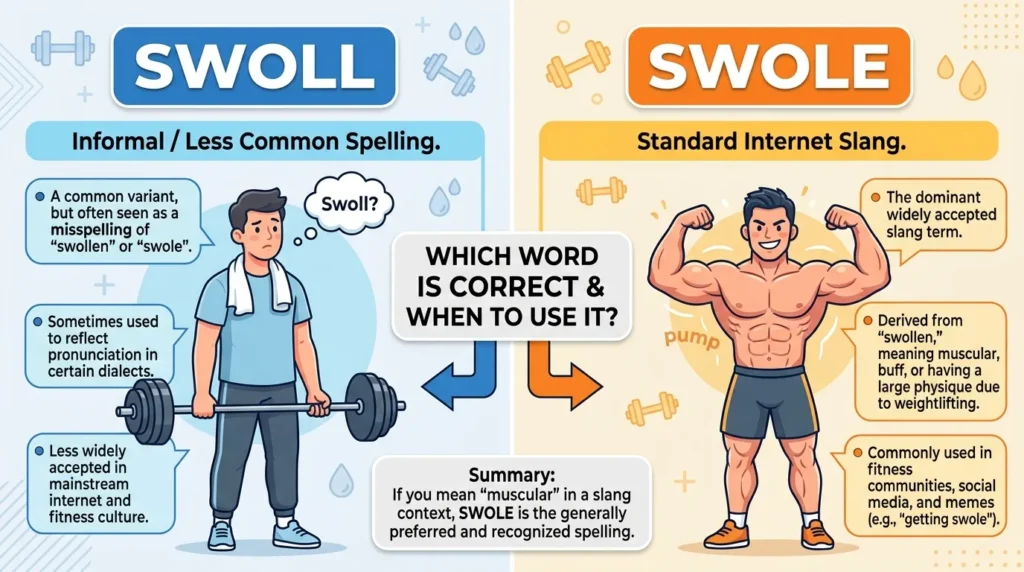
Swole is the most widely accepted and commonly used spelling.
Swoll appears occasionally as a slang variation, but it is much less common.
Examples
✅ Common and accepted:
- After six months in the gym, he got swole.
- She looks swole after her strength training program.
⚠️ Informal variation:
- He got swoll after lifting weights all summer.
For most situations, especially online fitness content, swole is the preferred choice.
The Origin of Swoll or Swole
The word swole comes from the standard English word “swollen.”
Historically, swell is the verb, and swollen is the traditional past participle. Over time, American slang began using “swole” as an informal replacement for “swollen.”
Example
Traditional English:
- His arm was swollen after the injury.
Fitness slang:
- His arms are swole from training.
As gym culture and bodybuilding became more popular, swole evolved to mean muscular, well-built, or heavily trained.
Why Does “Swoll” Exist?
Swoll likely developed as a phonetic spelling. People heard “swole” in conversation and wrote it differently. However, dictionaries, fitness magazines, and mainstream media overwhelmingly favor swole.
British English vs American English Spelling
Unlike many English spelling differences, there is no official British or American spelling distinction here.
Both regions generally recognize swole as the common slang form.
Comparison Table
| Language Version | Preferred Form | Alternative Form |
|---|---|---|
| American English | swole | swoll |
| British English | swole | swoll |
| Canadian English | swole | swoll |
| Australian English | swole | swoll |
Examples
American English
- He got swole after a year of training.
British English
- The rugby player looked swole during the match.
In both countries, swole is the spelling people recognize most.
Which Spelling Should You Use: Swole or Alternative Variations?
If you are unsure which spelling to use, swole is the clear choice. It is the most widely recognized and accepted form in modern English, especially in fitness communities, social media, and informal conversations. Whether you are writing for a blog, creating workout content, or posting online, swole is the spelling your audience is most likely to recognize.
For American English Audiences
Use swole.
The term is extremely popular in the United States and is commonly used in:
- Fitness blogs
- Gym conversations
- Social media posts
- Bodybuilding forums
- Workout videos and podcasts
Examples:
- He’s getting swole after months of training.
- Everyone wants to get swole before summer.
For British and Commonwealth Audiences
Use swole as well.
Although the expression originated in American slang, it is now widely understood in countries such as the United Kingdom, Canada, Australia, and New Zealand. Readers are far more likely to recognize swole than any uncommon spelling variation.
For International Audiences
If your content is intended for a global audience, swole is the best option. It is the dominant spelling used across websites, fitness articles, YouTube videos, online communities, and social media platforms.
Using swole also improves consistency and makes your writing easier for readers from different English-speaking regions to understand.
Professional Writing Recommendation
While swole is the correct and most common informal spelling, remember that it is still slang. In formal or academic writing, professional alternatives are often more appropriate, such as:
- Muscular
- Well-built
- Physically fit
- Highly muscular
- Well-developed physique
Choose swole for casual, conversational, or fitness-related content, and use more formal vocabulary when writing academic papers, business documents, or professional reports.
Quick Recommendation
| Audience | Recommended Spelling |
|---|---|
| United States | swole |
| United Kingdom | swole |
| Canada | swole |
| Australia | swole |
| International | swole |
Common Mistakes When Using Swoll or Swole
Although swole is the widely recognized slang term, many writers still confuse it with swoll or use it in situations where more formal language is appropriate. Understanding these common mistakes will help you choose the right word for your audience and writing style.
Mistake 1: Using “Swoll” Instead of “Swole”
One of the most common errors is writing swoll instead of swole. While swoll occasionally appears in social media posts or casual online conversations, it is not the standard or widely accepted spelling.
Incorrect:
- ❌ He looks swoll after months of training.
Correct:
- ✅ He looks swole after months of training.
For blogs, articles, and other published content, swole is the preferred spelling.
Mistake 2: Assuming “Swoll” Is a Standard English Word
Some people believe swoll is simply another correct version of swole, but that is not the case. Most dictionaries and style references recognize swole as the established slang term, while swoll is generally treated as a non-standard spelling.
Incorrect:
- ❌ Swoll is the correct dictionary spelling.
Correct:
- ✅ Swole is the commonly accepted slang term used in fitness culture.
Mistake 3: Using “Swole” in Formal or Academic Writing
Although swole is popular in gym culture and everyday conversation, it is still an informal slang word. It is usually not appropriate for academic papers, scientific studies, business reports, or professional documents.
Less Appropriate:
- ❌ The fitness report stated participants became swole.
More Professional:
- ✅ The fitness report stated that participants increased their muscle mass.
- ✅ The participants developed greater muscular strength and size.
- ✅ The training program resulted in significant muscle growth.
Using formal vocabulary makes your writing clearer and more suitable for professional audiences.
Mistake 4: Confusing “Swole” with “Swollen”
Another common mistake is assuming swole and swollen have the same meaning. While swole originally developed from the word swollen, its modern meaning is different.
- Swollen usually refers to inflammation or enlargement caused by injury, illness, or irritation.
- Swole refers to someone who is muscular, well-built, or has developed large muscles through exercise.
Examples:
- ✅ His ankle is swollen after the injury.
- ✅ He’s looking swole after six months of weight training.
Mistake 5: Overusing Slang in Professional Content
Even when swole is spelled correctly, using it repeatedly can make professional or educational writing sound too informal. If your audience expects a formal tone, choose more precise alternatives.
Instead of swole, consider using:
- Muscular
- Well-built
- Physically fit
- Muscular physique
- Increased muscle mass
- Well-developed physique
These alternatives are more appropriate for research papers, health articles, medical content, and business reports.
Writing Tip
Use swole for casual conversations, fitness blogs, workout videos, and social media posts. For professional, academic, or scientific writing, replace it with more formal terms such as muscular, well-built, or increased muscle mass to maintain a polished and professional tone.
Quick Corrections Table
| Incorrect or Less Preferred | Better Choice |
|---|---|
| swoll | swole |
| very swoll | very swole |
| became swoll | became swole |
| swoll physique | swole physique |
Swoll or Swole: Real-Life Examples in Everyday Communication
The word swole is widely used in casual English, especially in fitness culture, bodybuilding communities, and social media. While swoll occasionally appears online, swole is the more widely recognized and accepted slang term. Knowing how to use it correctly in different situations can help you communicate naturally while choosing appropriate language for your audience.
In Emails
Although swole is an informal word, it may be appropriate in friendly or personal emails where the tone is casual.
Examples:
- I’ve been working out regularly and finally feel swole.
- After six months at the gym, I’m definitely getting swole.
- My workout routine is paying off—I feel stronger and more swole every week.
For professional business emails, however, it is better to use more formal expressions such as more muscular or physically stronger.
In News Articles
Lifestyle magazines and fitness publications sometimes use swole to create an engaging and conversational tone.
Examples:
- Fitness influencers are sharing safe ways to get swole.
- More people are joining strength-training programs to get swole and improve their health.
- Social media trends continue to promote the idea of getting swole through consistent exercise.
In serious news reporting or academic journalism, writers often prefer more formal terms like muscular, well-built, or increased muscle mass.
On Social Media
The term swole is especially popular on platforms such as Instagram, TikTok, X, and Facebook because it fits the casual style of online conversations.
Examples:
- Summer gains are here—feeling swole!
- Finally looking swole after months of hard work.
- Gym progress is real. Time to get swole!
- Nothing beats that post-workout swole feeling.
In Gym Conversations
Among gym-goers and fitness enthusiasts, swole is commonly used to describe noticeable muscle growth or an impressive physique.
Examples:
- That workout has me feeling swole.
- He’s looking really swole after his new training program.
- If you stay consistent, you’ll get swole over time.
- Everyone noticed how swole he looked after the competition.
In Fitness Blogs and Workout Guides
Fitness blogs often use swole to connect with readers in a friendly and motivational way.
Examples:
- Many beginners want to get swole quickly, but building muscle takes time and consistency.
- The best way to get swole is by combining strength training with proper nutrition.
- Recovery and adequate protein intake are just as important as lifting weights if your goal is to get swole.
In Formal and Professional Writing
Because swole is an informal slang term, it is generally avoided in academic papers, medical reports, scientific research, and business documents. In these situations, more precise and professional language is recommended.
Instead of swole, use terms such as:
- Muscular
- Well-built
- Physically fit
- Physically developed
- Increased muscle mass
- Well-developed physique
- Improved muscular development
Example:
- ❌ The athletes became swole after the training program.
- ✅ The athletes experienced significant muscle growth after the training program.
Writing Tip
Use swole in casual conversations, fitness-related content, and social media where an informal tone is appropriate. For professional, academic, or medical writing, choose more formal alternatives to ensure your content remains clear, credible, and suitable for your audience.
Swoll or Swole – Google Trends & Usage Data
Search interest strongly favors swole over swoll.
People usually search “swoll or swole” because they encounter both spellings online.
Countries Where Searches Are Common
- United States
- Canada
- United Kingdom
- Australia
- New Zealand
Common Search Intent
Users want to know:
- Which spelling is correct?
- Is swoll a real word?
- What does swole mean?
- Can swole be used in writing?
Usage Comparison
| Variation | Dictionary Recognition | Popularity |
|---|---|---|
| swole | Yes (slang/informal) | Very High |
| swoll | Limited recognition | Low |
Today, swole dominates fitness websites, gym forums, and social media platforms.
Swoll vs Swole Comparison Table
| Feature | Swole | Swoll |
|---|---|---|
| Commonly Used | Yes | Rare |
| Fitness Slang | Yes | Sometimes |
| Dictionary Recognition | Yes | Limited |
| Used Online Frequently | Yes | Less Often |
| Recommended Usage | Yes | No |
| Global Recognition | High | Low |
| Best Choice for Writers | Yes | No |
Frequently Asked Questions About Swoll vs Swole
1. Is “Swoll” a Real Word?
Swoll does appear occasionally in online conversations, social media posts, and fitness communities, but it is not the standard or widely accepted spelling. Most dictionaries and language references recognize swole as the established slang term, while swoll is generally considered a non-standard spelling variation.
2. Which Is Correct: Swoll or Swole?
Swole is the correct and more widely accepted spelling. It is commonly used in bodybuilding, fitness culture, gym conversations, and social media to describe someone who has developed a muscular physique through regular exercise and strength training.
3. What Does “Swole” Mean?
Swole is an informal slang word that describes someone who is muscular, well-built, or noticeably developed through weight training. It is often used to compliment a person’s physical appearance after consistent workouts.
Example:
- After months of lifting weights, he’s looking really swole.
4. Is “Swole” Proper English?
Swole is recognized as an informal slang term, not as formal Standard English. It is perfectly acceptable in casual conversations, fitness blogs, workout videos, and social media, but it is generally avoided in academic papers, business reports, and other formal writing.
5. Do Dictionaries Recognize “Swole”?
Yes. Many modern English dictionaries include swole as an informal or slang word. It is commonly defined as describing someone who has become very muscular or physically developed, particularly through exercise and bodybuilding.
6. Can I Use “Swole” in Professional Writing?
It depends on your audience. If you are writing a fitness blog or informal article, swole is perfectly acceptable. However, for academic, medical, scientific, or business writing, it is better to use more formal alternatives such as:
- Muscular
- Well-built
- Physically fit
- Increased muscle mass
- Well-developed physique
These expressions are more appropriate for professional communication.
7. Why Do People Say “Swole” Instead of “Swollen”?
The word swole developed as a slang variation of swollen within American gym and bodybuilding culture. Originally, it described muscles that looked “swollen” after an intense workout because of increased blood flow, often called a muscle pump. Over time, the term evolved to describe anyone with a muscular, athletic physique, and it became a popular part of fitness vocabulary around the world.
8. Is “Swole” Used Around the World?
Yes. Although swole originated in American English, it is now widely understood in many English-speaking countries, including the United Kingdom, Canada, Australia, and New Zealand. Thanks to social media, fitness influencers, and online workout communities, the term has become internationally recognized.
9. Can “Swole” Describe Women as Well as Men?
Yes. While swole is often used to describe muscular men, it can also refer to women who have built noticeable muscle through strength training and fitness. The term is informal and focuses on a person’s muscular appearance rather than their gender.
10. How Can I Remember the Correct Spelling?
A simple way to remember the correct spelling is to think of the common phrase “get swole”, which is widely used in fitness communities. If you see swoll, remember that swole is the accepted and more commonly used slang spelling.
Conclusion
When comparing swoll or swole, the clear winner is swole. It is the spelling most people recognize, the form most often found in dictionaries, and the version widely used across fitness communities, blogs, social media platforms, and gym conversations. While swoll appears occasionally as an alternative spelling, it lacks the same level of acceptance and popularity.
Another important point is that neither British English nor American English officially prefers swoll. In both regions, swole is the common slang term. If you are writing for a fitness audience, using swole will help readers understand your meaning immediately.
For professional or academic writing, however, it is often better to choose words such as muscular, well-built, or physically developed. These terms sound more formal and precise. Overall, if you need acasual fitness term, choose swole and avoid swoll whenever possible.