Have you ever heard someone say, “She’s a real trouper,” and wondered whether the correct word is trouper or trooper? You are not alone. These two words sound very similar, but they have different meanings and are used in different contexts.
Trouper generally describes a person who stays dependable, cheerful, and determined when facing difficulties. Trooper, on the other hand, traditionally refers to a soldier, especially a cavalry soldier, and is also commonly used for certain law-enforcement officers. The words are therefore not simply two spellings of the same term.
Understanding the difference between trouper and trooper can help you choose the right word in everyday conversation, professional writing, emails, and online content. It is especially useful when you want to describe someone as resilient or dependable without confusing that meaning with a military or police-related role.
In this guide, you’ll learn the meaning of trouper, the meaning of trooper, the difference between trouper and trooper, their origins, common mistakes, and examples of how to use each word correctly. By the end, you’ll know which word fits your sentence and why.
Trouper or Trooper – Quick Answer
Trouper and trooper are both correct English words, but they have different meanings.
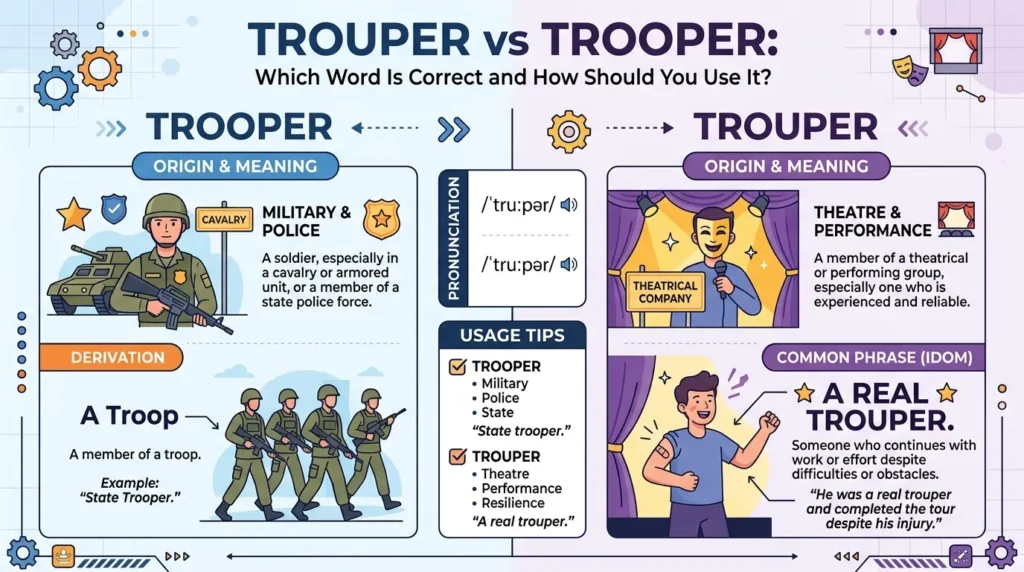
- Trouper usually means a person who is dependable, resilient, and willing to keep going through difficult situations.
- Trooper usually means a soldier, especially a cavalry soldier, and can also refer to certain law-enforcement officers.
Trouper Meaning
A trouper is someone who handles difficulties with determination and remains reliable or cheerful despite challenging circumstances.
Example:
- She was a real trouper during the difficult project.
Trooper Meaning
A trooper is traditionally a soldier, particularly a cavalry soldier. In some contexts, the word also refers to a police or law-enforcement officer.
Example:
- The state trooper stopped the vehicle for speeding.
Quick Rule
Remember the difference this way:
Trouper = a resilient or dependable person
Trooper = a soldier or certain law-enforcement officer
Although the two words sound very similar, trouper and trooper are not interchangeable in every context. The correct choice depends on what you mean.
The Origin of Trouper or Trooper
Although trouper and trooper sound almost identical, they come from different words and developed different meanings.
Origin of Trouper
Trouper comes from troupe, a word used for a group of performers, actors, or entertainers. Originally, a trouper was a member of a theatrical troupe, particularly someone who regularly performed with the group.
Over time, the word developed a broader figurative meaning. A person who continues working hard, remains dependable, and handles difficult circumstances without giving up can be called a trouper.
For example:
- She was a real trouper and finished the project despite all the problems.
Today, trouper is most commonly used to describe someone who shows determination, reliability, or resilience.
Origin of Trooper
Trooper comes from troop, which refers to a group of soldiers. The word originally referred to a soldier, particularly a cavalry soldier.
The meaning later expanded in some contexts to include members of law enforcement, such as a state trooper in the United States.
For example:
- The state trooper helped clear the road after the accident.
Why Are Trouper and Trooper Confused?
The main reason for the confusion is pronunciation. Trouper and trooper sound very similar in spoken English, even though their spellings and origins are different.
Their meanings can also overlap loosely when describing someone who is brave, determined, or persistent. However, their standard uses remain different:
- Trouper → a dependable or resilient person
- Trooper → a soldier or, in some contexts, a law-enforcement officer
Knowing their origins makes the spelling easier to remember: trouper comes from troupe, while trooper comes from troop.
British English vs American English
There is no spelling difference between British and American English for trouper and trooper. Both varieties of English use the same spellings, but the meaning depends on the context.
| Meaning | British English | American English |
|---|---|---|
| A dependable or resilient person | trouper | trouper |
| A soldier or cavalry soldier | trooper | trooper |
| Certain law-enforcement officers | trooper | trooper |
Examples in British English
- She was a real trouper throughout the difficult experience.
- The trooper was part of the military unit.
Examples in American English
- He was a real trouper during the long recovery.
- The state trooper stopped the vehicle.
Does the Meaning Change by Country?
No. The basic distinction remains the same in both British and American English:
Trouper is generally used for a dependable or resilient person, while trooper is associated with soldiers and, in certain contexts, law-enforcement officers.
Therefore, when choosing between trouper or trooper, focus on the meaning you want to express, not whether you are writing for a British or American audience.
Which Spelling Should You Use?
Choosing between trouper or trooper depends on the person, role, or situation you are describing. Both spellings are correct, but they are not normally used for the same meaning.
Use “Trouper” for a Dependable Person
Use trouper when you are describing someone who remains strong, reliable, cheerful, or determined during a difficult situation.
A trouper person is someone who keeps going despite problems or challenges.
Examples:
- She was a real trouper during the difficult project.
- You have been a trouper throughout this stressful week.
- He is a real trouper and never gives up easily.
Use “Trooper” for a Soldier or Law-Enforcement Officer
Use trooper when referring to a soldier, particularly a cavalry soldier, or to certain law-enforcement officers.
Examples:
- The state trooper pulled the car over.
- The cavalry trooper prepared for the mission.
- A trooper assisted the drivers after the accident.
An Easy Way to Remember
Think of the word troupe when you mean a dependable person:
troupe → trouper
Think of troop when you mean a soldier:
troop → trooper
This simple connection can help you remember which spelling to use.
Does “Trooper” Ever Describe a Tough Person?
Yes. In informal English, trooper can also be used figuratively for someone who is tough, persistent, or able to cope with difficulties. For example, someone might say, “He’s a real trooper.”
However, trouper is the traditional spelling when the intended meaning is a person who is dependable and perseveres through difficulties. The exact choice can therefore depend on context and style.
Common Mistakes with Trouper or Trooper
Because trouper and trooper sound very similar, it is easy to confuse them in writing. The best way to choose the correct word is to consider what you are describing.
Mistake 1: Confusing “Trouper” With “Trooper”
If you are describing someone who is dependable and continues through a difficult situation, trouper is the traditional choice.
❌ She was a real trooper during the difficult project.
✅ She was a real trouper during the difficult project.
However, trooper can also be used informally to describe a tough or persistent person, so the first sentence is not necessarily impossible. The choice depends on the intended meaning and context.
Mistake 2: Using “Trouper” for a State Police Officer
When referring to a state police officer, the standard word is trooper.
❌ The state trouper stopped the vehicle.
✅ The state trooper stopped the vehicle.
Mistake 3: Using “Trouper” for a Soldier
When referring to a soldier, particularly a cavalry soldier, use trooper.
❌ The army trouper joined the unit.
✅ The army trooper joined the unit.
Mistake 4: Assuming the Two Words Have Exactly the Same Meaning
Although trouper and trooper can both appear in descriptions of someone who is strong or persistent, they have different origins and standard meanings.
Trouper is associated with troupe and traditionally describes a dependable or resilient person.
Trooper is associated with troop and refers primarily to a soldier or, in certain contexts, a law-enforcement officer.
Quick Corrections
| Intended meaning | Correct word | Example |
|---|---|---|
| Dependable or resilient person | trouper | She is a real trouper. |
| State police officer | trooper | The state trooper arrived quickly. |
| Cavalry soldier | trooper | The trooper served with the cavalry. |
| Person described informally as tough or persistent | trooper can be used | He’s a real trooper. |
When you are unsure, identify the context first. If the word relates to troupe or the traditional idea of a performer who perseveres, trouper is usually appropriate. If it relates to a troop, soldier, or law-enforcement role, trooper is the better choice.
Trouper or Trooper in Everyday Examples
Seeing trouper and trooper in different sentences makes the difference easier to remember. The correct word depends on whether you are describing a person’s determination or referring to a military or law-enforcement role.
Examples With “Trouper”
Use trouper when describing someone who remains dependable, positive, or determined during a difficult situation.
- She was a real trouper throughout the challenging project.
- Despite feeling tired, he was a trouper and continued helping the team.
- My sister was a real trouper during the long journey.
- Everyone appreciated how much of a trouper she was during the difficult week.
Examples With “Trooper”
Use trooper when referring to a soldier or a law-enforcement officer.
- The state trooper stopped the vehicle for speeding.
- The trooper helped direct traffic after the accident.
- The cavalry trooper reported back to his unit.
- The trooper responded quickly to the emergency.
Trouper or Trooper in Workplace Communication
When praising a colleague for handling a difficult task, trouper can be appropriate.
- Thanks for staying late—you were a real trouper.
When referring to an officer, use trooper.
- The state trooper arrived at the scene within minutes.
Trouper or Trooper in Casual Conversation
In casual speech, both words may sometimes be used figuratively to describe someone who is tough or persistent. For example:
- She’s a real trouper.
- He’s a real trooper.
However, trouper is traditionally associated with the idea of a dependable person who perseveres, while trooper has its established military and law-enforcement meanings.
Quick Tip
Ask yourself what you are talking about:
A dependable or resilient person? → Trouper
A soldier or certain law-enforcement officer? → Trooper
Trouper or Trooper – Google Trends & Usage Data
Search data shows that trooper is searched much more frequently than trouper.
This is mainly because trooper is used in military, law enforcement, entertainment, and popular culture contexts.
Countries with High Search Interest
- United States
- United Kingdom
- Canada
- Australia
- New Zealand
Common Search Intent
People often search:
- Is it trouper or trooper?
- What is a real trouper?
- What does trooper mean?
- Are the words interchangeable?
Usage Comparison
| Word | Meaning | Popularity |
|---|---|---|
| trooper | Soldier or police officer | Very High |
| trouper | Reliable person | Moderate |
The phrase “real trouper” remains common in modern English despite the higher overall popularity of trooper.
Trouper vs Trooper Comparison Table
| Feature | Trouper | Trooper |
|---|---|---|
| Correct English word | Yes | Yes |
| Refers to performer origins | Yes | No |
| Means dependable person | Yes | No |
| Means soldier | No | Yes |
| Means police officer | No | Yes |
| Common phrase | Real trouper | State trooper |
| Frequently confused | Yes | Yes |
FAQs
1. Which is correct: trouper or trooper?
Both are correct, but they have different meanings.
2. What does “real trouper” mean?
It means a person who remains cheerful, reliable, and helpful during difficult situations.
3. What is a trooper?
A trooper is generally a soldier or law enforcement officer.
4. Why do people confuse trouper and trooper?
They sound nearly identical when spoken.
5. Is “real trooper” wrong?
If you mean a dependable person, real trouper is technically the correct phrase.
6. Do British and American English use different spellings?
No. Both varieties use the same spellings and meanings.
7. Which word is more common?
Trooper is more common overall because it appears frequently in military and law enforcement contexts.
Conclusion
The debate over trouper or trooper is not about choosing one correct spelling over another. Both words are valid English words, but they serve different purposes. Trouper refers to a dependable, cheerful, and hardworking person who handles challenges well. Trooper, on the other hand, refers to a soldier, cavalry member, or law enforcement officer.
The confusion arises because the words sound almost the same. Many people mistakenly write trooper when they mean trouper, especially in the popular phrase “real trouper.” Understanding the distinction helps make your writing more accurate and professional.
Fortunately, there is no British-versus-American spelling issue here. The meanings remain the same across all major English-speaking countries. When choosing between the two words, focus on context. If you’re praising someone’s determination, use trouper. If you’re referring to military or police service, use trooper. Following this simple rule will help you avoid one of the most common word mix-ups in English.