Have you ever written a sentence and wondered whether to use since or because? You are not alone. These two words often cause confusion because both can explain a reason. Many students, writers, professionals, and English learners search for “since or because” to understand which word is correct in different situations.
At first glance, the words seem interchangeable. For example, you can say, “I stayed home because it was raining” or “I stayed home since it was raining.” Both sentences sound correct. However, there are important differences in meaning, tone, and usage. In some cases, using the wrong word can make a sentence unclear or confusing.
The good news is that the difference is easy to understand once you know the basic rules. This article explains the meanings of since and because, their origins, usage in British and American English, common mistakes, real-life examples, and professional writing advice. By the end, you will know exactly when to use since and when because is the better choice.
Since or Because – Quick Answer
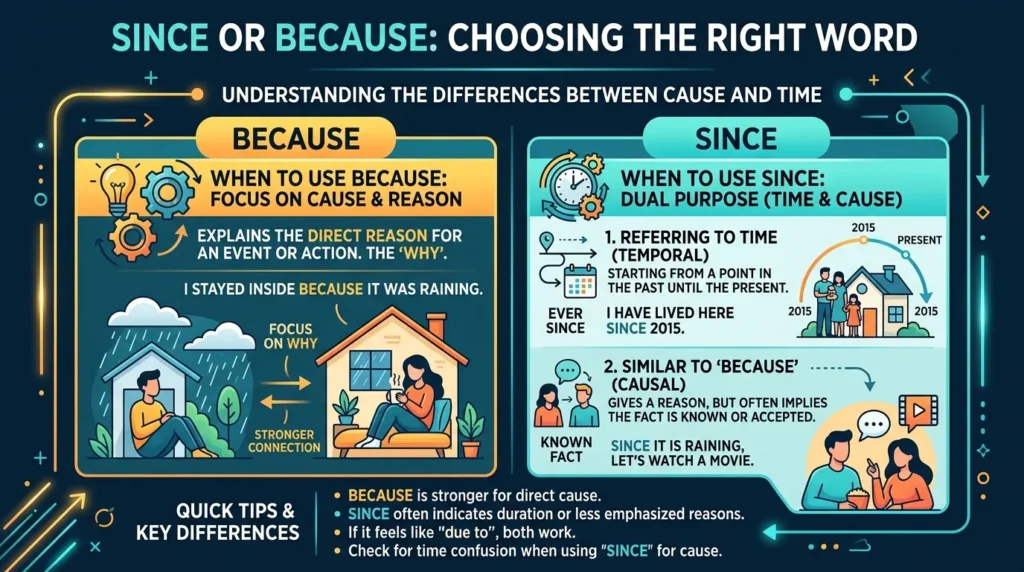
Both since and because can introduce a reason, but they are not always identical.
Because
Because directly explains why something happened.
Examples:
- I was late because the traffic was heavy.
- She smiled because she was happy.
Since
Since can also explain a reason, but it often sounds less direct and more formal.
Examples:
- Since the weather was bad, we stayed indoors.
- Since everyone agreed, the meeting ended early.
Quick Rule
- Use because when the reason is important and direct.
- Use since when the reason is already known or less important.
The Origin of Since or Because
Understanding the history of these words helps explain their different uses.
Origin of Since
The word since comes from Old English and originally referred to time, meaning “from a particular point in the past until now.”
Example:
- I have lived here since 2020.
Over time, it developed a second meaning related to reason.
Example:
- Since it was raining, we canceled the picnic.
Origin of Because
The word because comes from Middle English and evolved from phrases meaning “by cause.”
Its primary purpose has always been to explain reasons and causes.
Example:
- The game was canceled because of rain.
Why the Difference Exists
Because started as a word for causes and reasons.
Since started as a time-related word and later gained a reason-related meaning.
British English vs American English Spelling
Unlike words such as “color” and “colour,” since and because do not have different spellings in British and American English.
The spelling remains exactly the same.
Comparison Table
| Feature | Since | Because |
|---|---|---|
| British English | Since | Because |
| American English | Since | Because |
| Spelling Difference | None | None |
| Common Usage | Yes | Yes |
| Formal Writing | Common | Very Common |
| Everyday Speech | Common | Very Common |
Key Point
The difference is about meaning and usage, not spelling.
Which Spelling Should You Use?
Since and because are both correct words. The choice depends on your sentence.
For American Audiences
Use:
- Because for clear explanations.
- Since for softer or secondary reasons.
For British and Commonwealth Audiences
The same rule applies.
For Academic and Professional Writing
Many style guides prefer because when the reason is important because it is more precise.
Example:
✅ Sales increased because demand grew.
This is clearer than:
⚠️ Sales increased since demand grew.
For Global Communication
If clarity is important, choose because.
Common Mistakes with Since or Because
Many writers confuse these words.
Mistake 1: Using Since When Time Is Unclear
❌ Since I was tired yesterday, I stayed home.
This can sometimes sound like a time reference.
✅ Because I was tired yesterday, I stayed home.
Mistake 2: Assuming They Always Mean the Same Thing
❌ Since and because are always interchangeable.
✅ They are often similar, but context matters.
Mistake 3: Using Since in Critical Explanations
❌ The machine failed since the power supply stopped.
✅ The machine failed because the power supply stopped.
Mistake 4: Forgetting the Time Meaning of Since
Since can indicate:
- Time
- Reason
Because only indicates:
- Reason
Since or Because in Everyday Examples
In Emails
Because Example
“I missed the meeting because I was sick.”
Since Example
“Since the report is complete, we can move forward.”
In News Writing
Because Example
“The event was postponed because of severe weather.”
Since Example
“Since attendance was low, organizers reduced seating.”
On Social Media
Because Example
“I’m staying home because it’s raining.”
Since Example
“Since everyone loved it, I watched it too.”
In Formal Writing
Because Example
“The project succeeded because proper planning was implemented.”
Since Example
“Since all requirements were met, approval was granted.”
Since or Because – Google Trends & Usage Data
Search data shows that both words are extremely common.
Why People Search “Since or Because”
Users often want to know:
- Which word is grammatically correct
- The difference between since and because
- Which sounds more professional
- Which should be used in essays
Popularity by Country
| Country | Since Searches | Because Searches |
|---|---|---|
| United States | Very High | Very High |
| United Kingdom | Very High | Very High |
| Canada | High | High |
| Australia | High | High |
Usage Trends
Because is generally preferred in:
- Academic writing
- Technical writing
- Professional communication
Since is commonly used in:
- Everyday conversation
- Formal writing
- Situations where the reason is already understood
Since vs Because Comparison Table
| Feature | Since | Because |
|---|---|---|
| Primary Meaning | Time or reason | Reason only |
| Direct Explanation | Moderate | Strong |
| Formal Writing | Common | Very Common |
| Academic Writing | Less Preferred | Preferred |
| Can Mean Time | Yes | No |
| Clarity | Sometimes Less Clear | Usually Clearer |
Frequently Asked Questions (FAQs)
1. Is since the same as because?
Not exactly. Both can explain a reason, but since can also refer to time.
2. Which is more formal, since or because?
Both are acceptable, but because is often clearer in professional and academic writing.
3. Can I always replace because with since?
No. Sometimes replacing because with since can create ambiguity.
4. Why do teachers prefer because?
Because clearly shows cause and effect, making writing easier to understand.
5. Does since always refer to time?
No. Since can indicate either time or reason.
6. Which word is better for essays?
Because is usually the safer choice because it is more precise.
7. Is using since incorrect?
No. Since is completely correct when used properly.
Conclusion
The difference between since or because is simple once you understand their main functions. Both words can introduce a reason, but because is more direct and specific. It clearly explains why something happened and is often preferred in academic, technical, and professional writing.
Since, on the other hand, has two meanings. It can refer to time or provide a reason. Because of this dual role, it can sometimes create confusion if the context is not clear. For that reason, many writers choose because when they want the strongest and clearest explanation.
Neither word is wrong. The best choice depends on your audience, writing style, and purpose. If clarity is your goal, especially in formal writing, use because. If the reason is already understood or you want a smoother tone, since can work well. Understanding this difference will help you write more accurately and confidently in every situation.