Have you ever seen a fragrance bottle labeled perfume on one product and parfum on another? Many shoppers, writers, beauty enthusiasts, and English learners wonder whether these words mean the same thing or if one is more correct than the other. Because both terms appear frequently in the fragrance industry, the confusion is understandable.
The truth is that perfume and parfum are closely related, but they are not always used in exactly the same way. In English, “perfume” is the standard word for a scented fragrance product. “Parfum” comes from French and is often used by luxury fragrance brands to describe a specific fragrance concentration or to give products a premium feel.
People search for “perfume or parfum” because they want to understand the difference, choose the right term in writing, and make informed purchasing decisions. This guide explains the meanings, origins, spelling differences, usage examples, trends, and common mistakes. By the end, you’ll know exactly when to use perfume and when parfum is the better choice.
Perfume or Parfum – Quick Answer
Perfume and parfum are both correct, but they are used differently.
Perfume
Perfume is the standard English word for a scented liquid used to provide a pleasant fragrance.
Examples:
- She bought a new perfume for her birthday.
- This perfume has a floral scent.
Parfum
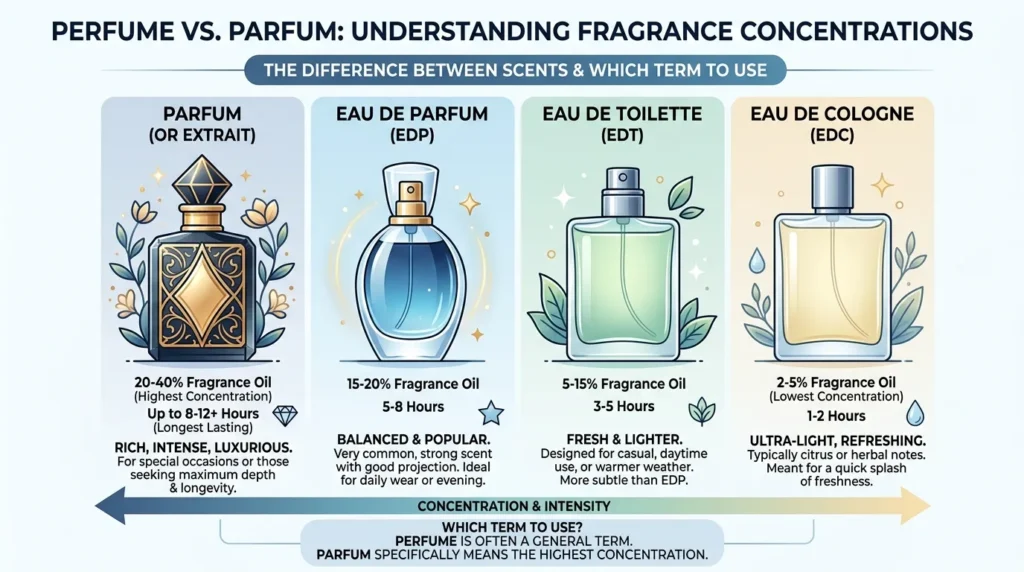
Parfum is the French word for perfume. In the fragrance industry, it often refers to a highly concentrated fragrance.
Examples:
- The brand released a new parfum collection.
- Parfum typically lasts longer on the skin than lighter fragrance types.
Quick Rule
- Perfume = Standard English term
- Parfum = French term often used in luxury fragrances
The Origin of Perfume or Parfum
Understanding the history of these words helps explain why both are common today.
Origin of Perfume
The English word perfume comes from the Latin phrase per fumum, meaning “through smoke.”
Ancient civilizations burned fragrant materials during religious ceremonies and rituals. Over time, the term evolved into the modern English word “perfume.”
Origin of Parfum
Parfum is the French version of the same word. France has long been considered one of the world’s leading centers for fragrance production.
Many luxury fragrance companies use the French spelling because it reflects the industry’s historical roots and premium image.
Why Both Terms Exist
The fragrance industry is heavily influenced by French traditions. As a result:
- Everyday English uses perfume.
- Luxury branding often uses parfum.
British English vs American English Spelling
Unlike words such as “color” and “colour,” the difference between perfume and parfum is not primarily a British-versus-American spelling issue.
Both countries generally use perfume in everyday English.
Comparison Table
| Feature | Perfume | Parfum |
|---|---|---|
| Language Origin | English | French |
| Common in US English | Yes | Sometimes |
| Common in UK English | Yes | Sometimes |
| Used in Luxury Branding | Often | Very Often |
| Standard Dictionary Word | Yes | Usually listed as French |
| Everyday Usage | Very Common | Less Common |
Key Point
Both American and British English primarily use perfume, while parfum is often reserved for luxury or fragrance-industry contexts.
Which Spelling Should You Use?
The best choice depends on your audience and purpose.
For American Audiences
Use perfume in:
- Blogs
- Articles
- Product descriptions
- General writing
For British and Commonwealth Audiences
The same advice applies.
Use perfume for most communication.
For Luxury Fragrance Brands
Use parfum when referring to:
- Premium fragrance collections
- Official product names
- Fragrance concentration categories
For Global Audiences
Choose:
- Perfume for clarity
- Parfum when discussing luxury fragrance terminology
Common Mistakes with Perfume or Parfum
Many writers confuse these terms.
Mistake 1: Assuming They Are Different Products
❌ Perfume and parfum are completely different products.
✅ They refer to fragrance products, though parfum often indicates a stronger concentration.
Mistake 2: Using Parfum in Everyday Writing
❌ I bought a new parfum at the local store.
✅ I bought a new perfume at the local store.
Mistake 3: Thinking Parfum Is a Misspelling
❌ Parfum is incorrect.
✅ Parfum is the French spelling and is widely used in the fragrance industry.
Mistake 4: Ignoring Brand Terminology
Many luxury brands intentionally use “parfum” on packaging.
Always follow the official product name when referencing a specific fragrance.
Perfume or Parfum in Everyday Examples
In Emails
Perfume Example
“I would like to order the perfume you recommended.”
Parfum Example
“The new parfum collection will launch next month.”
In News Writing
Perfume Example
“The perfume industry experienced strong sales growth this year.”
Parfum Example
“The luxury house introduced a limited-edition parfum.”
On Social Media
Perfume Example
“This perfume smells amazing!”
Parfum Example
“My favorite parfum lasts all day.”
In Formal Writing
Perfume Example
“Perfume has been used throughout human history.”
Parfum Example
“The brand markets its flagship parfum as a premium fragrance.”
Perfume or Parfum – Google Trends & Usage Data
Search behavior shows interesting differences between these terms.
Perfume Search Trends
People commonly search for:
- Best perfume for women
- Men’s perfume
- Perfume brands
- Perfume gifts
These searches are extremely popular worldwide.
Parfum Search Trends
People search for:
- Eau de parfum
- Luxury parfum
- Parfum concentration
- French parfum brands
These searches are often associated with fragrance enthusiasts.
Popularity by Country
| Country | Perfume Searches | Parfum Searches |
|---|---|---|
| United States | Very High | Moderate |
| United Kingdom | Very High | Moderate |
| Canada | High | Moderate |
| Australia | High | Moderate |
| France | High | Very High |
Overall Trend
“Perfume” receives significantly more searches because it is the standard English term.
Perfume vs Parfum Comparison Table
| Word | Meaning | Typical Use |
|---|---|---|
| Perfume | Standard English term for fragrance | Everyday writing |
| Parfum | French term for fragrance | Luxury branding |
| Perfume | General fragrance product | Retail and media |
| Parfum | Often indicates higher concentration | Fragrance industry |
Frequently Asked Questions (FAQs)
1. Is perfume or parfum correct?
Both are correct. Perfume is English, while parfum is French.
2. What is the difference between perfume and parfum?
Perfume is the general English word. Parfum is often used in luxury fragrance branding and may indicate higher concentration.
3. Which spelling is more common?
Perfume is much more common in everyday English.
4. Is parfum stronger than perfume?
In fragrance terminology, parfum often refers to a higher fragrance concentration that lasts longer.
5. Do Americans use parfum?
Yes, but mostly when discussing luxury fragrances or specific product names.
6. Is parfum a French word?
Yes. Parfum is the French word for perfume.
7. Which should I use in an article?
For most English-language articles, use perfume unless discussing official fragrance classifications or luxury branding.
Conclusion
The debate between perfume or parfum is less about correct versus incorrect spelling and more about context. Both words refer to fragrance products, but they serve different purposes in modern language. Perfume is the standard English term and is the preferred choice for everyday communication, articles, advertisements, and general discussions about fragrances.
Parfum, on the other hand, comes from French and is commonly used in luxury branding and fragrance-industry terminology. It often appears on premium products and may indicate a higher fragrance concentration. Because French culture has played such a major role in perfume history, the term remains popular among high-end fragrance brands.
When writing for a broad audience, perfume is usually the safest and clearest option. When discussing luxury fragrances, official product names, or fragrance concentrations, parfum may be more appropriate. Understanding the difference helps you communicate accurately and professionally while avoiding common mistakes.