The words “honey” and “hunny” often confuse people because they sound the same but are spelled differently. Many users search this keyword when they see it in messages, love notes, social media captions, or cartoons and wonder which spelling is correct. Is it a real English word? Or is one of them wrong?
In reality, “honey” is the correct standard English word, while “hunny” is an informal, playful, or stylistic spelling used mainly in casual conversations. People often use “hunny” to sound cute, romantic, or friendly. You might see it in text messages like “good morning hunny ❤️” or in fictional characters like Winnie the Pooh, where the spelling is intentionally changed for charm.
This confusion grows because both versions are widely used online, especially in social media, memes, and relationship chats. Some people think “hunny” is British English, while others believe it is slang or a modern trend. This article clears all confusion by explaining the meaning, origin, correct usage, and differences between the two spellings in simple terms. By the end, you will know exactly when to use “honey” and when “hunny” is acceptable.
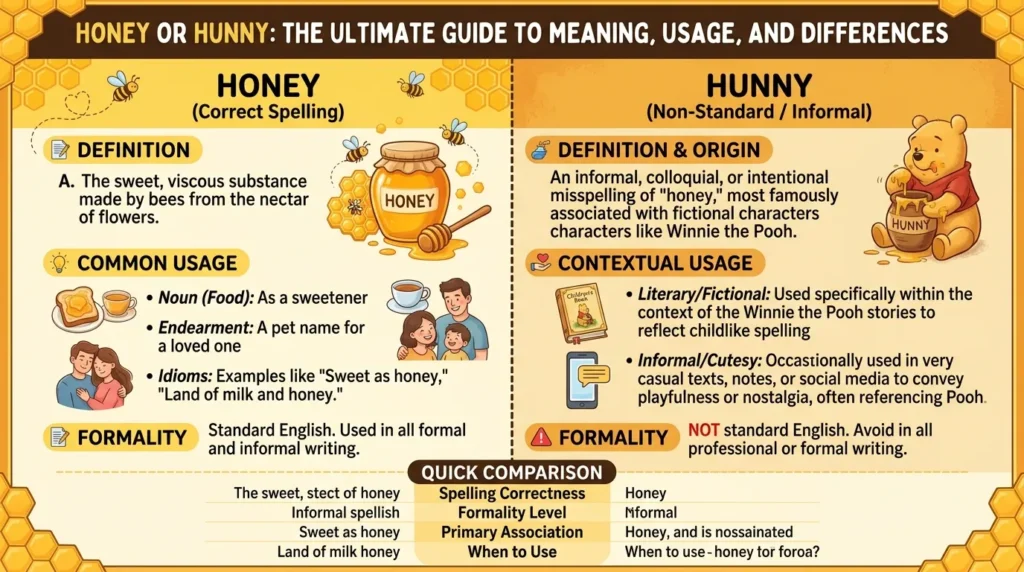
Honey or Hunny – Quick Answer
“Honey” is the correct standard English spelling.
“Hunny” is an informal, cute, or playful version used in casual writing.
Examples:
- Correct: “Thank you, honey.”
- Informal: “Good night, hunny ❤️”
- Formal writing: Always use “honey”
👉 Both mean the same thing, but usage depends on tone.
The Origin of Honey or Hunny
The word “honey” comes from Old English hunig, which referred to the sweet substance made by bees. Over time, it became a common term of endearment, meaning someone sweet or loved.
The spelling “hunny” is not historically correct. It developed later in modern internet culture, texting, and fiction. Writers and users changed the spelling to make it look softer, cuter, or more playful. It became popular in:
- Text messaging
- Social media posts
- Cartoon characters (like Winnie the Pooh’s “hunny pot”)
- Romantic slang
So, “hunny” is not an official English evolution—it is a creative variation.
British English vs American English Spelling
There is no real difference between British and American English for this word. Both use “honey” as the correct spelling.
However, usage tone differs slightly:
| Feature | British English | American English |
|---|---|---|
| Correct spelling | Honey | Honey |
| Informal usage | Honey / Hun (more common) | Honey / Hunny (online slang more common) |
| Formal writing | Honey | Honey |
| Texting style | Less spelling variation | More playful variations |
👉 Conclusion: “hunny” is not regional—it is informal internet slang.
Which Spelling Should You Use?
Your choice depends on context:
- Formal writing (essays, emails, business): Use honey
- Romantic texting: Both are okay, but hunny adds cuteness
- Social media captions: Either is fine depending on tone
- Professional communication: Always avoid hunny
👉 Rule: Use “honey” for correctness, and “hunny” for emotion or style.
Common Mistakes with Honey or Hunny
- ❌ Using “hunny” in formal documents
- ❌ Thinking “hunny” is British English
- ❌ Mixing both in the same sentence incorrectly
- ❌ Assuming “hunny” is more correct than “honey”
✔ Correct:
- “You are my honey.”
- “Good morning, hunny ❤️” (informal only)
Honey or Hunny in Everyday Examples
Emails (Formal)
- “Dear Sir, thank you for your help.” (avoid both words)
Text Messages
- “Good night, honey.”
- “Miss you, hunny ❤️”
Social Media
- “Weekend vibes with my hunny 😍”
- “Sweet as honey 🍯”
Romantic Writing
- “You are my honey forever.”
Casual Chat
- “Hey hunny, what’s up?”
Honey or Hunny – Google Trends & Usage Data
- “Honey” is widely used in dictionaries, books, and formal writing
- “Hunny” appears mostly in:
- Social media posts
- Messaging apps
- Meme culture
- Relationship slang
📊 Popularity by region:
- USA: High usage of “hunny” in texting culture
- UK: Mostly “honey” preferred
- Global: “honey” dominates formal and educational content
👉 Trend insight: “hunny” spikes during social media trends and romantic content seasons.
Comparison Table: Honey vs Hunny
| Feature | Honey | Hunny |
|---|---|---|
| Correct spelling | Yes | No (informal) |
| Dictionary word | Yes | No |
| Usage | Formal + informal | Casual only |
| Meaning | Sweet substance / term of love | Cute/slang version of honey |
| Context | Emails, books, speech | Texts, memes, captions |
FAQs About Honey or Hunny
1. Is “hunny” a real English word?
No, it is informal slang used for style or cuteness.
2. Which is correct: honey or hunny?
“Honey” is the correct spelling.
3. Can I use hunny in formal writing?
No, it should only be used in casual communication.
4. Why do people write hunny instead of honey?
To make messages sound cute, emotional, or playful.
5. Is hunny British or American English?
Neither—it is internet slang, not official English.
6. What does honey mean in slang?
It is a term of endearment meaning a loved or sweet person.
7. Is hunny used in dictionaries?
No, it is not included in standard dictionaries.
Conclusion
The difference between “honey” and “hunny” is simple but important. “Honey” is the correct and standard English spelling used in all formal and professional writing. It refers both to the natural sweet substance made by bees and also a common term of affection for someone dear.
On the other hand, “hunny” is an informal, playful variation that appears mainly in texting, social media, and romantic conversations. It is not officially recognized in English grammar rules, but it has become popular because it adds emotion, softness, and personality to messages.
For students, writers, and professionals, it is always safe to use “honey”. For casual chats, romantic texts, or creative captions, “hunny” can be used to express warmth and affection. Understanding the difference helps you communicate clearly and avoid mistakes in formal situations.
In short, both words carry the same emotional meaning, but only one is grammatically correct in standard English usage.