The terms “tons” and “tonnes” often confuse students, writers, engineers, and business professionals because they look similar but are used in different parts of the world. People frequently search this keyword when reading shipping documents, science data, news reports, or trade statistics. The confusion mainly comes from not knowing whether these words mean the same weight or represent different measurement systems.
In simple terms, both tons and tonnes are units of mass, but they belong to different measurement systems. “Ton” is commonly used in the United States, while “tonne” is used in most other countries following the metric system. The problem arises when international data mixes both terms, making it hard to understand exact values.
For example, a shipment report may say “100 tons of steel” while another document says “100 tonnes of steel,” and readers may think they are identical. However, they are not exactly the same weight.
This article explains the difference in a very simple way. You will learn their origin, usage, spelling differences, real examples, and when to use each term correctly. By the end, you will clearly understand how “tons” and “tonnes” work in global communication and technical writing.
Tons or Tonnes – Quick Answer
“Ton” (tons) is used mainly in the US and UK imperial systems.
“Tonne” is the metric unit used internationally.
Key difference:
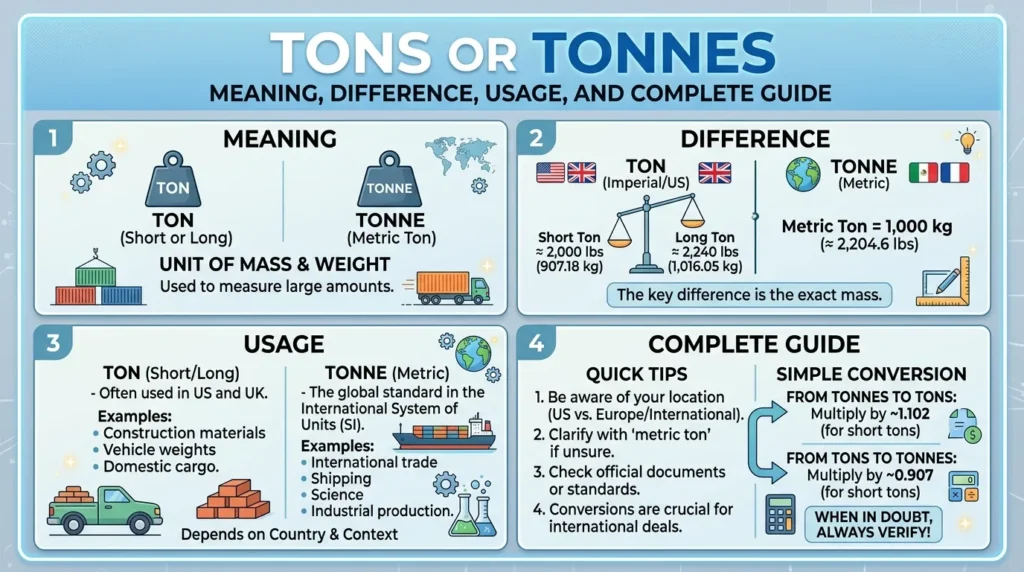
- 1 tonne = 1,000 kg (metric system)
- 1 US ton = 907 kg (short ton)
- 1 UK ton = 1,016 kg (long ton)
Examples:
- “The truck carries 5 tons of goods.” (US usage)
- “The shipment weighs 5 tonnes.” (International usage)
👉 They are similar but not identical.
The Origin of Tons or Tonnes
The word “ton” comes from the Old English word tun, meaning a large cask or barrel used for storage and transport. Over time, it became associated with weight measurement.
As measurement systems evolved, different regions developed their own versions:
- US ton (short ton) = 2,000 pounds
- UK ton (long ton) = 2,240 pounds
- Metric tonne = 1,000 kilograms
The spelling “tonne” was introduced to clearly represent the metric system and avoid confusion with imperial tons. It comes from the French word tonne, adopted when the metric system was standardized.
British English vs American English Spelling
The difference between “tons” and “tonnes” is mainly regional and system-based.
| Feature | British English | American English |
|---|---|---|
| Common unit | Tonne (metric), ton (imperial) | Ton (short ton) |
| Spelling | Tonne (metric system preferred) | Ton (standard usage) |
| Measurement system | Metric + imperial mix | Imperial system |
| Usage in trade | International shipping uses tonnes | Domestic trade uses tons |
👉 Conclusion: Britain uses both systems, but “tonne” is preferred in science and trade.
Which Spelling Should You Use?
Your choice depends on audience:
- US audience: Use tons (short ton system)
- UK/Commonwealth: Use tonnes for metric, tons for imperial contexts
- Global/scientific writing: Always use tonnes
- Engineering/science reports: Prefer tonnes for clarity
👉 Rule: Use tonnes for international clarity.
Common Mistakes with Tons or Tonnes
- ❌ Assuming tons and tonnes are exactly equal
- ❌ Mixing both units in the same report
- ❌ Using “tons” in scientific writing
- ❌ Not specifying US ton vs UK ton
✔ Correct:
- “The shipment weighs 10 tonnes.”
- “The truck carries 10 US tons of cargo.”
Tons or Tonnes in Everyday Examples
Shipping Reports
- “The vessel carries 50,000 tonnes of oil.”
News Articles
- “Floods displaced tons of soil and debris.” (informal)
Science & Engineering
- “CO₂ emissions reached 1.5 million tonnes.”
Business Emails
- “We exported 200 tonnes of wheat this quarter.”
Social Media
- “Tons of fun at the event!” (informal meaning, not weight)
Tons or Tonnes – Google Trends & Usage Data
📊 Usage patterns:
- “Tons”
- Most common in USA
- Used in informal speech and everyday language
- Appears in casual writing and news headlines
- “Tonnes”
- Dominant in Europe, Asia, Australia
- Used in science, engineering, and trade reports
- Preferred in international organizations
👉 Insight: “tonnes” dominates formal global usage, while “tons” dominates US casual usage.
Comparison Table: Tons vs Tonnes
| Feature | Tons | Tonnes |
|---|---|---|
| System | Imperial | Metric |
| Weight value | 907–1,016 kg (varies) | 1,000 kg |
| Usage | US, informal UK | Global standard |
| Precision | Less precise | More precise |
| Field use | Casual, transport | Science, trade |
FAQs About Tons or Tonnes
1. Are tons and tonnes the same?
No, they are different units with different weights.
2. What is 1 tonne equal to?
1 tonne = 1,000 kilograms.
3. Why does the US use tons instead of tonnes?
The US uses the imperial system instead of the metric system.
4. Which is more accurate, tons or tonnes?
Tonnes are more precise because they are metric-based.
5. Can I use tons and tonnes interchangeably?
No, it can cause confusion in technical writing.
6. What is the difference between US ton and UK ton?
US ton = 2,000 pounds; UK ton = 2,240 pounds.
7. Which should I use in international reports?
Use tonnes for global consistency.
Conclusion
The difference between “tons” and “tonnes” is small but very important in global communication. While both refer to units of mass, they belong to different measurement systems. “Ton” is part of the imperial system mainly used in the United States, while “tonne” is part of the metric system used worldwide in science, engineering, and international trade.
Understanding this difference helps avoid mistakes in shipping documents, academic writing, and business reports. Using the wrong unit can lead to confusion or incorrect data interpretation, especially in technical fields.
For beginners, the simplest rule is: use “tonnes” for international and scientific work, and use “tons” only when referring to US or informal contexts. Always check your audience before choosing the unit.
In today’s global world, where data is shared across countries, consistency is very important. Learning the correct usage of “tons” and “tonnes” ensures clear communication and professional accuracy in writing, engineering, and business documentation.