Have you ever wondered whether you should say Google or search when looking for information online? Many people use these words as if they mean the same thing. For example, someone might say, “Just Google it,” while another person says, “Search for it online.”
This confusion is common because Google is the world’s most popular search engine. Over time, the brand name Google became closely linked with the action of searching the internet. As a result, many people use “Google” as a verb even when they are not using the Google search engine itself.
Understanding the difference between Google and search is important for clear communication, professional writing, and SEO purposes. While one is a company and search engine, the other is a general action that can happen on any platform or website.
In this guide, you’ll learn the meaning of both terms, their history, spelling considerations, common mistakes, usage examples, popularity trends, and when each term is the better choice.
Google or Search – Quick Answer
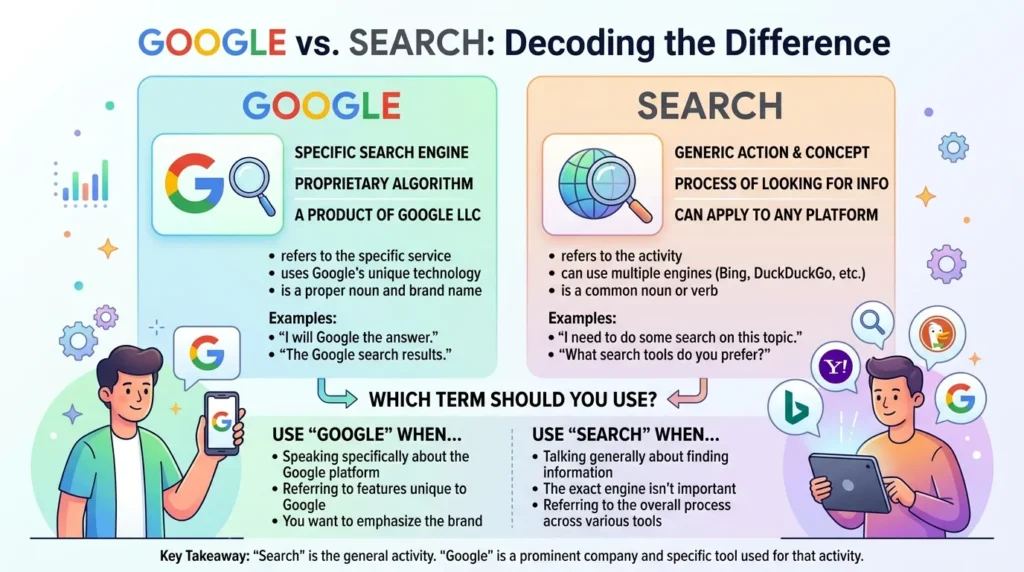
Google is a specific search engine and technology company.
Search is the general action of looking for information.
Examples
- “Google the restaurant before visiting.”
- “Search for nearby restaurants online.”
In simple terms:
| Term | Meaning |
|---|---|
| A specific search engine owned by Google | |
| Search | The act of looking for information |
The Origin of Google or Search
Origin of “Search”
The word search comes from the Old French word cerchier, meaning “to seek” or “to look for.”
For hundreds of years, people used “search” to describe finding information, objects, or answers.
Examples:
- Search for lost keys.
- Search a database.
- Search the internet.
Origin of “Google”
Google was founded in 1998 by Larry Page and Sergey Brin.
The name comes from the mathematical term googol, which means the number 1 followed by 100 zeros.
The founders chose the name to represent the vast amount of information available online.
Over time, “Google” became so popular that people started using it as a verb:
- Google it.
- I Googled the answer.
Why Differences Exist
Unlike spelling differences such as color and colour, Google and search are not spelling variations.
They represent:
- A brand name (Google)
- A general action (search)
British English vs American English Spelling
There is no spelling difference between Google and search in British and American English.
Both countries use the same spellings.
Comparison Table
| American English | British English | Meaning |
|---|---|---|
| Search engine | ||
| Search | Search | Looking for information |
| Google it | Google it | Use Google |
| Search online | Search online | Look for information |
Key Point
Unlike words such as:
| American | British |
|---|---|
| Color | Colour |
| Organize | Organise |
| Center | Centre |
Google and search remain identical worldwide.
Which Spelling Should You Use?
Since there is no spelling difference, the decision depends on context.
Use “Google” When:
- Referring to Google’s search engine
- Mentioning the company
- Giving casual instructions
Examples:
- Google the address.
- Google Maps can help.
Use “Search” When:
- Writing professionally
- Referring to any search engine
- Discussing information retrieval generally
Examples:
- Search online for reviews.
- Search the database for records.
Audience-Based Advice
| Audience | Recommended Term |
|---|---|
| USA Readers | Google or Search |
| UK Readers | Google or Search |
| Australia | Google or Search |
| Business Writing | Search |
| Academic Writing | Search |
| Casual Conversation |
Common Mistakes with Google or Search
Many people misuse these terms.
Mistake 1
❌ Google means every search engine.
✅ Google is one search engine.
Mistake 2
❌ Google is always appropriate in formal writing.
✅ Search is often better in professional documents.
Mistake 3
❌ Search only refers to internet use.
✅ Search can mean looking for anything.
Mistake 4
❌ Every online search is a Google search.
✅ Searches can happen on Bing, Yahoo, DuckDuckGo, and other platforms.
Google or Search in Everyday Examples
Emails
- Please search the company website for the report.
- You can Google the supplier’s contact details.
News Articles
- Users search for breaking news daily.
- Google announced a new feature.
Social Media
- Just Google it.
- Search this hashtag for updates.
Business Writing
- Employees should search the internal database.
- Customers can search our website for products.
Academic Writing
- Researchers search scientific databases.
- Avoid using Google as a generic term.
Google or Search – Google Trends & Usage Data
Google is the dominant search engine in many countries.
Popularity by Context
| Context | Most Common Term |
|---|---|
| Casual Conversation | |
| Online Searches | Search |
| Academic Writing | Search |
| Business Communication | Search |
| Social Media |
Popularity by Country
| Country | Common Usage |
|---|---|
| United States | |
| Canada | |
| United Kingdom | |
| Australia | |
| India |
The phrase “Google it” is extremely popular because of Google’s strong market presence worldwide.
Comparison Table: Google vs Search
| Feature | Search | |
|---|---|---|
| Type | Brand | Action |
| Meaning | Search Engine | Looking for Information |
| Formal Writing | Less Common | Preferred |
| Casual Speech | Very Common | Common |
| Academic Use | Limited | Recommended |
| Business Use | Limited | Recommended |
| Global Recognition | Very High | Very High |
Frequently Asked Questions (FAQs)
1. Is Google the same as search?
No. Google is a search engine, while search is the action of finding information.
2. Can I use Google as a verb?
Yes. Many people say “Google it” when searching online.
3. Which term is better for professional writing?
Search is generally preferred in professional and academic writing.
4. Is Google a dictionary word?
Yes. Many dictionaries recognize Google as a verb meaning to search online.
5. Does search only mean internet searches?
No. Search can mean looking for anything, including objects, records, or information.
6. Why do people say “Google it”?
Google became the most popular search engine, causing its name to become associated with online searching.
7. Should businesses use Google or search?
Businesses usually use search in formal content because it is more neutral and professional.
Conclusion
The difference between Google and search is simple but important. Google is a specific company and search engine, while search is the general act of looking for information. Although many people use the terms interchangeably in everyday conversation, they are not exactly the same. Saying “Google it” is common in casual speech because Google dominates the search engine market worldwide. However, in professional, academic, and business writing, the word “search” is often the better choice because it is more accurate and platform-neutral.
There are no British or American spelling differences between these terms, making them easy to use globally. Understanding the distinction helps improve communication, writing quality, and SEO accuracy. Whether you choose Google or search depends on your audience and purpose. For casual conversations, Google works well. For formal writing and broader communication, search remains the preferred option.