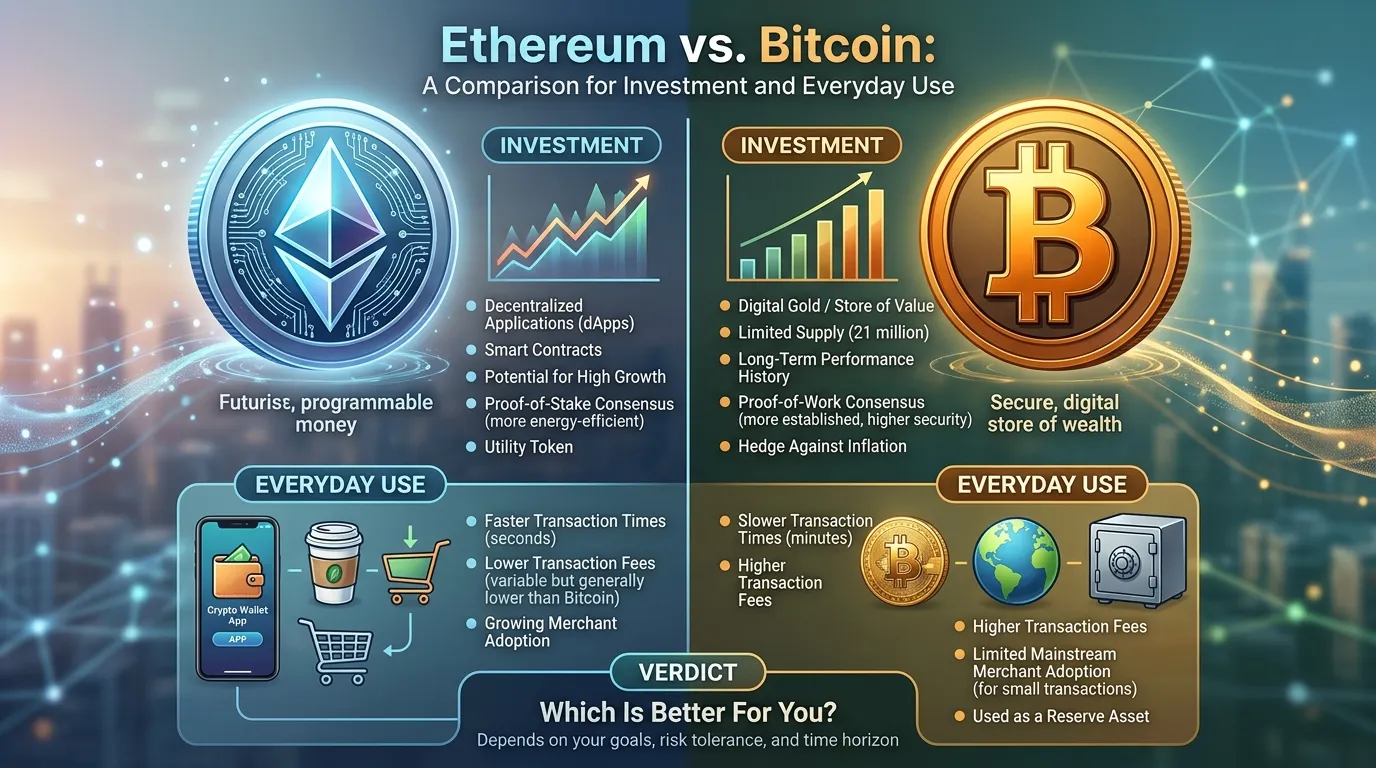
If you’re new to cryptocurrency, one of the first questions you’ll probably ask is: Ethereum or Bitcoin—which one is better? Both are among the world’s most popular cryptocurrencies, but they were created for different purposes. Bitcoin is often called “digital gold” because it was designed as a decentralized digital currency and store of value. Ethereum, on the other hand, is a blockchain platform that supports smart contracts and decentralized applications (dApps), making it much more than just a digital currency.
People search for “Ethereum or Bitcoin” because they want to understand the differences before investing, trading, or using cryptocurrency. While both use blockchain technology, they differ in speed, functionality, transaction fees, and long-term goals. Choosing between them depends on your investment strategy and how you plan to use cryptocurrency.
This guide explains Bitcoin and Ethereum in simple language, compares their features, advantages, disadvantages, use cases, and investment potential, helping beginners and experienced users make informed decisions.
Ethereum or Bitcoin – Quick Answer
Bitcoin (BTC) is primarily designed as a decentralized digital currency and store of value.
Ethereum (ETH) is a blockchain platform that enables smart contracts, decentralized applications (dApps), and its own cryptocurrency called Ether.
Quick Examples
- Want digital gold or long-term value storage? → Bitcoin
- Want smart contracts, NFTs, or decentralized finance (DeFi)? → Ethereum
Quick Comparison
| Feature | Bitcoin | Ethereum |
|---|---|---|
| Main Purpose | Digital currency | Smart contract platform |
| Cryptocurrency | BTC | ETH |
| Smart Contracts | No | Yes |
| NFTs | Limited | Yes |
| DeFi Support | Limited | Extensive |
| Best For | Store of value | Blockchain applications |
What Is Bitcoin?
Bitcoin is the world’s first cryptocurrency. It was introduced in 2009 by an unknown person or group using the name Satoshi Nakamoto.
Bitcoin allows people to send and receive digital money without banks or other financial institutions. Transactions are verified by a decentralized network of computers using blockchain technology.
Key Features
- Decentralized
- Limited supply of 21 million coins
- Strong security
- Widely accepted
- Store of value
What Is Ethereum?
Ethereum was launched in 2015 by Vitalik Buterin and other developers.
Unlike Bitcoin, Ethereum is more than a cryptocurrency. It is a blockchain platform where developers can build decentralized applications (dApps) and execute smart contracts.
Its native cryptocurrency is called Ether (ETH).
Key Features
- Smart contracts
- Decentralized applications
- NFT support
- DeFi ecosystem
- Programmable blockchain
Ethereum vs Bitcoin: Key Differences
| Feature | Bitcoin | Ethereum |
|---|---|---|
| Launch Year | 2009 | 2015 |
| Founder | Satoshi Nakamoto | Vitalik Buterin |
| Currency Symbol | BTC | ETH |
| Primary Purpose | Digital money | Smart contract platform |
| Smart Contracts | No | Yes |
| NFTs | No | Yes |
| Supply Limit | 21 Million | No fixed maximum supply |
| Block Time | About 10 minutes | About 12 seconds |
| Typical Use | Payments, investment | Apps, NFTs, DeFi |
Ethereum or Bitcoin for Investment
Many investors compare Ethereum and Bitcoin when building a cryptocurrency portfolio.
Bitcoin
Bitcoin is often viewed as a long-term investment because of its limited supply and widespread recognition.
Potential benefits include:
- Strong brand recognition
- Limited supply
- Broad institutional interest
Ethereum
Ethereum attracts investors interested in blockchain innovation and decentralized applications.
Potential benefits include:
- Smart contract ecosystem
- Growing developer community
- Expanding DeFi and NFT markets
Remember that cryptocurrency prices can be highly volatile, and no investment is guaranteed to increase in value.
Ethereum or Bitcoin for Beginners
If you’re new to cryptocurrency, both Bitcoin and Ethereum are widely available on major exchanges.
Bitcoin May Be Better If You Want
- A simple digital asset
- Long-term holding
- Easy understanding
- Broad market acceptance
Ethereum May Be Better If You Want
- Learn blockchain technology
- Explore NFTs
- Use decentralized finance (DeFi)
- Interact with decentralized applications
Ethereum or Bitcoin for Payments
Bitcoin
- Accepted by many merchants
- Often used for larger transactions
- Network fees can vary
Ethereum
- Supports payments and blockchain applications
- Transaction fees depend on network activity
- Commonly used within decentralized ecosystems
Advantages and Disadvantages
Bitcoin Advantages
- High security
- Limited supply
- Strong market recognition
- Widely accepted
Bitcoin Disadvantages
- Slower transactions than some newer blockchains
- Limited functionality beyond payments
- Energy-intensive mining model
Ethereum Advantages
- Smart contracts
- Large developer community
- Supports NFTs and DeFi
- Fast block creation
Ethereum Disadvantages
- Network congestion during busy periods
- Transaction fees can increase
- More complex for beginners
Common Mistakes
Thinking Bitcoin and Ethereum Are the Same
They use blockchain technology but serve different purposes.
Assuming Ethereum Is Only a Cryptocurrency
Ethereum is also a programmable blockchain platform.
Ignoring Transaction Fees
Both networks may have transaction fees that vary depending on network demand.
Believing Cryptocurrency Investments Are Risk-Free
Cryptocurrency prices can change significantly over short periods.
Ethereum or Bitcoin in Everyday Examples
Investing
Many investors hold Bitcoin for long-term value while using Ethereum for exposure to blockchain innovation.
Online Payments
Some businesses accept Bitcoin and Ethereum as payment for goods and services.
NFTs
Ethereum is commonly used for buying and selling NFTs.
Decentralized Finance
Ethereum powers many lending, borrowing, and trading platforms through smart contracts.
Business
Companies may use Ethereum-based applications for supply chain management and digital identity solutions.
Ethereum or Bitcoin – Google Trends & Usage Data
Search interest in “Ethereum or Bitcoin” remains high because both cryptocurrencies play major roles in the digital asset market.
People commonly search this keyword when they:
- Start investing
- Learn cryptocurrency
- Compare blockchain platforms
- Explore NFTs
- Study decentralized finance (DeFi)
Countries with high search interest often include:
- United States
- United Kingdom
- Canada
- India
- Australia
- Germany
Interest tends to increase during periods of significant cryptocurrency price movements or major blockchain developments.
Ethereum vs Bitcoin Comparison Table
| Feature | Bitcoin | Ethereum |
|---|---|---|
| Digital Currency | Yes | Yes |
| Smart Contracts | No | Yes |
| NFTs | Limited | Yes |
| DeFi | Limited | Extensive |
| Blockchain Platform | Basic | Advanced |
| Supply Limit | Fixed | Dynamic |
| Common Investment | Yes | Yes |
| Store of Value | Strong | Moderate |
| Developer Ecosystem | Smaller | Larger |
Frequently Asked Questions
1. Is Ethereum better than Bitcoin?
Neither is universally better. Bitcoin is widely viewed as a store of value, while Ethereum offers additional functionality through smart contracts and decentralized applications.
2. Which cryptocurrency is safer?
Both use strong blockchain security, but each has different technical designs and risks.
3. Can I invest in both?
Yes. Many investors diversify by holding both Bitcoin and Ethereum.
4. Which has lower transaction fees?
Transaction fees vary depending on network activity and can change over time for both cryptocurrencies.
5. Is Ethereum replacing Bitcoin?
No. They serve different purposes and continue to coexist within the cryptocurrency ecosystem.
6. Which cryptocurrency is better for beginners?
Bitcoin is often considered easier to understand, while Ethereum offers more features for users interested in blockchain applications.
7. Should I choose Bitcoin or Ethereum?
Your choice depends on your financial goals, risk tolerance, and intended use. Consider researching carefully before making investment decisions.
Conclusion
Choosing between Ethereum or Bitcoin depends on your goals and how you plan to use cryptocurrency. Bitcoin was created as a decentralized digital currency and is widely regarded as a store of value due to its limited supply and strong market recognition. Ethereum, in contrast, offers a flexible blockchain platform that powers smart contracts, decentralized applications, NFTs, and decentralized finance. While both cryptocurrencies have transformed the digital asset industry, they serve different purposes and appeal to different users. Before investing, take time to understand how each network works, the risks involved, and how cryptocurrency fits into your overall financial strategy. Careful research and informed decision-making are essential when exploring any digital asset.