Have you noticed a small bump or dark spot on your skin and wondered whether it is a mole or wart? You are not alone. Many people search for this question because moles and warts can look similar at first, but they are very different skin conditions. Knowing the difference is important because the cause, treatment, and health risks are not the same.
A mole is usually a natural skin growth made of pigment-producing cells. Most moles are harmless and stay the same for many years. A wart, however, is a rough skin growth caused by the human papillomavirus (HPV). Warts can spread from one area of the body to another or even from person to person.
This guide explains the difference between a mole or wart using simple language. You’ll learn how to identify each one, understand their causes, compare their appearance, know when to see a doctor, and avoid common mistakes. By the end, you’ll have a clear answer to the question: Is it a mole or a wart?
Mole or Wart – Quick Answer
Quick Answer:
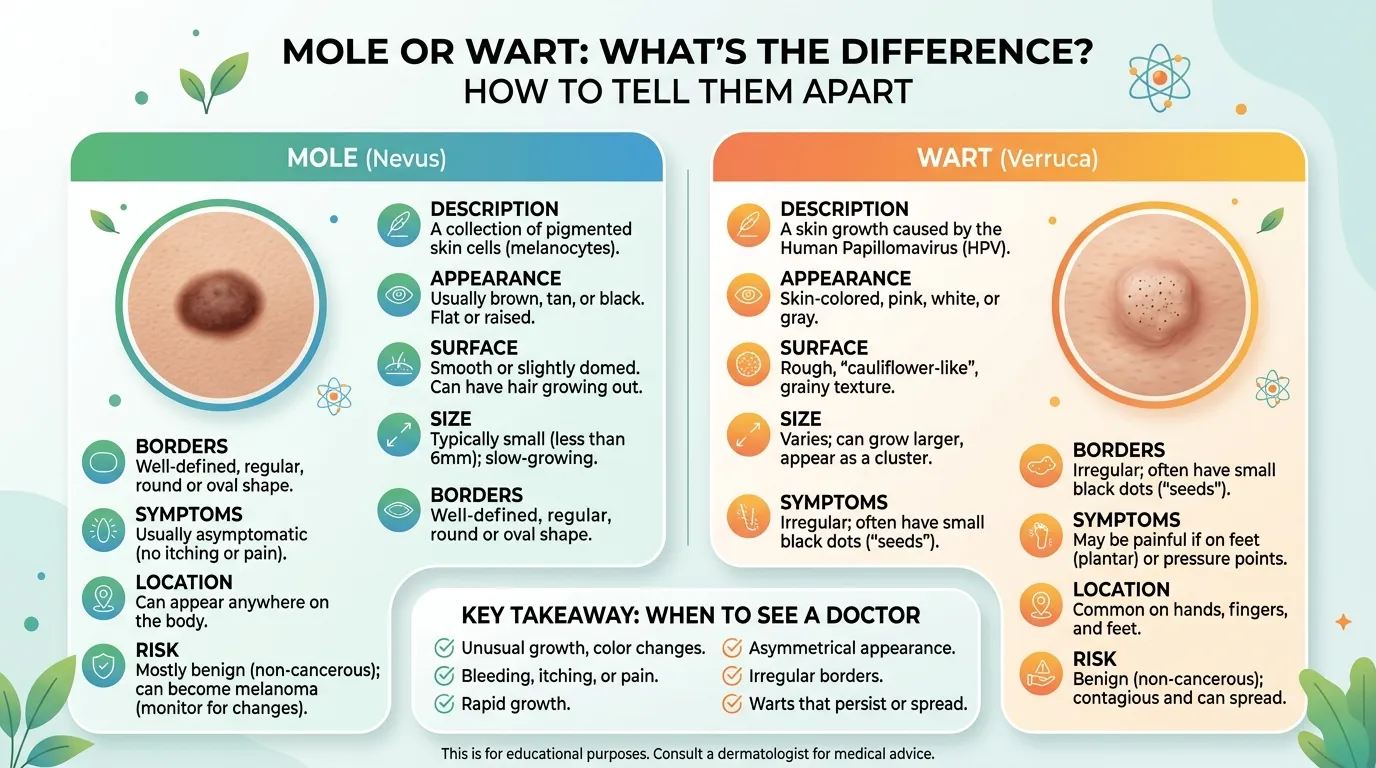
A mole is usually a flat or raised pigmented skin spot that develops naturally.
A wart is a rough skin growth caused by a viral infection (HPV).
Simple Examples
Mole
- Usually brown, black, or skin-colored
- Smooth or slightly raised
- Does not spread by touch
- Often appears during childhood or early adulthood
Wart
- Rough surface
- Often skin-colored
- Caused by HPV
- Can spread to other parts of the body
If a skin growth changes in size, shape, or color, or starts bleeding, it should be examined by a healthcare professional.
The Origin of “Mole” and “Wart”
The words mole and wart have different histories because they describe different skin conditions.
Origin of “Mole”
The English word mole comes from the Middle English word mol, meaning a small spot or mark on the skin.
Today, doctors use mole to describe a melanocytic nevus, a common collection of pigment-producing skin cells.
Origin of “Wart”
The word wart comes from the Old English word wearte, meaning a small rough growth on the skin.
Modern medicine defines a wart as a skin growth caused by infection with certain types of human papillomavirus (HPV).
Why the Confusion?
People often confuse moles and warts because both appear as small bumps on the skin. However, they have different causes and usually look different when examined closely.
British English vs American English Spelling
Unlike many English words, mole and wart are spelled the same in both British and American English.
| Meaning | British English | American English |
|---|---|---|
| Mole | Mole | Mole |
| Wart | Wart | Wart |
| Spelling Difference | None | None |
Example
British English:
She has a small mole on her arm.
American English:
She has a small mole on her arm.
The spelling does not change between regions.
Which Spelling Should You Use?
There are no spelling differences between American and British English.
United States
Use:
- Mole
- Wart
United Kingdom
Use:
- Mole
- Wart
Australia, Canada, and Other English-Speaking Countries
The same spellings apply:
- Mole
- Wart
No alternative spellings are considered standard English.
Common Mistakes with Mole or Wart
People often make incorrect assumptions about these skin conditions.
Mistake 1
❌ Every raised bump is a wart.
✅ Many raised bumps are harmless moles or other skin growths.
Mistake 2
❌ Every dark spot is a mole.
✅ Some dark spots may be freckles, age spots, or other skin conditions.
Mistake 3
❌ Warts always hurt.
✅ Many warts are painless unless they are located on pressure points, such as the soles of the feet.
Mistake 4
❌ Moles are contagious.
✅ Moles are not contagious.
Mistake 5
❌ Warts cannot spread.
✅ Warts can spread because they are caused by HPV.
Mole or Wart in Everyday Examples
I noticed a new skin growth. Could you tell me if it looks more like a mole or a wart?
News
Doctors encourage people to check unusual moles for early signs of skin cancer.
Social Media
Not every skin bump is a wart. Learn the difference between a mole and a wart.
Medical Report
The examination showed a harmless mole with no concerning changes.
Conversation
I thought it was a wart, but my doctor said it was only a mole.
Mole or Wart – Google Trends & Usage Data
Searches for mole or wart remain popular throughout the year because many people notice new skin spots and want to identify them before visiting a doctor.
Countries with High Search Interest
- United States
- United Kingdom
- Canada
- Australia
- India
- Pakistan
Most searches come from people who notice:
- New skin bumps
- Dark skin spots
- Rough skin growths
- Changes in existing moles
Many users are looking for quick information to decide whether they should seek medical advice.
Comparison Table
| Feature | Mole | Wart |
|---|---|---|
| Cause | Pigment cells (melanocytes) | Human papillomavirus (HPV) |
| Color | Brown, black, or skin-colored | Usually skin-colored or slightly darker |
| Texture | Smooth or slightly raised | Rough and grainy |
| Contagious | No | Yes |
| Can Spread | Usually no | Yes |
| Typical Appearance | Round or oval | Irregular rough bump |
| Medical Concern | Monitor for changes | Usually harmless but may require treatment |
Frequently Asked Questions (FAQs)
Is a mole the same as a wart?
No. A mole is made of pigment-producing skin cells, while a wart is caused by a viral infection.
How can I tell if I have a mole or a wart?
Moles are often smooth, evenly colored, and stable over time. Warts usually have a rough surface and may spread.
Can a mole become a wart?
No. They are different skin conditions with different causes.
Are moles dangerous?
Most moles are harmless. However, if a mole changes in color, shape, size, or begins to bleed or itch, it should be examined by a healthcare professional.
Are warts contagious?
Yes. Warts are caused by HPV and can spread through direct skin contact or contaminated surfaces.
Should I remove a mole at home?
No. Removing a mole yourself is not recommended. A healthcare professional can determine whether it is safe to remove and whether it should be examined.
When should I see a doctor?
You should seek medical advice if a skin growth:
- Changes in size, shape, or color
- Bleeds or does not heal
- Becomes painful
- Grows quickly
- Causes concern because it looks unusual
Conclusion
Understanding the difference between a mole or wart can help you make better decisions about your skin health. A mole is usually a harmless collection of pigment cells that develops naturally, while a wart is a rough skin growth caused by the human papillomavirus (HPV). Although they may sometimes look similar, they differ in their cause, appearance, and treatment. Moles are not contagious, but warts can spread through direct contact. Most moles and warts are harmless, but any skin growth that changes in size, color, shape, or begins to bleed should be checked by a qualified healthcare professional. Instead of guessing, it is always safer to have unusual skin changes evaluated, especially if they continue to grow or look different from your other spots. Knowing the key differences between a mole and a wart can help you recognize normal skin changes and understand when professional medical advice is needed.