Have you ever typed “leed or lead” into Google because you were unsure which spelling is correct? You’re not alone. Thousands of people search for this question every month while writing emails, school assignments, business documents, resumes, or social media posts. At first glance, both words may seem similar because they sound alike in some situations. However, they have very different meanings.
The confusion usually happens because lead has multiple pronunciations and meanings. It can be a verb that means “to guide,” a noun referring to someone in front, or even the name of a metal. On the other hand, leed is generally not a standard English word. It appears only in a few proper names, place names, or as a misspelling of lead.
This guide explains the difference between leed or lead in simple English. You’ll learn which spelling is correct, where each word comes from, how to use lead correctly in American and British English, common mistakes to avoid, and practical examples you can use in everyday writing.
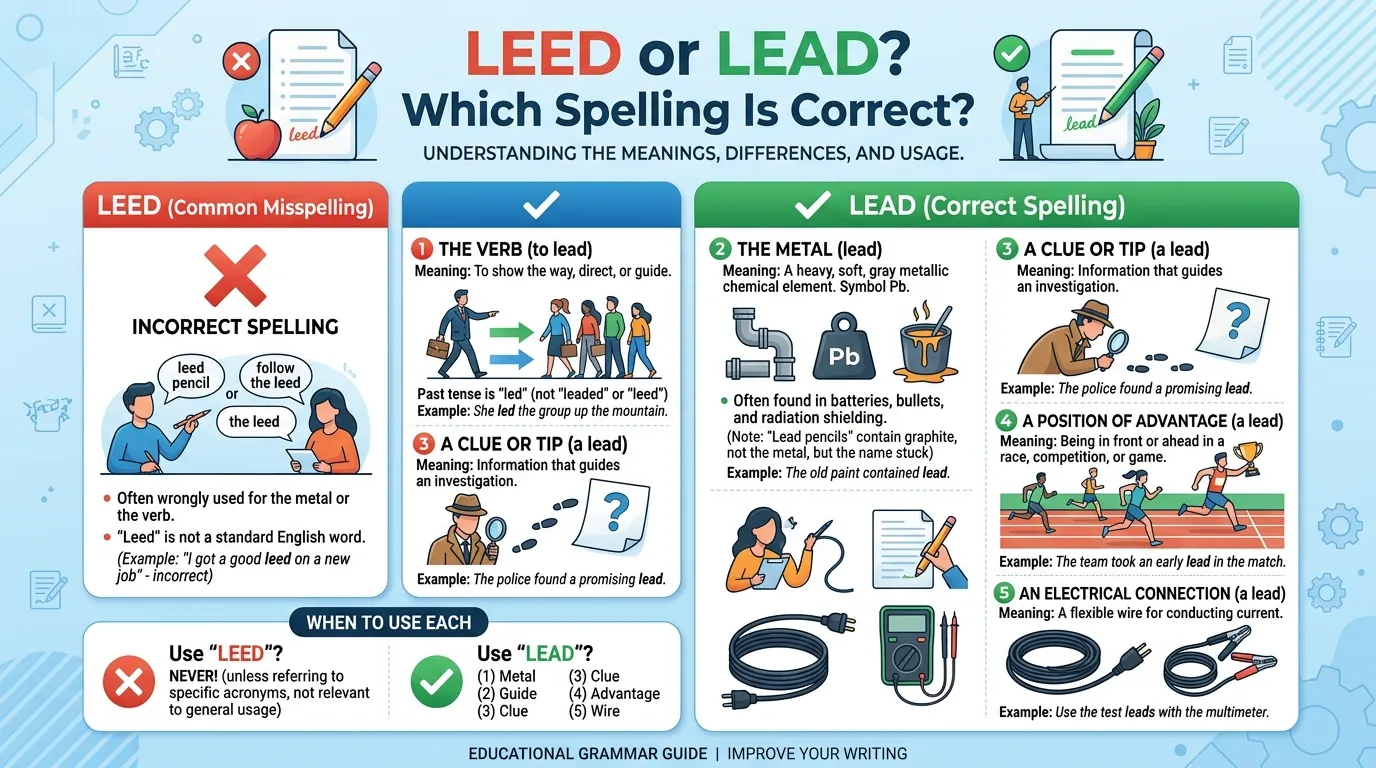
Leed or Lead – Quick Answer
Quick Answer: Lead is the correct English word in almost every situation.
Leed is not a standard English spelling and is usually a typo or misspelling.
Correct Examples
- She will lead the meeting tomorrow.
- Good leaders lead by example.
- The company has taken the lead in innovation.
- The pipe is made of lead metal.
Incorrect Example
- ❌ She will leed the meeting tomorrow.
Unless you are referring to a person’s name, surname, or a specific place called “Leed,” you should always use lead.
The Origin of Lead
The word lead has a long history dating back to Old English.
As a Verb
The verb lead comes from the Old English word lædan, which means:
- To guide
- To show the way
- To bring someone somewhere
For hundreds of years, English speakers have used lead to describe guiding people, managing teams, or being first.
Examples:
- Lead a project
- Lead a company
- Lead a team
- Lead a discussion
As a Noun
The noun lead has two different meanings.
It can refer to:
- A person or team that is ahead.
- An advantage over others.
Example:
- Our team has a five-point lead.
As a Metal
Lead is also the name of a heavy metal (chemical symbol Pb).
Example:
- Older buildings sometimes contain lead pipes.
Why Does “Leed” Exist?
The spelling leed does not come from standard English.
It usually appears because:
- People spell lead the way it sounds.
- They confuse it with words like need, feed, or seed.
- It is used as a surname, company name, or place name.
For normal English writing, lead is always correct.
British English vs American English Spelling
Unlike many English words, lead has the same spelling in both British English and American English.
The only difference is pronunciation depending on the meaning.
| Meaning | British English | American English |
|---|---|---|
| Guide someone | Lead | Lead |
| Be in front | Lead | Lead |
| Heavy metal | Lead | Lead |
| Correct spelling | ✅ Lead | ✅ Lead |
| Leed | ❌ Incorrect | ❌ Incorrect |
Pronunciation Difference
Interestingly, lead changes pronunciation depending on its meaning.
| Word | Pronunciation | Meaning |
|---|---|---|
| Lead (verb) | LEED | To guide |
| Lead (metal) | LED | Heavy metal |
This pronunciation difference is one of the main reasons people mistakenly search for “leed or lead.”
Which Spelling Should You Use?
For almost every situation, choose lead.
If Your Audience Is American
Always write:
- Lead
Examples:
- Lead engineer
- Lead developer
- Team lead
If Your Audience Is British
Also use:
- Lead
Examples:
- Lead architect
- Lead designer
- Lead investigator
If Your Audience Is Global
The safest and correct spelling remains:
- Lead
Never replace it with leed unless it is someone’s official name.
Common Mistakes with Leed or Lead
Many writers make similar mistakes when using this word.
Mistake 1
❌ I will leed the meeting.
✅ I will lead the meeting.
Mistake 2
❌ She is our leed engineer.
✅ She is our lead engineer.
Mistake 3
❌ The company is the market leed.
✅ The company is the market leader.
Mistake 4
❌ He took the leed in sales.
✅ He took the lead in sales.
Mistake 5
❌ Leed by example.
✅ Lead by example.
Leed or Lead in Everyday Examples
Understanding how lead is used in real life makes it easier to remember.
Correct:
Please lead tomorrow’s client meeting.
Business
Correct:
Sarah is the lead project manager.
News
Correct:
The team took the lead during the second half.
Social Media
Correct:
Great leaders lead with honesty.
Education
Correct:
The teacher asked one student to lead the discussion.
Formal Writing
Correct:
The research team will lead the investigation.
Leed or Lead – Google Trends & Usage Data
Search interest for “leed or lead” remains steady because many English learners and native speakers become confused by pronunciation rather than spelling.
Countries Where This Question Is Common
- United States
- United Kingdom
- Canada
- Australia
- India
- Pakistan
- Philippines
Most searches come from students, professionals, job seekers, and people writing business documents.
The majority of users are trying to confirm that lead is the correct spelling before submitting important work.
Comparison Table
| Word | Correct? | Meaning | Example |
|---|---|---|---|
| Lead | ✅ Yes | Guide someone | Lead the team |
| Lead | ✅ Yes | Be ahead | Take the lead |
| Lead | ✅ Yes | Heavy metal | Lead pipe |
| Leed | ❌ Usually No | Misspelling or proper name | Not standard English |
Frequently Asked Questions (FAQs)
Is it lead or leed?
Lead is correct in standard English. Leed is generally a misspelling unless it is a proper name.
Why is lead pronounced like “leed”?
When used as a verb meaning “to guide,” lead is pronounced LEED.
Why is lead metal pronounced “led”?
English has many words with historical pronunciation changes. The metal lead is pronounced LED, while the verb is pronounced LEED.
Is leed ever correct?
Only as a person’s name, business name, or place name. It is not the standard English word for guiding someone.
How do I remember the correct spelling?
Always write lead.
Remember:
- Lead (verb) = pronounced LEED.
- Lead (metal) = pronounced LED.
The spelling never changes.
Is lead correct in both British and American English?
Yes. Both British and American English use the spelling lead.
Why do people search for “leed or lead”?
Most people hear the pronunciation LEED and assume the spelling should also be leed, but English spelling follows historical rules rather than pronunciation alone.
Conclusion
The confusion between leed or lead is common, but the answer is simple. In standard English, lead is the correct spelling whether you mean to guide someone, describe a person or team that is ahead, or refer to the heavy metal. The spelling leed is not accepted in normal English writing and is usually a typing mistake or an incorrect guess based on pronunciation. The only exceptions are proper names, surnames, or business names that intentionally use “Leed.” Understanding that lead can have two different pronunciations—LEED for the verb and LED for the metal—helps explain why many people become confused. When writing emails, reports, academic papers, business documents, or social media posts, always choose lead unless you are referring to a specific name. Following this simple rule will help your writing look professional, accurate, and grammatically correct.