Nouns are one of the most important parts of English grammar, but not all nouns work in the same way. Types of nouns help us understand how words name people, places, things, animals, ideas, groups, and substances.
A word like teacher names a person, while London names a specific place. Happiness names a feeling, and team names a group. Although all of these words are nouns, they belong to different categories.
People often search for “Types of Nouns” because they want to understand these categories for school, exams, writing, or English learning. The topic can feel confusing because different grammar books may group nouns in slightly different ways.
The good news is that the main types are easy to learn when you use clear examples. In this guide, we will explain the most common types of nouns, how they differ, where they are used, and how to identify them in sentences.
By the end, you will be able to recognize common noun types and use them correctly in everyday English.
Types of Nouns – Quick Answer
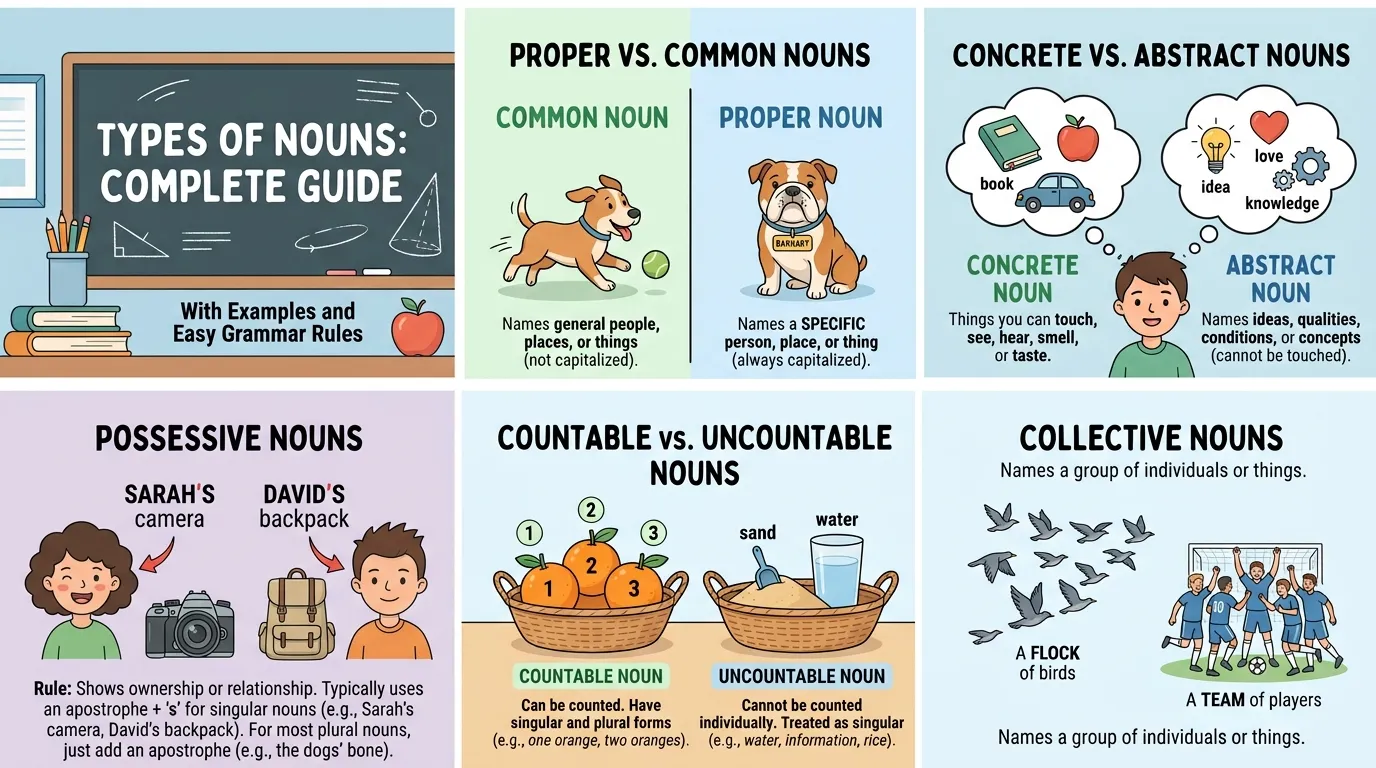
Types of nouns are categories used to describe how nouns name people, places, things, animals, ideas, groups, or substances.
The main types include:
- Common Nouns – general names
teacher, city, book - Proper Nouns – specific names
Ahmed, London, Monday - Concrete Nouns – things we can experience with our senses
table, apple, dog - Abstract Nouns – ideas, feelings, or qualities
love, honesty, happiness - Collective Nouns – names for groups
team, family, crowd - Countable Nouns – things that can be counted
one book, two books - Uncountable Nouns – substances or ideas not normally counted individually
water, rice, information
Simple Example
Sarah bought three books for her class.
- Sarah = proper noun
- books = countable noun
- class = collective noun
Some nouns can belong to more than one category.
The Origin of Types of Nouns
The word noun comes from the Latin nomen, meaning “name.” The idea behind a noun is simple: it gives a name to something.
As grammar developed, teachers and scholars began grouping nouns according to their meaning and function. This helped students understand how different nouns behave in sentences.
The categories used today are based on several features. For example, we can ask whether a noun is:
- General or specific
- Physical or abstract
- Singular or plural
- Countable or uncountable
- A single item or a group
This is why a single noun can sometimes fit into more than one category.
For example:
London is a city.
“London” is a proper noun because it is a specific name. It is also a concrete noun because it refers to a real place.
Why Noun Categories Matter
Knowing noun types makes it easier to:
- Build correct sentences
- Use capital letters correctly
- Form plurals
- Choose articles such as a and an
- Understand countable and uncountable nouns
- Improve writing and speaking
Common Nouns
A common noun gives a general name to a person, place, animal, thing, or idea.
Examples include:
- teacher
- student
- city
- country
- car
- school
- river
- dog
Examples in Sentences
The teacher entered the room.
I bought a new car.
The dog is sleeping.
Common nouns usually do not begin with a capital letter unless they appear at the beginning of a sentence.
Common Noun vs Proper Noun
Compare:
I visited a city.
I visited Paris.
“City” is a common noun because it is a general name.
“Paris” is a proper noun because it identifies one specific city.
Proper Nouns
A proper noun names a specific person, place, organization, day, month, or other unique entity.
Examples include:
- Ahmed
- Sarah
- Pakistan
- London
- Monday
- January
- Asia
Proper nouns normally begin with a capital letter.
Examples
Ali lives in Pakistan.
We visited London in July.
Monday is my first working day.
Common and Proper Nouns Table
| Common Noun | Proper Noun |
|---|---|
| city | London |
| country | Canada |
| person | Ahmed |
| river | Nile |
| company | |
| month | January |
| day | Monday |
Concrete Nouns
A concrete noun names something that can be experienced through one or more of the five senses.
The five senses are:
- Sight
- Hearing
- Touch
- Taste
- Smell
Examples of concrete nouns include:
- apple
- phone
- house
- dog
- chair
- music
- flower
Examples
The apple is red.
I heard music.
She touched the table.
Concrete nouns do not have to be objects that you can touch. For example, music is a concrete noun because you can hear it.
Abstract Nouns
An abstract noun names an idea, feeling, quality, condition, or concept.
Examples include:
- love
- happiness
- honesty
- freedom
- courage
- wisdom
- beauty
- knowledge
You cannot normally see or touch these things as physical objects.
Examples
Honesty is important.
Everyone wants happiness.
Courage helps people face difficult situations.
Concrete vs Abstract Nouns
| Concrete Noun | Abstract Noun |
|---|---|
| book | knowledge |
| flower | beauty |
| person | kindness |
| house | safety |
| food | hunger |
A useful test is to ask:
Can I experience this as a physical thing through my senses?
If not, it may be an abstract noun.
Collective Nouns
A collective noun refers to a group of people, animals, or things as one unit.
Common examples include:
- team
- family
- class
- crowd
- committee
- audience
- army
- flock
- herd
Examples
The team won the match.
The family went on vacation.
A flock of birds flew over the house.
Common Collective Nouns
| Group | Collective Noun |
|---|---|
| Players | Team |
| Students | Class |
| Birds | Flock |
| Cattle | Herd |
| Soldiers | Army |
| People watching a show | Audience |
| People in a meeting | Committee |
Collective nouns are useful because they let us talk about a group without naming every individual member.
Countable Nouns
A countable noun refers to something that can be counted as individual units.
Examples:
- one book
- two books
- three cars
- four students
- five apples
Countable nouns can usually have both singular and plural forms.
Examples
I have one book.
She has three books.
There are five students in the room.
We can use numbers with countable nouns.
Common Countable Nouns
- chair
- computer
- phone
- house
- student
- car
- apple
- pen
Uncountable Nouns
An uncountable noun refers to something that we usually do not count as separate individual units.
Examples include:
- water
- milk
- rice
- sugar
- information
- advice
- furniture
- knowledge
Examples
I need some water.
She gave me useful advice.
We need more information.
We normally do not say:
two advices
Instead, say:
two pieces of advice
Similarly:
a piece of information
Countable vs Uncountable Nouns
| Countable | Uncountable |
|---|---|
| book | information |
| apple | water |
| chair | furniture |
| student | knowledge |
| car | rice |
| idea | advice |
Compound Nouns
A compound noun is made from two or more words that work together as one noun.
Examples:
- toothpaste
- football
- bedroom
- bus stop
- swimming pool
- school bus
- mother-in-law
Compound nouns can be written in different ways:
One Word
toothbrush
Two Words
bus stop
Hyphenated
mother-in-law
Examples in Sentences
I missed the bus stop.
My toothbrush is new.
She visited the swimming pool.
Possessive Nouns
A possessive noun shows ownership or a relationship.
Examples:
Ahmed’s car
Sarah’s book
The dog’s tail
For a singular noun, we usually add ‘s.
Examples
This is John’s phone.
That is the teacher’s desk.
For many plural nouns ending in s, we normally add only an apostrophe.
The students’ books are on the table.
The books belong to the students.
Singular and Plural Nouns
Nouns can also be classified by number.
Singular Nouns
A singular noun refers to one person, place, animal, thing, or idea.
Examples:
- book
- student
- car
- dog
The student is reading.
Plural Nouns
A plural noun refers to more than one.
Examples:
- books
- students
- cars
- dogs
The students are reading.
Most regular nouns form plurals by adding -s or -es.
Some have irregular forms:
- child → children
- man → men
- woman → women
- foot → feet
- tooth → teeth
- mouse → mice
British English vs American English Spelling
The spelling of most noun types is the same in British and American English.
For example:
- noun
- proper noun
- common noun
- collective noun
- abstract noun
- concrete noun
However, some individual nouns may have different spellings in British and American English.
Comparison Table
| Meaning | British English | American English |
|---|---|---|
| Colour | colour | color |
| Centre | centre | center |
| Organisation | organisation | organization |
| Travelling | travelling | traveling |
| Programme | programme | program |
These spelling differences do not change the basic types of nouns.
Example
British English:
The organisation opened a new centre.
American English:
The organization opened a new center.
The spelling changes, but both words remain nouns.
Which Spelling Should You Use?
There is no single “better” variety of English. Choose the style that matches your readers.
For US Readers
Use American English spelling if your website, school, business, or publication targets the United States.
Examples:
- color
- center
- organization
For UK Readers
Use British English spelling for a UK-focused audience.
Examples:
- colour
- centre
- organisation
For Commonwealth Readers
Countries such as Australia and New Zealand generally follow British-based spelling conventions, although local usage can vary.
For Global Readers
The most important thing is consistency. Do not switch between British and American spelling without a reason.
Common Mistakes With Types of Nouns
Mistake 1: Confusing Common and Proper Nouns
Incorrect:
I live in london.
Correct:
I live in London.
“London” is a proper noun and needs a capital letter.
Mistake 2: Calling Every Physical Thing a Proper Noun
Incorrect idea:
“Car” is a proper noun.
Correct:
“Car” is a common concrete noun.
A proper noun would be the specific name of a car model or brand, depending on context.
Mistake 3: Treating Uncountable Nouns Like Countable Nouns
Incorrect:
I need two informations.
Correct:
I need two pieces of information.
Mistake 4: Confusing Abstract and Concrete Nouns
Happiness is abstract.
House is concrete.
The first names a feeling or state. The second names a physical thing.
Mistake 5: Forgetting Irregular Plurals
Incorrect:
Two childs are playing.
Correct:
Two children are playing.
Types of Nouns in Everyday Examples
Nouns appear in almost every type of communication.
In Emails
Please send the report before the meeting.
- report = common noun
- meeting = common noun
In News
The government announced a new policy.
- government = common noun
- policy = common noun
On Social Media
Our team won the match!
- team = collective noun
- match = common noun
In Formal Writing
Education improves knowledge and creates new opportunities.
- education = abstract noun
- knowledge = abstract noun
- opportunities = countable noun
In Everyday Conversation
My brother bought a new car.
- brother = common noun
- car = common noun
Types of Nouns – Google Trends & Usage Data
The phrase “Types of Nouns” has strong educational search intent. Students and English learners often use it when studying parts of speech, grammar, writing, and language tests.
Searches for this topic commonly come from:
- School students
- English learners
- Teachers
- Parents helping children
- Exam candidates
- Writers
- Bloggers
Users also search for related phrases such as:
- types of nouns with examples
- 8 types of nouns
- 10 types of nouns
- types of nouns in English
- common noun examples
- proper noun examples
- abstract noun examples
- collective noun examples
- countable and uncountable nouns
Search interest can vary by country, school curriculum, and language-learning needs. The topic is especially useful in countries where English is taught as a second or additional language.
Types of Nouns Comparison Table
| Type | What It Names | Example |
|---|---|---|
| Common | General person, place, or thing | city |
| Proper | Specific name | London |
| Concrete | Physical or sensory thing | apple |
| Abstract | Idea or feeling | happiness |
| Collective | Group | team |
| Countable | Individual items that can be counted | book |
| Uncountable | Substance or concept not normally counted individually | water |
| Compound | Two or more words forming one noun | toothpaste |
| Possessive | Ownership or relationship | John’s car |
How to Identify Different Types of Nouns
Use these simple questions.
Step 1: Is It a Naming Word?
If it names a person, place, thing, animal, or idea, it is probably a noun.
Step 2: Is It Specific?
If it names one particular person or place, it may be a proper noun.
Ahmed, London, Monday
Step 3: Can You Experience It Physically?
If yes, it may be a concrete noun.
chair, phone, dog
If it represents an idea or feeling, it may be an abstract noun.
love, courage, freedom
Step 4: Can You Count It?
If you can say one, two, three, and so on, it is likely countable.
one book, two books
If not, it may be uncountable.
water, advice, information
Step 5: Does It Name a Group?
If it refers to several members as one unit, it may be a collective noun.
team, family, committee
FAQs About Types of Nouns
What are the main types of nouns?
The main types include common, proper, concrete, abstract, collective, countable, and uncountable nouns. Compound and possessive nouns are also important categories.
What is a common noun?
A common noun gives a general name to a person, place, animal, thing, or idea.
Examples include teacher, city, dog, book, and school.
What is a proper noun?
A proper noun names a specific person, place, organization, day, or month.
Examples include Ahmed, London, Monday, and January.
What is the difference between concrete and abstract nouns?
A concrete noun refers to something that can be experienced through the senses, such as table or apple.
An abstract noun refers to an idea, feeling, or quality, such as love or honesty.
What is a collective noun?
A collective noun names a group as one unit.
Examples include team, family, class, flock, and committee.
What is the difference between countable and uncountable nouns?
Countable nouns can be counted as individual units, such as books and cars.
Uncountable nouns are not normally counted individually, such as water, advice, and information.
Can one noun belong to more than one type?
Yes. A noun can fit into multiple categories.
For example, London is both a proper noun and a concrete noun because it is a specific name for a real place.
Conclusion
Understanding the types of nouns makes English grammar much easier. Nouns are not all used in the same way, so grammar groups them into useful categories.
The most important types are common, proper, concrete, abstract, collective, countable, and uncountable nouns. Other useful categories include compound, possessive, singular, and plural nouns.
Remember the simple differences: a common noun gives a general name, while a proper noun gives a specific name. A concrete noun refers to something physical or sensory, while an abstract noun refers to an idea, feeling, or quality. Collective nouns describe groups, while countable and uncountable nouns show whether something can normally be counted.
The best way to learn these categories is through examples. Read sentences, identify the nouns, and ask what each noun names and how it is being used. With regular practice, identifying types of nouns becomes a simple and natural part of English grammar.