A sentence can be hard to understand if you do not know what a noun is. Nouns are among the first grammar concepts students learn because they appear in almost every sentence we speak or write.
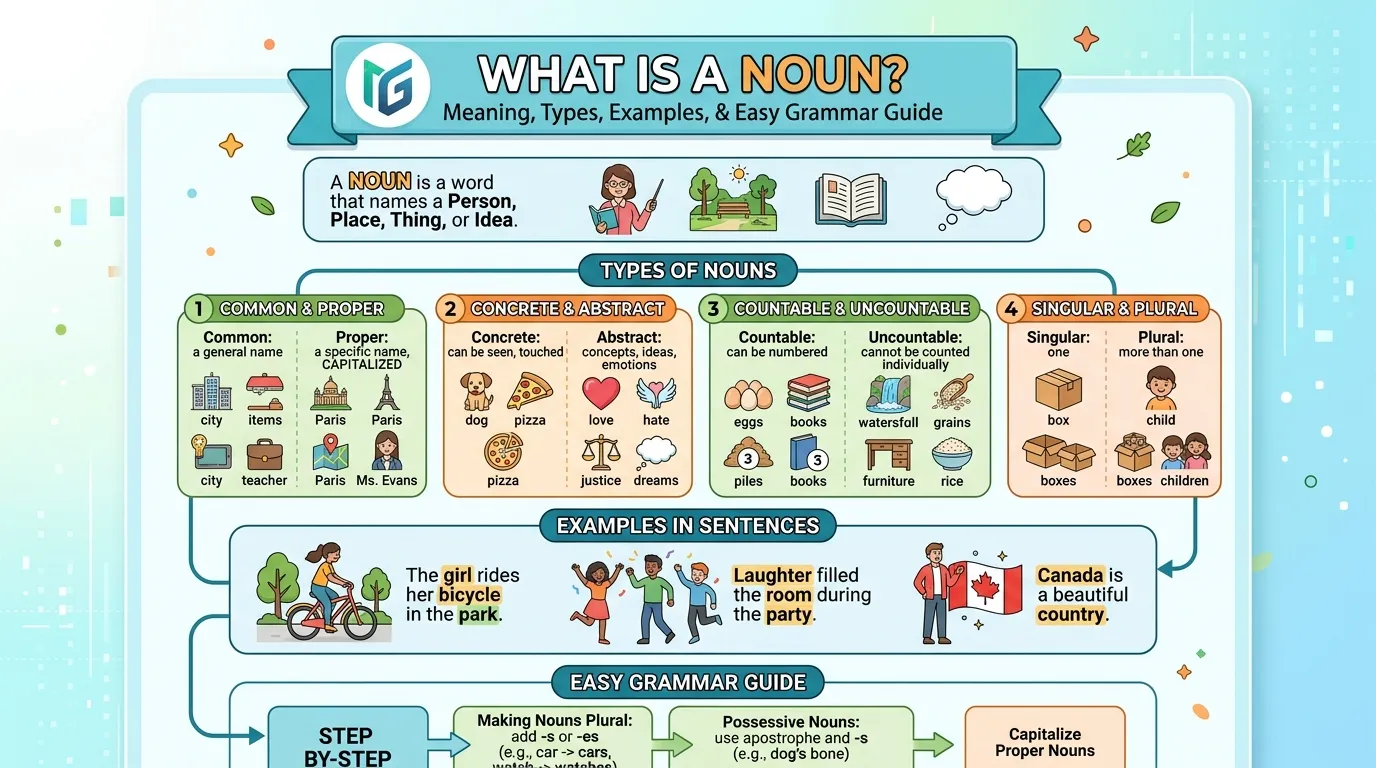
A noun is a word used to name a person, place, thing, animal, or idea. Words such as teacher, school, book, cat, and happiness are all nouns.
People often search for “What is Noun?” because they want a simple definition, clear examples, and an easy way to identify nouns in sentences. The topic can seem confusing because nouns have many types, including common nouns, proper nouns, abstract nouns, collective nouns, and concrete nouns.
Learning nouns is important because they form the basic building blocks of English sentences. Once you understand nouns, it becomes easier to learn verbs, adjectives, pronouns, and other parts of speech.
In this guide, you will learn what a noun means, its types, how to identify nouns, common mistakes, everyday examples, and answers to frequently asked questions.
What Is Noun? – Quick Answer
A noun is a word that names a person, place, thing, animal, or idea.
Examples of Nouns
- Person: teacher, doctor, Ali, mother
- Place: school, London, park, hospital
- Thing: table, phone, book, computer
- Animal: dog, horse, lion, bird
- Idea: love, freedom, honesty, happiness
Examples in Sentences
The teacher opened the book.
Sarah lives in London.
The dog is sleeping.
Honesty is important.
In these examples, the bold words are nouns because they name people, places, animals, things, or ideas.
The Origin of the Word Noun
The word noun comes from the Old French nom, meaning “name.” It is also related to the Latin word nomen, which means “name.”
The basic idea has remained the same for centuries. A noun gives a name to something.
English grammar developed from several older languages, including Latin, French, and Germanic languages. As grammar rules developed, noun became the standard term for words that name people, places, things, and concepts.
Why Is the Word Important?
Naming things is one of the most basic functions of language.
For example, instead of saying:
Give me that.
We can say:
Give me the book.
The noun book makes the meaning clearer.
Types of Nouns
English has several important types of nouns. Understanding these types makes grammar much easier.
Common Noun
A common noun names a general person, place, animal, thing, or idea.
Examples:
- city
- teacher
- country
- car
- river
- school
- student
Example:
The teacher entered the classroom.
“Teacher” is a common noun because it does not name one specific teacher.
Proper Noun
A proper noun names a specific person, place, organization, or other particular entity.
Examples:
- Ahmed
- Pakistan
- London
- Monday
- Asia
Proper nouns normally begin with a capital letter.
Example:
Ahmed visited London.
Concrete Noun
A concrete noun names something that can be experienced through the senses.
Examples:
- apple
- chair
- phone
- car
- dog
- house
For example:
The apple is on the table.
You can see and touch an apple, so it is a concrete noun.
Abstract Noun
An abstract noun names an idea, feeling, quality, or state that cannot normally be touched or seen.
Examples:
- love
- happiness
- courage
- freedom
- honesty
- wisdom
Example:
Honesty builds trust.
You cannot physically touch honesty, but you can understand the idea.
Collective Noun
A collective noun refers to a group of people, animals, or things.
Examples:
- team
- family
- class
- crowd
- committee
- flock
Example:
The team won the match.
“Team” refers to a group of players.
Countable Noun
A countable noun can be counted.
Examples:
- one book
- two books
- three cars
- five students
Example:
I bought three books.
Countable nouns can usually have singular and plural forms.
Uncountable Noun
An uncountable noun refers to something that is not normally counted as separate individual units.
Examples:
- water
- rice
- information
- advice
- furniture
- sugar
Example:
I need some water.
We usually do not say:
three waters
when talking about the substance itself.
Noun vs Pronoun
A noun and a pronoun are related, but they are not the same.
A noun names someone or something.
A pronoun replaces a noun.
Example:
Ahmed is a student. He works hard.
Here:
- Ahmed = noun
- He = pronoun
Pronouns help us avoid repeating the same noun.
Noun vs Verb
A noun can sometimes look similar to a verb, but its function in a sentence can be different.
For example:
I work in an office.
Here, work is a verb.
But:
My work is difficult.
Here, work is a noun.
The role of the word in the sentence helps determine whether it is being used as a noun or another part of speech.
British English vs American English Spelling
There is generally no major spelling difference between the word noun in British and American English.
Both use:
noun
The main differences between British and American English usually appear in other words, such as colour/color and centre/center.
| Feature | British English | American English |
|---|---|---|
| Noun | noun | noun |
| Plural | nouns | nouns |
| Grammar term | noun | noun |
| Capitalization | Same general rules | Same general rules |
| Definition | Naming word | Naming word |
Example
British English:
A noun names a person, place, thing, or idea.
American English:
A noun names a person, place, thing, or idea.
Both are correct.
Which Spelling Should You Use?
Because noun has the same spelling in major forms of English, you do not need to choose between British and American spelling.
However, you should keep your overall English style consistent.
For US English
Use American English spelling and grammar if your audience is mainly in the United States.
For UK English
Use British English spelling and grammar if your audience is mainly in the United Kingdom.
For Global Readers
Simple international English is often best for educational websites, blogs, and general audiences.
The word noun remains the same in all these varieties.
Common Mistakes with Nouns
Mistake 1: Forgetting Capital Letters for Proper Nouns
Incorrect:
I visited london.
Correct:
I visited London.
Specific names normally begin with capital letters.
Mistake 2: Confusing Nouns and Verbs
Consider:
I watch television.
Here, watch is a verb.
But:
My watch is broken.
Here, watch is a noun.
Mistake 3: Using an Incorrect Plural
Some nouns have irregular plural forms.
Incorrect:
Two childs are playing.
Correct:
Two children are playing.
Other examples include:
- man → men
- woman → women
- foot → feet
- tooth → teeth
- mouse → mice
Mistake 4: Treating Uncountable Nouns as Countable
Incorrect:
I need an advice.
Correct:
I need some advice.
Or:
I need a piece of advice.
Mistake 5: Confusing Abstract and Concrete Nouns
A word such as happiness is an abstract noun because it represents a feeling or idea.
A word such as house is a concrete noun because it refers to something physical.
What Is Noun in Everyday Examples?
Nouns appear everywhere in everyday communication.
In Emails
Please send the report before the meeting.
The nouns are report and meeting.
In News
The government announced a new policy.
The nouns include government and policy.
On Social Media
My friend bought a new phone.
The nouns are friend and phone.
In Formal Writing
Education plays an important role in society.
“Education” and “society” are nouns.
In Conversation
The car is outside the house.
“Car” and “house” are nouns.
How to Identify a Noun
Finding nouns becomes easier when you ask a simple question:
Is this word naming a person, place, thing, animal, or idea?
If the answer is yes, it may be a noun.
Example
The young boy carried a bag to school.
Ask:
- Who? → boy
- What? → bag
- Where? → school
All three are nouns.
Another Example
Honesty and kindness are important qualities.
The nouns are:
- honesty
- kindness
- qualities
Noun Forms and Plurals
Many nouns can change from singular to plural.
Regular Plurals
Most regular nouns form the plural by adding -s.
Examples:
- book → books
- car → cars
- student → students
- house → houses
Some nouns take -es.
Examples:
- box → boxes
- bus → buses
- watch → watches
Irregular Plurals
Some nouns change completely.
| Singular | Plural |
|---|---|
| Child | Children |
| Man | Men |
| Woman | Women |
| Foot | Feet |
| Tooth | Teeth |
| Mouse | Mice |
Learning common irregular plurals is important for accurate English writing.
Nouns in a Sentence
Nouns can perform different jobs in sentences.
Subject
The dog barked.
“Dog” is the subject.
Object
She bought a book.
“Book” is the object.
After a Preposition
The keys are on the table.
“Table” is the noun after the preposition on.
Subject Complement
Ahmed is a teacher.
“Teacher” identifies Ahmed.
Noun Comparison Table
| Type of Noun | Meaning | Example |
|---|---|---|
| Common | General name | city |
| Proper | Specific name | London |
| Concrete | Physical thing | table |
| Abstract | Idea or feeling | happiness |
| Collective | Group | team |
| Countable | Can be counted | apple |
| Uncountable | Not normally counted individually | water |
What Is Noun? Google Trends and Usage Data
The search phrase “What is Noun?” is common in educational searches because nouns are one of the first grammar topics taught to English learners.
Students, teachers, parents, and English learners often search for noun definitions when studying:
- English grammar
- Parts of speech
- School assignments
- English tests
- Writing skills
- Language learning
Search interest can vary by country and education level. The topic is especially useful in regions where English is taught as a second or additional language.
People also search related questions such as:
- What is a noun?
- What are nouns?
- Types of nouns
- Noun examples
- What is a common noun?
- What is a proper noun?
- What is an abstract noun?
This shows that users usually want both a simple definition and practical examples.
Noun Examples: Quick Reference
Here are some easy examples.
People
- teacher
- doctor
- student
- mother
- engineer
Places
- school
- city
- country
- park
- hospital
Things
- phone
- computer
- chair
- book
- table
Animals
- dog
- cat
- horse
- bird
- elephant
Ideas
- love
- freedom
- peace
- honesty
- happiness
FAQs About Nouns
What is a noun in simple words?
A noun is a naming word. It names a person, place, thing, animal, or idea.
What are five examples of nouns?
Five examples are teacher, school, book, dog, and happiness.
What are the main types of nouns?
Common types include common, proper, concrete, abstract, collective, countable, and uncountable nouns.
Is a name a noun?
Yes. A person’s name, such as Ahmed or Sarah, is a proper noun.
Is a place a noun?
Yes. Places can be nouns. Examples include school, London, park, and hospital.
Is an idea a noun?
Yes. Ideas, feelings, and qualities can be abstract nouns. Examples include love, freedom, honesty, and happiness.
What is the difference between a noun and a pronoun?
A noun names a person, place, thing, or idea. A pronoun replaces a noun.
Example:
Sarah is happy. She is smiling.
Sarah is a noun, while she is a pronoun.
Can one word be both a noun and a verb?
Yes. Some words can have different grammatical roles.
Example:
I watch TV. — verb
My watch is expensive. — noun
The sentence tells us how the word is being used.
Conclusion
A noun is one of the most important parts of English grammar. It is a word that names a person, place, thing, animal, or idea. Words such as teacher, school, computer, dog, and happiness are all examples of nouns.
Nouns can be divided into several types, including common, proper, concrete, abstract, collective, countable, and uncountable nouns. They can also perform different roles in a sentence, such as subject, object, or complement.
Learning nouns is important because they appear in almost every form of communication. Once you can identify nouns, it becomes easier to understand other parts of speech and build correct sentences.
The easiest way to identify a noun is to ask: “Is this word naming someone, somewhere, something, or an idea?” With regular practice and simple examples, nouns become easy to recognize and use correctly in everyday English.