A common noun is one of the first grammar ideas students learn, yet it can be easy to confuse with a proper noun. The difference is simple once you know what to look for.
Words such as teacher, city, country, book, and dog are common nouns. They name people, places, animals, or things in a general way. In contrast, Mr. Ahmed, London, and Pakistan are specific names and are proper nouns.
People often search for “Common Noun” because they want a simple definition, clear examples, and an easy way to identify common nouns in sentences. Students may also need help with capitalization, plural forms, and the difference between common and proper nouns.
Understanding common nouns is important because they appear in almost every type of English communication. You use them when writing emails, speaking with friends, reading news, completing schoolwork, or writing formal documents.
In this guide, you will learn what a common noun is, how it works, how it differs from a proper noun, common mistakes, everyday examples, and easy rules for using common nouns correctly.
Common Noun – Quick Answer
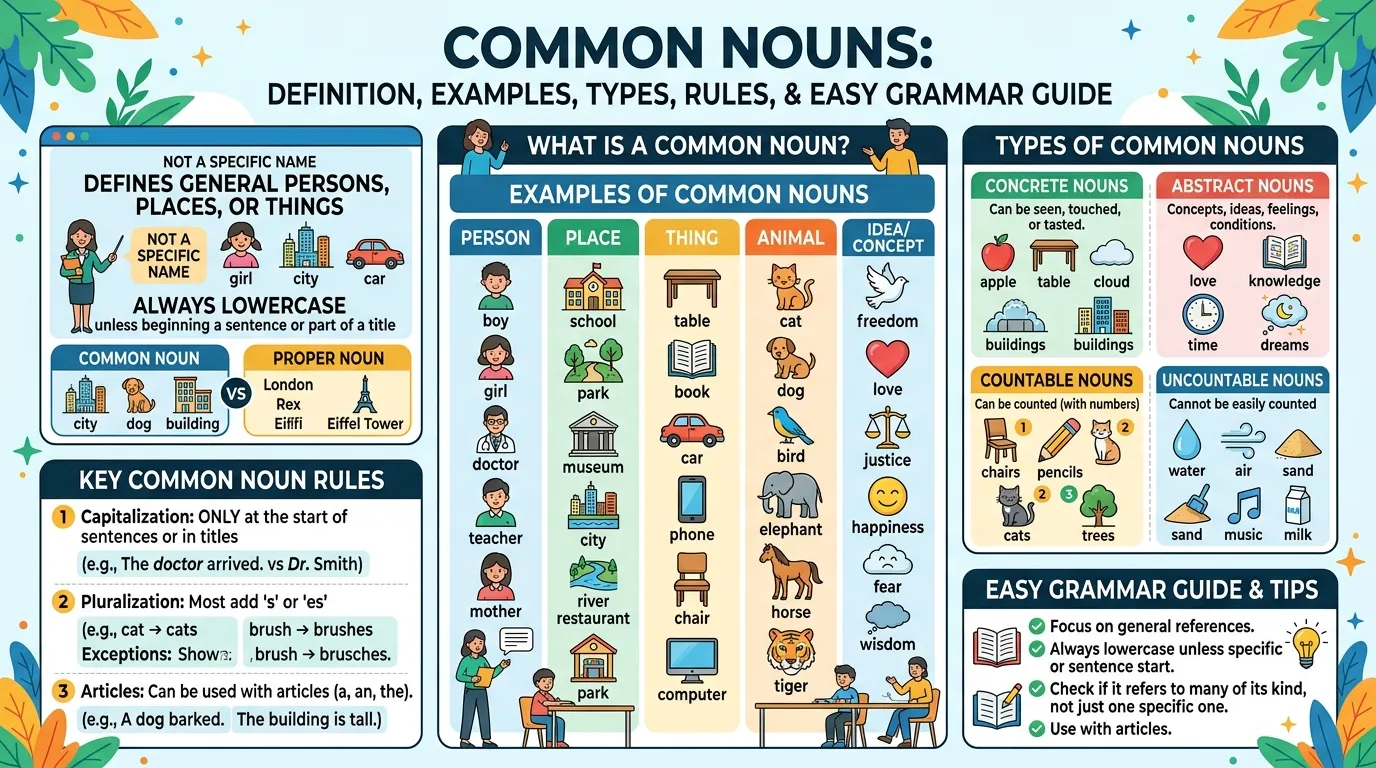
A common noun is a general name for a person, place, animal, thing, or idea.
Examples of Common Nouns
- Person: teacher, doctor, student
- Place: city, school, country
- Animal: dog, cat, horse
- Thing: book, phone, table
- Idea: happiness, freedom, education
Examples in Sentences
The teacher entered the classroom.
I bought a new phone.
The dog is sleeping.
She lives in a large city.
The bold words are common nouns because they give general names rather than specific names.
Common Noun vs Proper Noun
Compare these examples:
| Common Noun | Proper Noun |
|---|---|
| city | London |
| country | Pakistan |
| teacher | Mr. Ahmed |
| river | Nile |
| company | Microsoft |
| school | Oxford University |
A common noun is general. A proper noun identifies something specific.
The Origin of Common Noun
The word noun comes from the Latin word nomen, meaning “name.” The term eventually developed through French and English and became the standard grammar term for a naming word.
The word common means shared or general. Therefore, a common noun is a general naming word.
For example, the word city can describe thousands of places around the world:
London is a city.
Riyadh is a city.
Paris is a city.
The word city is common because it does not identify one particular city.
Why Common Nouns Are Important
Common nouns make communication simple.
Instead of giving every object a unique name, we can use general categories:
- car
- house
- school
- student
- computer
This allows people to understand ideas quickly.
Features of a Common Noun
Common nouns have several useful features.
1. They Give General Names
A common noun does not normally identify one unique person or place.
The doctor helped the patient.
We know the person’s job, but we do not know which doctor.
2. They Usually Do Not Need Capital Letters
Common nouns normally use lowercase letters.
The student opened the book.
However, a common noun is capitalized when it starts a sentence.
The student opened the book.
3. They Can Be Singular or Plural
Many common nouns can have singular and plural forms.
one book
two books
one student
many students
4. Some Are Countable
Examples:
- one car
- two cars
- three houses
- four students
5. Some Are Uncountable
Examples:
- water
- information
- advice
- furniture
These nouns are still common nouns, but they are not normally counted as individual units.
Types of Common Nouns
Common nouns can describe many different things.
Common Nouns for People
Examples:
- teacher
- doctor
- engineer
- student
- driver
- farmer
- manager
- worker
Example:
The engineer checked the machine.
Common Nouns for Places
Examples:
- city
- village
- school
- hospital
- park
- country
- office
Example:
The children went to the park.
Common Nouns for Animals
Examples:
- dog
- cat
- bird
- horse
- lion
- elephant
Example:
The horse ran across the field.
Common Nouns for Things
Examples:
- computer
- phone
- chair
- table
- book
- car
Example:
My computer is on the desk.
Common Nouns for Ideas
Some common nouns refer to ideas or concepts.
Examples:
- education
- freedom
- happiness
- knowledge
- love
- peace
Example:
Education can create new opportunities.
These are common nouns because they are general concepts rather than specific names.
British English vs American English Spelling
The spelling of common noun is the same in British and American English.
Both use:
common noun
There is no British-American spelling difference in this grammar term.
However, the common nouns themselves can sometimes have different spellings in British and American English.
Comparison Table
| Meaning | British English | American English |
|---|---|---|
| Colour | colour | color |
| Centre | centre | center |
| Organisation | organisation | organization |
| Favourite | favourite | favorite |
| Travelling | travelling | traveling |
These are all nouns or words that can appear in different grammatical forms, but the spelling may vary between English varieties.
Example
British English:
The colour of the car is blue.
American English:
The color of the car is blue.
The noun has the same meaning, but the spelling differs.
Common Noun vs Proper Noun
This is one of the most important grammar differences to understand.
Common Noun
A common noun gives a general name.
city
country
river
teacher
Proper Noun
A proper noun gives a specific name.
London
Pakistan
Nile
Mr. Khan
Comparison
I visited a city.
“City” is a common noun.
I visited London.
“London” is a proper noun.
The easiest way to remember the difference is:
Common = general
Proper = specific
Which Spelling Should You Use?
Because common noun has the same spelling in British and American English, you do not need to choose between two spellings.
However, your overall writing should match your audience.
For American Readers
Use American English when writing mainly for people in the United States.
For example:
- color
- center
- favorite
- organization
For British Readers
Use British English when your audience is mainly in the United Kingdom.
For example:
- colour
- centre
- favourite
- organisation
For Commonwealth Readers
British-based spelling is common in countries such as the United Kingdom, Australia, and New Zealand, although individual countries can have their own preferences.
For Global Audiences
Choose one style and use it consistently.
For educational websites, simple English is often best because it helps readers from different countries understand the content.
Common Mistakes With Common Noun
Mistake 1: Capitalizing Every Common Noun
Incorrect:
The Teacher entered the Classroom.
Correct:
The teacher entered the classroom.
Common nouns normally use lowercase letters.
Mistake 2: Confusing a Common Noun With a Proper Noun
Incorrect:
“London” is a common noun.
Correct:
“London” is a proper noun.
“City” is the common noun.
Mistake 3: Forgetting Capitalization for Proper Names
Incorrect:
I live in london.
Correct:
I live in London.
London is a proper noun.
Mistake 4: Using Incorrect Plural Forms
Incorrect:
Two childs are playing.
Correct:
Two children are playing.
Some common nouns have irregular plural forms.
Mistake 5: Incorrectly Counting Uncountable Nouns
Incorrect:
I need two informations.
Correct:
I need two pieces of information.
“Information” is generally uncountable.
Common Noun in Everyday Examples
Common nouns appear in almost every form of communication.
In Emails
Please send the report before the meeting.
Both report and meeting are common nouns.
In News
The government announced a new policy.
“Government” and “policy” are common nouns.
On Social Media
Our team won the match today!
“Team” and “match” are common nouns.
In Formal Writing
Education plays an important role in society.
“Education” and “society” are common nouns.
In Daily Conversation
My brother bought a new car.
“Brother” and “car” are common nouns.
Common Noun Examples by Category
| Category | Common Noun Examples |
|---|---|
| People | teacher, doctor, engineer |
| Places | city, school, hospital |
| Animals | dog, cat, horse |
| Things | phone, book, computer |
| Food | rice, bread, apple |
| Jobs | manager, driver, worker |
| Ideas | freedom, education, happiness |
| Groups | team, family, class |
Common Noun – Google Trends & Usage Data
The search term “Common Noun” has clear educational intent. Students and English learners often search for it while studying parts of speech, grammar, writing, and language tests.
Common related searches include:
- common noun definition
- common noun examples
- what is a common noun?
- common and proper nouns
- 10 examples of common nouns
- common noun and proper noun
- common noun examples for students
Search interest can vary by country and education system. The topic is especially useful in countries where English is taught as a second or additional language.
The phrase is also popular among teachers and parents looking for simple grammar explanations for children.
Common Noun Comparison Table
| Feature | Common Noun | Proper Noun |
|---|---|---|
| Meaning | General name | Specific name |
| Capital letter | Usually no | Yes |
| Example person | teacher | Ahmed |
| Example place | city | London |
| Example country | country | Pakistan |
| Example animal | dog | Bruno |
| Example company | company | |
| Example river | river | Nile |
How to Identify a Common Noun
Finding common nouns is easy when you follow a few steps.
Step 1: Find the Naming Words
Look for words that name people, places, animals, things, or ideas.
Example:
The boy carried a bag to school.
The nouns are:
- boy
- bag
- school
Step 2: Ask Whether the Name Is General
Ask:
Is this a general name or a specific name?
The city is large.
“City” is general, so it is a common noun.
Riyadh is large.
“Riyadh” is specific, so it is a proper noun.
Step 3: Check Capitalization
Common nouns normally begin with lowercase letters unless they start a sentence.
The car is outside.
But:
The car is outside.
The word The is capitalized because it begins the sentence, not because it is a common noun.
Common Noun and Sentence Structure
Common nouns can have different roles in sentences.
Subject
The dog barked.
“Dog” is the subject.
Object
She opened the door.
“Door” is the object.
After a Preposition
The keys are on the table.
“Table” is a noun after the preposition on.
Subject Complement
Ahmed is a teacher.
“Teacher” describes or identifies Ahmed.
FAQs About Common Nouns
What is a common noun?
A common noun is a general name for a person, place, animal, thing, or idea.
Examples include teacher, city, dog, book, and education.
What are 10 examples of common nouns?
Ten examples are:
teacher, student, school, city, dog, book, car, phone, house, and hospital.
What is the difference between a common noun and a proper noun?
A common noun gives a general name, while a proper noun gives a specific name.
Example:
city = common noun
London = proper noun
Does a common noun need a capital letter?
Usually, no. Common nouns are normally lowercase unless they begin a sentence.
The student opened the book.
Is “school” a common noun?
Yes. School is a common noun because it is a general name for a place.
However, the name of a specific school can be a proper noun.
I attend school.
I attend Oxford High School.
Is “dog” a common noun?
Yes. Dog is a common noun because it is a general name for an animal.
A specific dog’s name, such as Max, is a proper noun.
Can an abstract word be a common noun?
Yes. Words such as happiness, freedom, education, and knowledge can be common nouns because they name general ideas or concepts.
Conclusion
A common noun is a general naming word. It can name a person, place, animal, thing, or idea without identifying one specific example. Words such as teacher, city, dog, book, school, and happiness are common nouns.
The easiest way to understand common nouns is to compare them with proper nouns. A common noun is general, while a proper noun is specific. For example, city is a common noun, while London is a proper noun.
Common nouns are used everywhere. You will find them in emails, news reports, social media posts, conversations, books, and formal documents. They can also be singular, plural, countable, or uncountable.
Remember one simple rule: common nouns usually do not need capital letters unless they begin a sentence. Practice finding general naming words in everyday sentences, and you will quickly become confident with this important part of English grammar.