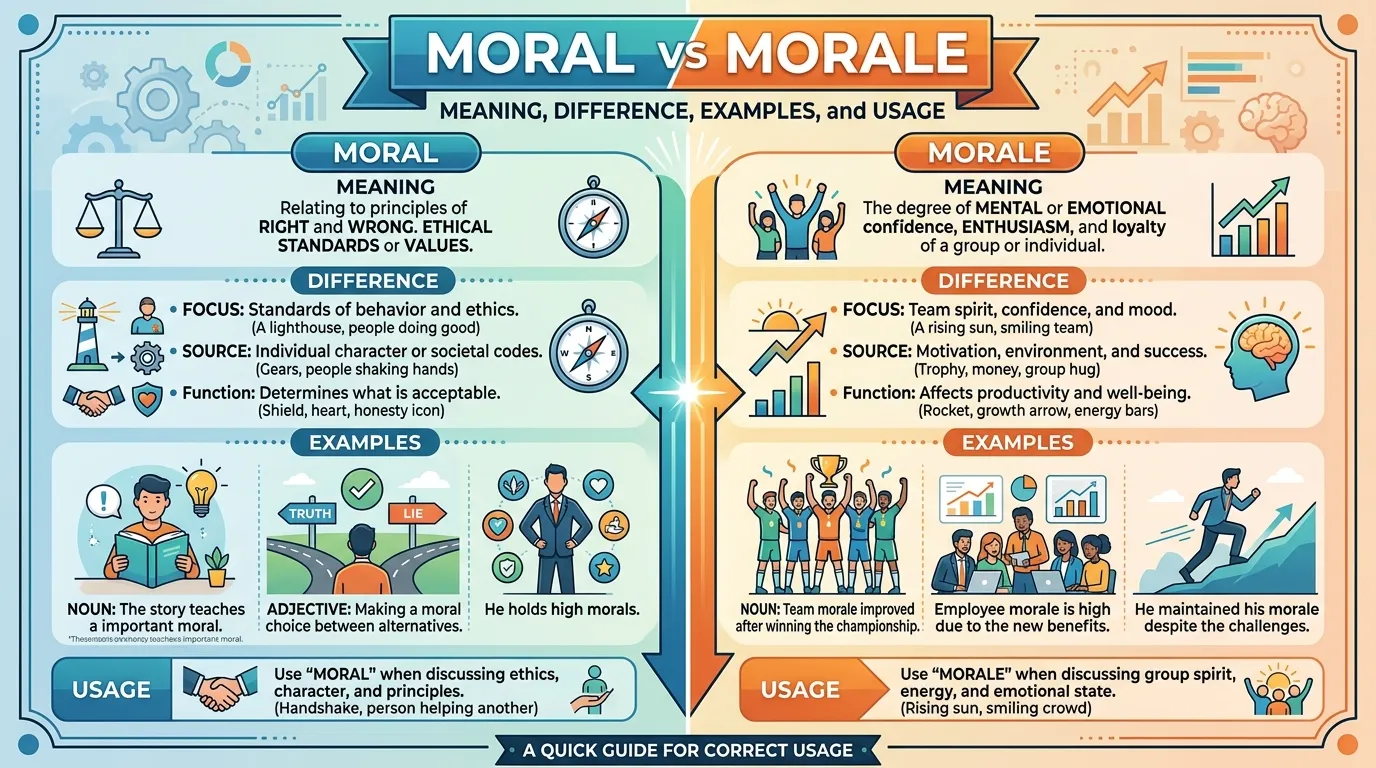
Moral vs morale is a common English word confusion because the two words look almost identical but have very different meanings. They are also pronounced differently, which can make the confusion even greater when people hear them in conversation.
Moral usually relates to right and wrong behavior, values, or principles. For example, “The story has a strong moral” means the story teaches a lesson about good or bad behavior. It can also describe a person’s principles, such as “He has strong moral values.”
Morale, on the other hand, means the confidence, enthusiasm, or emotional spirit of a person or group. For example, “The manager improved employee morale” means the manager helped employees feel more positive and motivated.
People often search for moral vs morale because both words begin with “mora-” and have similar spellings. The difference is especially important in business, education, writing, news, and everyday communication.
This guide explains moral vs morale in simple English. You will learn their meanings, origins, pronunciation, British and American usage, common mistakes, everyday examples, and easy memory tricks.
Moral vs Morale – Quick Answer
The easiest way to remember the difference is:
- Moral = about right and wrong, values, or principles.
- Morale = confidence, enthusiasm, or team spirit.
Moral Examples
The story teaches an important moral lesson.
She has strong moral values.
The decision raised several moral questions.
Here, moral relates to principles of right and wrong.
Morale Examples
The new manager improved employee morale.
Low morale affected the team’s performance.
The team’s morale increased after the victory.
Here, morale refers to confidence, enthusiasm, and emotional spirit.
Easy Memory Trick
Think:
Moral = values
Morale = mood
For example:
Moral values guide behavior.
Morale affects how people feel.
The Origin of Moral vs Morale
Although moral and morale look similar, they have different histories.
Origin of Moral
Moral comes from the Latin word moralis, meaning “relating to manners or character.” It is connected with mos, meaning “custom” or “way of life.”
The word entered English through French and developed its connection with:
- Right and wrong
- Ethics
- Character
- Principles
- Good behavior
Examples include:
moral responsibility
moral values
moral judgment
Origin of Morale
Morale also has French roots. It comes from the French moral, referring to the emotional condition or spirit of a person or group.
English later adopted morale with a more specific meaning: the mental and emotional condition of a group or person, especially confidence and enthusiasm.
Examples include:
employee morale
team morale
high morale
low morale
Why Are They Confused?
Both words come from related historical roots and share most of their letters.
| Word | Main Meaning |
|---|---|
| Moral | Right and wrong |
| Morale | Confidence and spirit |
The final -e in morale is important.
British English vs American English Spelling
There is no major spelling difference between British and American English for moral and morale.
Both varieties use:
- moral
- morale
However, their meanings remain different in both forms of English.
Comparison Table
| Meaning | British English | American English | Example |
|---|---|---|---|
| Related to right and wrong | moral | moral | Moral values matter. |
| Ethical principle | moral | moral | It was a moral decision. |
| Team confidence | morale | morale | Team morale is high. |
| Employee spirit | morale | morale | Employee morale improved. |
British English Examples
The story teaches a valuable moral lesson.
The company worked to improve employee morale.
American English Examples
The story teaches a valuable moral lesson.
The company worked to improve employee morale.
The spelling and basic distinction are the same.
Which Spelling Should You Use?
Your choice depends on what you are trying to describe.
Use Moral for Values and Ethics
Use moral when talking about:
- Right and wrong
- Ethics
- Principles
- Character
- Good or bad behavior
- Lessons from stories
Examples:
The decision raised a moral question.
Parents often teach moral values.
The story has a clear moral.
Use Morale for Confidence and Spirit
Use morale when talking about how positive, confident, or motivated a person or group feels.
Examples:
The manager wants to improve employee morale.
The team’s morale was low after the defeat.
Good leadership can boost morale.
Compare Them
The company has strong moral principles.
This describes the company’s ethical values.
The company has high employee morale.
This describes how confident and positive employees feel.
For US Readers
American English uses the same distinction.
For UK and Commonwealth Readers
British and Commonwealth English also use the same distinction.
For Global English
Remember:
Moral = principles.
Morale = feelings and confidence.
Common Mistakes with Moral vs Morale
Mistake 1: “Employee Moral”
Incorrect:
The company wants to improve employee moral.
Correct:
The company wants to improve employee morale.
Employee morale means employee confidence, motivation, and satisfaction.
Mistake 2: “Moral Was Low”
Incorrect:
Team moral was low.
Correct:
Team morale was low.
You are describing team spirit.
Mistake 3: “Moral of the Story” Misspelled
The correct phrase is:
The moral of the story
Here, moral means the lesson or principle.
Mistake 4: “Boost Moral”
Incorrect:
The manager tried to boost team moral.
Correct:
The manager tried to boost team morale.
Mistake 5: “Morale Values”
Incorrect:
The company has strong morale values.
Correct:
The company has strong moral values.
Values relate to ethics and principles.
Moral vs Morale in Everyday Examples
In Emails
Moral:
The committee discussed the moral issues involved in the decision.
Morale:
We are planning a team event to improve employee morale.
In News
Moral:
The case raised important moral questions.
Morale:
The team’s morale improved after its recent victory.
On Social Media
Moral:
This story has a powerful moral.
Morale:
A little good news can really boost team morale!
In Formal Writing
Moral:
The policy raises several important moral and ethical questions.
Morale:
Strong communication can improve employee morale.
In Education
Moral:
The teacher asked students to identify the moral of the story.
Morale:
Positive feedback can improve student morale.
In Business
Moral:
Leaders must consider the moral implications of their decisions.
Morale:
Recognition programs can increase employee morale.
Moral vs Morale – Comparison Table
| Word | Part of Speech | Main Meaning | Common Uses | Example |
|---|---|---|---|---|
| Moral | Adjective | Related to right and wrong | Moral values | She has strong moral values. |
| Moral | Noun | Lesson or principle | Moral of a story | What is the moral? |
| Morale | Noun | Confidence and enthusiasm | Team morale | Team morale is high. |
| Morale | Noun | Emotional spirit | Employee morale | Morale improved. |
Key Difference
Moral can be an adjective or noun.
Morale is primarily a noun.
You would say:
moral values
but:
employee morale
Moral vs Morale Pronunciation
Pronunciation is another useful way to separate these words.
Moral
Moral is commonly pronounced approximately:
MOR-uhl
Example:
The story has a moral lesson.
Morale
Morale is commonly pronounced:
muh-RAL
The second syllable is stronger.
Example:
Team morale is improving.
Pronunciation Table
| Word | Approximate Sound | Meaning |
|---|---|---|
| Moral | MOR-uhl | Related to ethics or values |
| Morale | muh-RAL | Confidence and team spirit |
The different pronunciation can help you recognize the correct word when speaking.
How to Remember Moral vs Morale
Moral = Values
Think:
Moral = values
Examples:
moral rules
moral behavior
moral principles
moral responsibility
Morale = Mood
Think:
Morale = mood
Examples:
high morale
low morale
employee morale
team morale
The Final “E” Trick
The extra e in morale can help you remember that it relates to people’s emotional energy.
Morale → mood and energy
This is only a memory trick, but it can make the difference easier to remember.
Moral vs Morale – Google Trends & Usage Data
Search interest for moral vs morale is mainly connected with English vocabulary, grammar, business writing, education, leadership, ethics, and workplace communication.
Moral is commonly searched in contexts involving ethics, values, stories, decisions, philosophy, and behavior. Common phrases include moral values, moral lesson, moral responsibility, and moral dilemma.
Morale is especially common in workplace, military, sports, education, and team settings. Common phrases include employee morale, team morale, high morale, low morale, and boost morale.
Both words are widely used in British and American English.
Google Trends interest can change by country and over time, so exact search-volume figures should be checked directly before publishing specific numerical claims.
The main search intent is usually to understand whether moral or morale is correct when discussing ethics or people’s confidence and spirit.
FAQs About Moral vs Morale
1. What is the difference between moral and morale?
Moral relates to right and wrong, ethics, values, or principles.
Morale means confidence, enthusiasm, and team spirit.
Moral values guide behavior.
Good morale improves teamwork.
2. Is it “employee moral” or “employee morale”?
The correct phrase is:
Employee morale
It means the confidence, motivation, and emotional well-being of employees.
3. Is it “moral of the story” or “morale of the story”?
The correct phrase is:
Moral of the story
It means the lesson or message of the story.
4. Can moral be a noun?
Yes. Moral can be a noun when it means a lesson or principle.
The moral of the story is to be honest.
It can also be an adjective:
She made a moral decision.
5. Is morale a feeling?
Morale describes the general confidence, enthusiasm, and emotional spirit of a person or group.
The team’s morale was high.
It is especially common when talking about groups.
6. What is an easy way to remember moral vs morale?
Remember:
Moral = values and ethics.
Morale = mood and confidence.
7. Are moral and morale different in British and American English?
No. Both British and American English use the same spellings and basic meanings.
Conclusion
The difference between moral vs morale becomes simple when you focus on values versus feelings. Moral relates to right and wrong, ethics, principles, character, or a lesson. Morale refers to confidence, enthusiasm, motivation, and the emotional spirit of a person or group.
For example, “The story has a strong moral” means the story teaches an important lesson. In contrast, “The manager improved employee morale” means the manager helped employees feel more positive, confident, or motivated.
A useful memory trick is moral = values and morale = mood. You can also remember the common phrases moral values, moral lesson, employee morale, and team morale.
British and American English use the same spellings, so there is no regional spelling issue. The key is understanding the meaning and choosing the correct word for the situation.
This distinction is especially useful in business, education, news, social media, and formal writing. Using moral when discussing ethics and morale when discussing confidence makes your writing clearer and more professional.
When you are unsure, ask yourself: Am I talking about right and wrong, or am I talking about how people feel? If it is about ethics, choose moral. If it is about confidence or team spirit, choose morale.