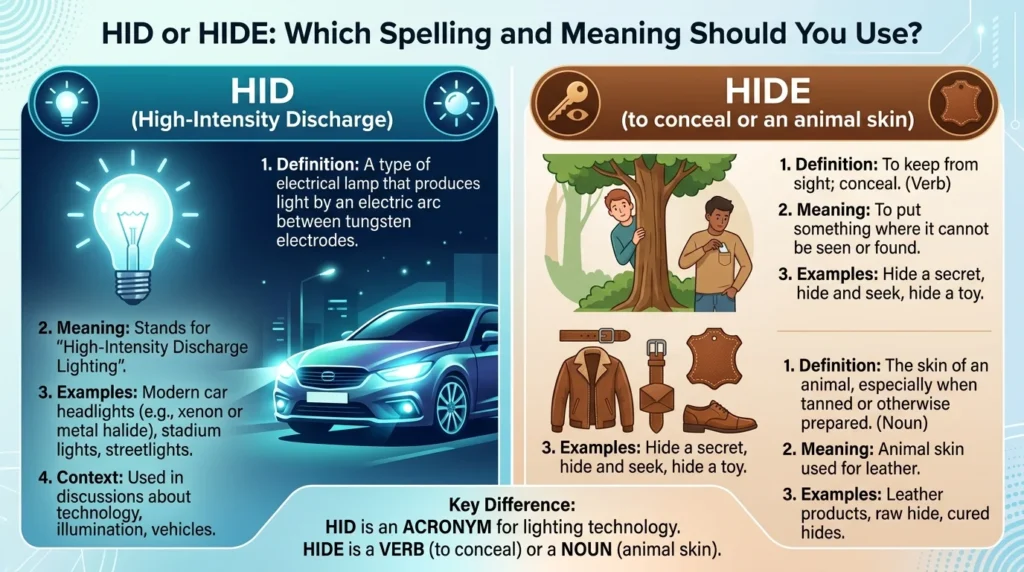
Many people search for “hid or hide” because they are confused about the difference between these two words. At first glance, they look very similar. Some people think they are spelling variations, while others wonder if both words are correct in the same sentence.
The confusion happens because “hide” and “hid” come from the same verb. One is the present form, and the other is the past tense. English learners, students, writers, and even native speakers often mix them up in emails, essays, social media posts, and daily conversations.
This guide explains the difference in a simple way. You will learn the meaning of each word, how to use them correctly, common mistakes to avoid, and when each form should appear in writing. We will also compare British and American English usage, show real examples, and explain which form works best in formal and casual communication.
By the end of this article, you will clearly understand “hid or hide” and never confuse them again.
Hid or Hide – Quick Answer
The quick answer is simple:
- Hide = present tense verb
- Hid = past tense verb
Examples
| Word | Meaning | Example |
| Hide | To keep something out of sight now | “I hide my keys in a drawer.” |
| Hid | Past action of hide | “She hid the gift yesterday.” |
Simple Rule
- Use hide for present or future actions.
- Use hid for actions already completed in the past.
The Origin of Hid or Hide
The word hide comes from Old English “hydan,” which meant “to conceal” or “put out of sight.” The word has been part of the English language for hundreds of years.
Over time, English verbs changed forms to show tense. Just like:
- go → went
- see → saw
- hide → hid
The word hid developed as the simple past tense form of “hide.”
Why the Confusion Exists
People often confuse “hid” and “hide” because:
- They sound related.
- Both words are correct English words.
- English verb forms can be irregular.
Unlike regular verbs that add “-ed,” the verb “hide” changes internally:
- hide → hid → hidden
Verb Forms
| Verb Form | Word |
| Base Form | hide |
| Past Tense | hid |
| Past Participle | hidden |
Example
- Present: “I hide my phone.”
- Past: “I hid my phone.”
- Perfect tense: “I have hidden my phone.”
British English vs American English Spelling
Unlike words such as “color” and “colour,” the words hid and hide are not British or American spelling differences. Both British English and American English use the same forms.
The difference is grammatical, not regional.
Comparison Table
| Form | British English | American English | Usage |
| hide | Correct | Correct | Present tense |
| hid | Correct | Correct | Past tense |
| hidden | Correct | Correct | Past participle |
Examples in Both Styles
| Sentence | Type |
| “They hide the files carefully.” | Present tense |
| “They hid the files yesterday.” | Past tense |
So, no matter where you live, the rules stay the same.
Which Spelling Should You Use?
The correct choice depends on the tense of your sentence.
Use “Hide” When:
- Talking about the present
- Talking about habits
- Giving commands
- Discussing future actions
Examples
- “Please hide the money.”
- “Cats hide under beds.”
- “I will hide the surprise.”
Use “Hid” When:
- Talking about completed past actions
Examples
- “He hid the letter.”
- “They hid behind the wall.”
- “She hid her feelings.”
Audience-Based Advice
| Audience | Recommended Usage |
| US readers | Use standard tense rules |
| UK readers | Use standard tense rules |
| Global audience | Use simple sentence structure for clarity |
The key is grammar, not location.
Common Mistakes with Hid or Hide
Many writers use the wrong tense by accident.
Mistake 1: Using “hid” in present tense
❌ “I hid my wallet every day.”
✅ “I hide my wallet every day.”
Reason: “Every day” shows a repeated present action.
Mistake 2: Using “hide” for past actions
❌ “She hide the keys yesterday.”
✅ “She hid the keys yesterday.”
Reason: “Yesterday” shows past time.
Mistake 3: Confusing “hid” and “hidden”
❌ “He has hid the documents.”
✅ “He has hidden the documents.”
Reason: Perfect tense uses “hidden.”
Mistake 4: Forgetting verb agreement
❌ “They hides the truth.”
✅ “They hide the truth.”
Hid or Hide in Everyday Examples
Here are real-life examples showing how people use these words.
In Emails
- “Please hide confidential files.”
- “I hid the old records last week.”
In News Writing
- “The suspect hid from police.”
- “Officials hide sensitive information.”
In Social Media
- “Why do people hide their feelings online?”
- “He hid the surprise perfectly!”
In Formal Writing
- “The company hid financial losses.”
- “Writers sometimes hide key details.”
In Casual Conversation
- “Did you hide my phone?”
- “Where did she hid—”
- Incorrect
- “Where did she hide it?”
- Correct
Hid or Hide – Google Trends & Usage Data
Search data shows that many users type “hid or hide” because they want:
- grammar help
- tense clarification
- spelling confirmation
- writing corrections
Popular Countries Searching This Topic
- United States
- United Kingdom
- India
- Pakistan
- Canada
- Australia
Common Search Questions
| Search Query | Purpose |
| hid vs hide | Grammar difference |
| hide meaning | Vocabulary help |
| hid meaning | Past tense understanding |
| hide past tense | Grammar learning |
| hidden vs hid | Verb form confusion |
Usage Context
| Word | Most Common Context |
| hide | Daily conversation |
| hid | Storytelling and past events |
| hidden | Formal and perfect tense writing |
Comparison Table: Hid vs Hide vs Hidden
| Word | Grammar Type | Time | Example |
| hide | Base verb | Present/Future | “I hide gifts.” |
| hid | Past tense | Past | “I hid gifts.” |
| hidden | Past participle | Perfect tense | “I have hidden gifts.” |
FAQs About Hid or Hide
Is “hid” a real word?
Yes. “Hid” is the past tense of “hide.”
Is “hide” present tense?
Yes. “Hide” is the base and present form of the verb.
Which is correct: “hid” or “hidden”?
Both are correct, but they are used differently:
- “I hid the book.”
- “I have hidden the book.”
Is “hide” British or American English?
Both British and American English use “hide.”
Why do people confuse hid and hide?
Because both words come from the same verb and sound similar.
What is the past participle of hide?
The past participle is “hidden.”
Can I say “he has hid”?
In standard English, “he has hidden” is preferred and grammatically correct.
Conclusion
Understanding the difference between “hid or hide” is very important for clear English writing and speaking. The good news is that the rule is simple once you know the tense. Use “hide” for present and future actions, and use “hid” for actions that already happened in the past. When using perfect tenses, choose “hidden.”
Many people search this topic because English irregular verbs can feel confusing. However, practice and simple examples make the difference easier to remember. Whether you are writing emails, social media posts, school assignments, or professional documents, using the correct form helps your writing look polished and natural.
There is also no British versus American spelling issue here. Both regions use the same grammar rules. The only thing that changes is the time of the action in your sentence.
If you remember one simple pattern — hide → hid → hidden — you will avoid most mistakes and use these words correctly in everyday English.