Many people search for “exist or exists” because they are confused about English grammar rules. These two words come from the same verb, but they are used differently depending on the subject in a sentence. Students, English learners, bloggers, writers, and professionals often make mistakes when choosing between “exist” and “exists” in emails, essays, business writing, and everyday communication.
The confusion usually happens because English verbs change based on singular and plural subjects. Some people are unsure whether they should write “problems exist” or “problems exists.” Others may not know why “he exists” is correct while “they exists” is wrong. Small grammar mistakes like these can affect writing quality and make sentences sound unnatural.
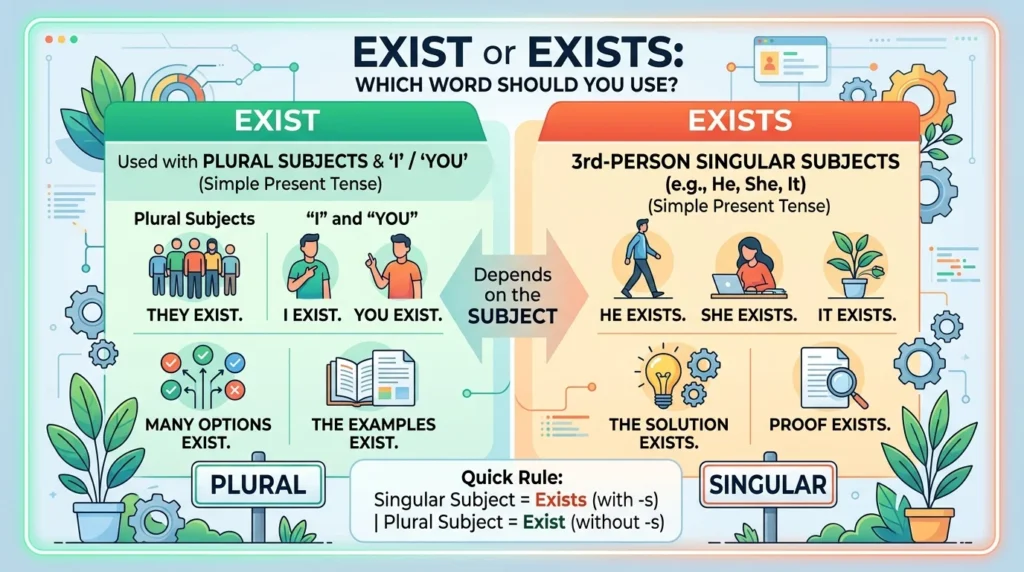
The good news is that the rule is simple once you understand subject-verb agreement. “Exist” is mainly used with plural subjects and pronouns like “I,” “you,” “we,” and “they.” “Exists” is used with singular subjects like “he,” “she,” or “it.”
In this article, you will learn the meaning of exist and exists, grammar rules, common mistakes, examples, usage tips, FAQs, and professional writing advice. By the end, you will clearly know when to use each word correctly.
Exist or Exists – Quick Answer
Both “exist” and “exists” are correct, but they are used differently.
Use “Exist”
Use “exist” with:
- I
- You
- We
- They
- Plural nouns
Examples
- Many animals exist in the forest.
- They exist to help people.
Use “Exists”
Use “exists” with:
- He
- She
- It
- Singular nouns
Examples
- A solution exists for this problem.
- He exists in our memories.
Quick Comparison
| Word | Used With | Example |
| Exist | Plural subjects | Problems exist |
| Exists | Singular subjects | A problem exists |
The Origin of Exist or Exists
Origin of “Exist”
The word “exist” comes from Latin and Old French roots. It originally meant “to appear” or “to have being.”
Development of “Exists”
“Exists” developed as the third-person singular form in English grammar.
Why the Confusion Happens
The confusion happens because:
- English verbs change with subjects
- Beginners forget subject-verb agreement
- Spoken English sometimes sounds similar
British English vs American English Spelling
Both British and American English use the same spellings:
- Exist ✅
- Exists ✅
The grammar rules are also the same.
British English Example
- Several solutions exist.
American English Example
- A problem exists in the system.
Comparison Table
| Word | British English | American English | Correct? |
| Exist | Yes | Yes | ✅ |
| Exists | Yes | Yes | ✅ |
Which Spelling Should You Use?
The correct word depends on your subject.
Use “Exist” When the Subject Is Plural
Examples
- Opportunities exist everywhere.
- Different opinions exist online.
Use “Exists” When the Subject Is Singular
Examples
- A chance exists for improvement.
- One answer exists.
Audience-Based Advice
| Subject Type | Correct Word |
| Singular noun | Exists |
| Plural noun | Exist |
| He/She/It | Exists |
| I/You/We/They | Exist |
Common Mistakes with Exist or Exists
Many English learners make grammar mistakes with these words.
Mistake 1: Using “Exists” with Plural Subjects
❌ Many options exists.
✅ Many options exist.
Mistake 2: Using “Exist” with Singular Subjects
❌ A problem exist.
✅ A problem exists.
Mistake 3: Forgetting Subject-Verb Agreement
The verb must match the subject.
Mistake 4: Confusion in Long Sentences
Writers sometimes lose track of the subject.
Example:
- A list of ideas exists. ✅
The main subject is “list,” not “ideas.”
Exist or Exists in Everyday Examples
In Emails
- Several opportunities exist within the company.
In News Articles
- A major issue exists in the market.
In Social Media
- Many people believe aliens exist.
In School Writing
- Different learning methods exist today.
In Formal Writing
- A legal solution exists for this case.
Exist or Exists – Google Trends & Usage Data
Many people search this keyword because subject-verb agreement is a common grammar challenge.
Countries Searching Most
- United States
- India
- United Kingdom
- Canada
- Australia
Common Search Questions
People often search:
- Exist or exists grammar
- When to use exists
- Difference between exist and exists
- Subject-verb agreement examples
Usage Context
| Word | Common Usage |
| Exist | Plural subjects |
| Exists | Singular subjects |
| Grammar help | English learning |
| Subject agreement | Writing improvement |
Comparison Table: Exist vs Exists
| Feature | Exist | Exists |
| Verb form | Base form | Singular form |
| Used with plural nouns | Yes | No |
| Used with singular nouns | No | Yes |
| Used with “they” | Yes | No |
| Used with “he/she/it” | No | Yes |
| Formal English | Correct | Correct |
Why People Confuse Exist and Exists
Several grammar rules create confusion.
Subject-Verb Agreement Rules
English verbs change depending on the subject.
Spoken English Habits
Fast speech sometimes hides grammar differences.
Long Sentences
Complex sentences make it harder to identify the subject.
Beginner Grammar Challenges
New English learners often memorize vocabulary before grammar.
Professional Advice for Writers and Students
Correct grammar improves professionalism and readability.
Best Writing Tips
- Identify the subject first.
- Singular subject = exists.
- Plural subject = exist.
- Proofread long sentences carefully.
Easy Memory Trick
Think:
- One thing exists.
- Many things exist.
FAQs About Exist or Exists
Which is correct: exist or exists?
Both are correct depending on the subject.
When should I use “exists”?
Use “exists” with singular subjects.
When should I use “exist”?
Use “exist” with plural subjects and pronouns like “they.”
Is “people exists” correct?
No. Correct sentence:
- People exist. ✅
Is “a solution exist” correct?
No. Correct sentence:
- A solution exists. ✅
Do British and American English differ?
No. Both follow the same grammar rules.
How can I remember the rule?
Singular subject = exists. Plural subject = exist.
Conclusion
Understanding the difference between exist or exists is important for correct English grammar and clear communication. Both words come from the same verb, but their usage depends on the subject in the sentence. “Exist” is used with plural subjects and pronouns like “they,” “we,” and “you,” while “exists” is used with singular subjects like “he,” “she,” “it,” or one object.
Learning this simple subject-verb agreement rule can improve your writing, speaking, and professional communication. Small grammar mistakes may confuse readers or make sentences sound incorrect. Whether you are a student, blogger, teacher, office worker, or English learner, knowing when to use exist and exists correctly will make your English stronger and more professional. Practice identifying singular and plural subjects, and choosing the correct verb form will become much easier over time.