The keyword “unshakable or unshakeable” is commonly searched by English learners, writers, and professionals who want to know which spelling is correct. Both versions look almost identical, but only one detail — the letter “e” — creates confusion. People often wonder if there is a difference in meaning or if one spelling is wrong.
This confusion happens because English has two major spelling systems: British English and American English. Many words ending in “-able” or “-ible” change slightly depending on the region. For example, learners may see “shake” becoming “shakeable” in some texts and “shakable” in others, which leads to uncertainty.
The word itself is widely used in personal development, business writing, and motivational language. You might hear phrases like “unshakable confidence” or “unshakeable belief,” both meaning strong, firm, and not easily broken.
In this article, you will learn the difference between unshakable and unshakeable, their origin, spelling rules, regional differences, common mistakes, real-life examples, and usage trends. By the end, you will clearly understand which spelling to use and when, without any confusion in writing or speaking.
“Unshakable or Unshakeable” – Quick Answer
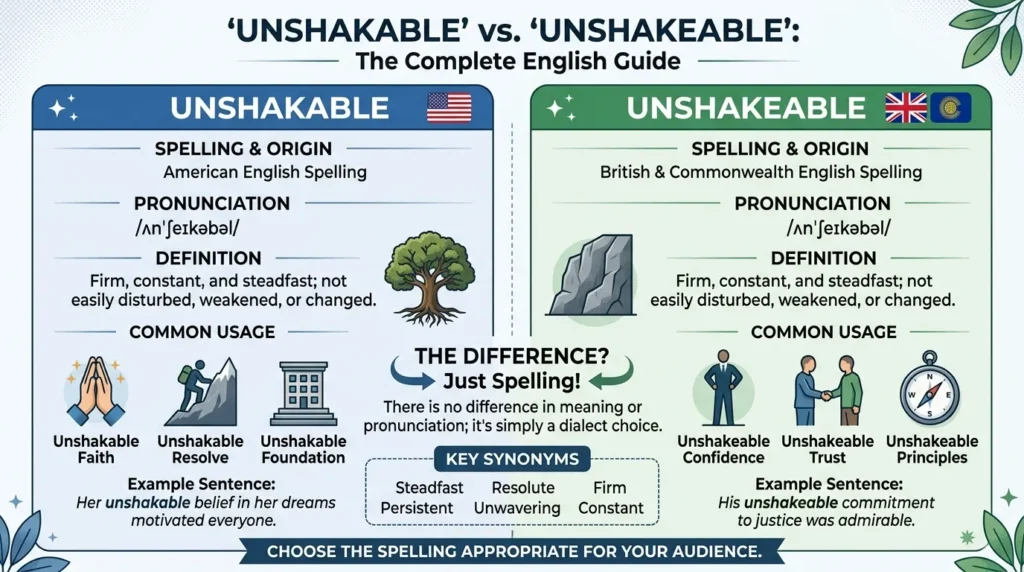
👉 Both spellings are correct
- Unshakable = American English (simplified spelling)
- Unshakeable = British English (traditional spelling)
Examples:
- She has unshakable confidence. ✔ (US style)
- He has unshakeable faith. ✔ (UK style)
👉 Simple rule:
Same meaning, different spelling style only.
The Origin of “Unshakable or Unshakeable”
The word comes from the verb “shake,” which has Old English roots: “sceacan,” meaning to move violently.
Over time:
- “Shake” became the modern English form
- The adjective form developed as “shakeable” (able to be shaken)
- The prefix “un-” was added to form “unshakeable / unshakable”
Why two spellings exist:
- British English kept the full form “unshakeable”
- American English simplified it to “unshakable” by removing the extra “e”
👉 This is part of a general English spelling simplification trend in the US.
British English vs American English Spelling
This is a classic spelling difference between UK and US English.
| Feature | British English | American English |
| Correct form | unshakeable | unshakable |
| Spelling style | traditional | simplified |
| Usage in books | UK publishers | US publishers |
| Meaning | same | same |
| Formal writing | unshakeable | unshakable |
👉 Conclusion: Both are correct, just region-based spelling styles.
Which Spelling Should You Use?
Your choice depends on your audience:
- 🇺🇸 Use “unshakable” when writing for:
- USA blogs
- American business content
- SEO targeting US readers
- 🇬🇧 Use “unshakeable” when writing for:
- UK audiences
- Commonwealth countries (UK, India, Australia, etc.)
- Academic writing in British style
- 🌍 Global websites:
- Choose one style and stay consistent
- “Unshakable” is often preferred in formal international writing
👉 Golden rule:
Consistency matters more than choice.
Common Mistakes with “Unshakable or Unshakeable”
❌ Wrong: unshakible confidence
✔ Correct: unshakable / unshakeable confidence
❌ Wrong: unshakablee belief
✔ Correct: unshakable belief
❌ Wrong: mixing both in one article
✔ Correct: choose one spelling style only
👉 Key mistake:
People confuse spelling variants with different meanings — but meaning is identical.
“Unshakable or Unshakeable” in Everyday Examples
📧 Emails:
- We need unshakable trust in our partnership.
- The team has unshakeable commitment to success.
📰 News:
- The leader showed unshakable confidence during crisis.
- The country’s unshakeable economy continues to grow.
📱 Social Media:
- Unshakable mindset 💪
- Unshakeable belief in dreams ✨
📄 Formal Writing:
- The organization has unshakable principles.
- She demonstrated unshakeable determination.
“Unshakable or Unshakeable” – Google Trends & Usage Data
Search behavior shows:
- High searches in education and self-improvement niches
- Popular in motivational content and business writing
- US prefers “unshakable,” UK prefers “unshakeable”
Top regions:
- United States
- United Kingdom
- Canada
- Australia
- India
👉 Why it trends:
- Used in motivational quotes
- Leadership content
- Psychology and self-help writing
Comparison Table: unshakable vs unshakeable
| Word | Region | Meaning | Usage |
| unshakable | US English | firm, strong, not easily changed | modern writing |
| unshakeable | UK English | firm, strong, not easily changed | traditional writing |
FAQs
1. What is the correct spelling: unshakable or unshakeable?
Both are correct depending on region.
2. Is there any difference in meaning?
No, both mean the same thing.
3. Which spelling is used in America?
“Unshakable” is used in American English.
4. Which spelling is used in British English?
“Unshakeable” is used in British English.
5. Can I use both in one article?
No, you should choose one style for consistency.
6. Is “unshakable” more modern?
Yes, it is the simplified American spelling.
7. Which one is better for SEO?
Both perform equally; choose based on your target audience.
Conclusion
The difference between “unshakable or unshakeable” is a simple example of British and American English spelling variation. Both words have the same meaning: something that is strong, firm, and not easily changed or broken. The only difference is spelling style, not definition or usage.
In American English, the simplified form “unshakable” is preferred, while British English uses the traditional spelling “unshakeable.” This difference comes from historical spelling changes where American English removed extra letters to make words shorter and easier to write.
For learners, writers, and professionals, the most important rule is consistency. Choose one spelling style based on your audience and use it throughout your writing. Mixing both forms in the same content can look unprofessional.
Whether you are writing motivational content, business communication, or academic work, both versions are widely accepted. The key is to understand your audience and apply the correct regional style. Once you learn this simple rule, using “unshakable or unshakeable” correctly becomes very easy and natural in everyday writing.