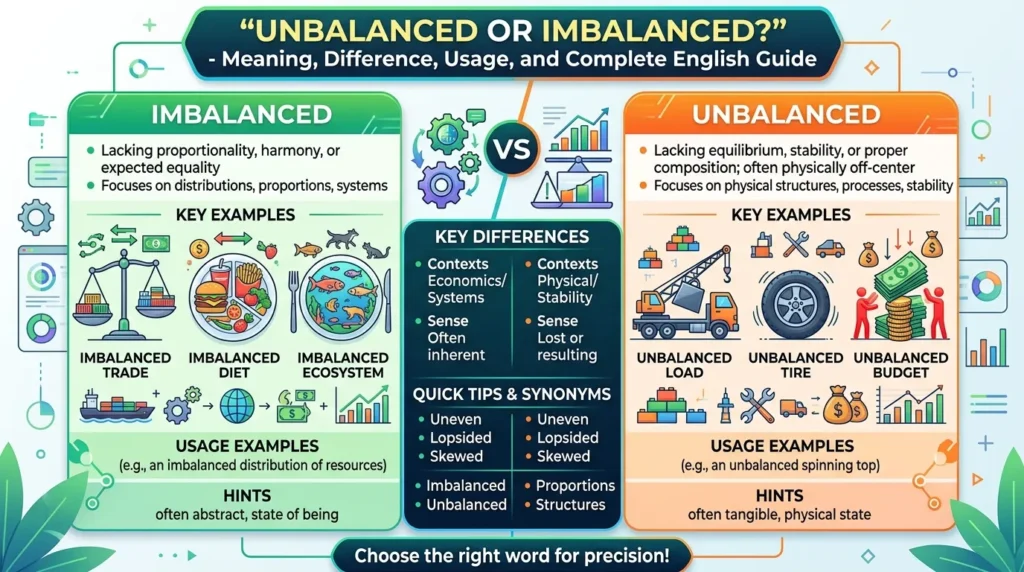
The keyword “unbalanced or imbalanced” is often searched by English learners, writers, and professionals who want to understand whether there is a real difference between these two similar words. At first glance, both words seem interchangeable, but subtle differences in usage, tone, and context make them slightly distinct in modern English.
Many people get confused when writing sentences like “unbalanced diet” or “imbalanced system,” especially in academic writing, science, fitness, and technical content. The confusion increases because both words describe something that is not equal, not stable, or not properly arranged.
For example:
- “The bridge is unbalanced” ✔
- “The chemical levels are imbalanced” ✔
- But choosing the best word depends on context and tone.
In general, “unbalanced” is the more commonly used and natural word in everyday English, while “imbalanced” is often used in technical, scientific, or formal contexts.
This article will clearly explain the difference between unbalanced and imbalanced, their origin, grammar usage, British vs American preferences, common mistakes, real-life examples, and SEO-friendly usage tips. By the end, you will know exactly which word to use in writing, exams, and professional communication without confusion.
“Unbalanced or Imbalanced” – Quick Answer
👉 Both words are correct, but usage differs:
- Unbalanced = more common, general English
- Imbalanced = more formal, technical, or scientific English
Examples:
- The chair is unbalanced ✔
- The economy is imbalanced ✔
- The table is unbalanced ✔
- Hormone levels are imbalanced ✔
👉 Simple rule:
Everyday use → unbalanced | Technical use → imbalanced
The Origin of “Unbalanced or Imbalanced”
Both words come from the root word “balance.”
- Balance comes from Latin “bilanx” meaning “two scales”
- Prefixes added later:
- un- = not (Old English origin)
- im- = not (Latin origin, used before “b/p/m” sounds)
So:
- Unbalanced = not balanced (general English formation)
- Imbalanced = also not balanced (Latin-style formation)
👉 Over time, English developed both forms, but usage diverged.
British English vs American English Spelling
There is no strict difference between British and American English for these words.
However, usage preference differs slightly:
| Feature | British English | American English |
| Unbalanced | very common | very common |
| Imbalanced | less common | more common in technical writing |
| Formal writing | unbalanced preferred | both used |
| Scientific usage | sometimes imbalanced | commonly imbalanced |
👉 Conclusion: Difference is stylistic, not grammatical.
Which Spelling Should You Use?
Your choice depends on context:
- ✅ Use “unbalanced” when:
- Talking about daily life
- Describing objects
- Writing simple English
- Blogging or casual content
- ✅ Use “imbalanced” when:
- Writing scientific reports
- Discussing economy, data, biology
- Using formal academic English
👉 Global rule:
Unbalanced = general | Imbalanced = technical
Common Mistakes with “Unbalanced or Imbalanced”
❌ Wrong: The system is unbalanced (in scientific paper)
✔ Correct: The system is imbalanced
❌ Wrong: The table is imbalanced
✔ Correct: The table is unbalanced
❌ Wrong: Using both randomly in one article
✔ Correct: Keep consistent tone
👉 Key mistake:
People think both words are identical in all contexts.
“Unbalanced or Imbalanced” in Everyday Examples
📧 Emails:
- The workload is unbalanced in the team.
- The data shows an imbalanced structure.
📰 News:
- The market is unbalanced due to demand changes.
- The economy remains imbalanced after inflation.
📱 Social Media:
- My life feels unbalanced 😅
- Nutrition is imbalanced in junk food diets 🍔
📄 Formal Writing:
- The system is unbalanced under pressure.
- The study shows an imbalanced distribution of resources.
“Unbalanced or Imbalanced” – Google Trends & Usage Data
Search trends show:
- High usage among students and writers
- Common in science, health, and economics topics
- “Unbalanced” dominates everyday searches
- “Imbalanced” appears more in academic research
Top regions:
- USA
- UK
- India
- Middle East
- Canada
👉 Why people search it:
- Writing correction
- Academic assignments
- SEO content writing
- Grammar confusion
Comparison Table: Unbalanced vs Imbalanced
| Word | Usage Type | Meaning | Example |
| unbalanced | general English | not equal or stable | unbalanced table |
| imbalanced | formal/technical | not properly distributed | imbalanced data |
FAQs
1. What is the difference between unbalanced and imbalanced?
“Unbalanced” is general; “imbalanced” is more formal or technical.
2. Is unbalanced correct English?
Yes, it is fully correct and widely used.
3. Is imbalanced a real word?
Yes, but it is more formal and less common.
4. Which is more common?
“Unbalanced” is more commonly used.
5. Can I use both interchangeably?
Not always; context matters.
6. Is there British or American difference?
No major difference, only usage preference.
7. Which one is better for SEO?
Both work, but “unbalanced” has higher general search volume.
Conclusion
The difference between “unbalanced or imbalanced” is subtle but important for clear and correct English usage. Both words are grammatically correct, but they are used in different contexts depending on tone, formality, and subject matter.
“Unbalanced” is the more common and natural choice in everyday English. It is used when talking about physical objects, emotions, general situations, or informal writing. On the other hand, “imbalanced” is more formal and often appears in scientific, technical, economic, or academic writing where precision is required.
There is no strict difference between British and American English in grammar rules, but usage trends show slight variation in preference. Understanding context is the key to choosing the right word.
For learners and writers, the simplest rule is this: use “unbalanced” for general communication and “imbalanced” for formal or technical content. This helps improve clarity, professionalism, and accuracy in writing.
By mastering this small distinction, you can avoid confusion and make your English more natural and effective in both academic and real-world situations.