The keyword “else’s or elses” is a very common grammar confusion among English learners. Many people are unsure how to correctly show possession when using the word “else.” This confusion often appears in writing sentences like “someone else’s phone” or incorrect forms like “someone elses phone.”
The problem happens because English grammar uses an apostrophe for possession, but “else” is not a normal noun. It is an adverb, which makes its possessive form slightly tricky. As a result, learners often mistakenly assume that “elses” might be correct or try to form a plural version of “else,” which does not exist.
For example:
- “Someone else’s book” ✔
- “Someone elses book” ❌
- “Someone else book” ❌
This keyword is frequently searched by students, writers, and English learners who want to avoid grammar mistakes in exams, emails, and professional writing. Even native speakers sometimes hesitate when using possessive structures with “else.”
In this article, you will learn the correct usage of else’s, why “elses” is incorrect, the origin of the rule, real-life examples, common mistakes, and simple memory tricks. By the end, you will clearly understand how to use “else’s” correctly in all situations.
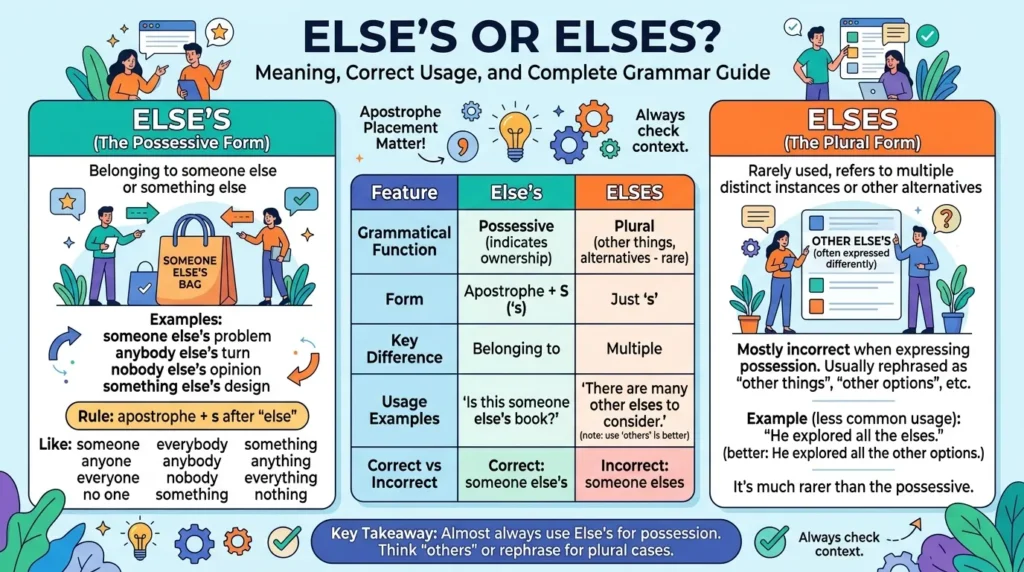
“Else’s or Elses” – Quick Answer
👉 Else’s = Correct (possessive form)
👉 Elses = Incorrect (not a valid English word)
Examples:
- Someone else’s phone ✔
- This is someone else’s idea ✔
- Someone elses phone ❌
👉 Simple rule:
Always use “else’s” with an apostrophe. “Elses” does not exist in standard English.
The Origin of “Else’s or Elses”
The word “else” comes from Old English “elles,” meaning “otherwise” or “in another way.”
Over time:
- “else” became an adverb used in phrases like “someone else”
- English grammar rules added possession forms using apostrophes
- This created the form “else’s” to show ownership
Why confusion happens:
- People try to make “else” plural (but it is not a noun)
- They mistakenly add “-s” instead of using apostrophe + s
👉 Important: “Else” does not follow normal noun rules.
British English vs American English Spelling
There is no difference between British and American English for “else’s.”
Both use the same grammar rule:
| Feature | British English | American English |
| Possessive form | else’s | else’s |
| Incorrect form | elses | elses |
| Usage rule | same | same |
| Formal writing | else’s | else’s |
👉 Conclusion: The rule is universal in English grammar.
Which Spelling Should You Use?
There is only one correct option:
- ✅ Use “else’s” in all situations:
- Academic writing
- Emails
- Business communication
- Exams
- Social media
- ❌ Never use “elses”
👉 Global rule:
“Else’s” is always correct, regardless of region.
Common Mistakes with “Else’s or Elses”
❌ Wrong: Someone elses phone
✔ Correct: Someone else’s phone
❌ Wrong: This is anyones elses idea
✔ Correct: This is someone else’s idea
❌ Wrong: I took elses book
✔ Correct: I took someone else’s book
👉 Key mistake:
People forget the apostrophe or try to form a plural.
“Else’s or Elses” in Everyday Examples
📧 Emails:
- Please review someone else’s report.
- This task belongs to someone else’s team.
📰 News:
- The decision was based on someone else’s recommendation.
- The idea came from someone else’s research.
📱 Social Media:
- Not my problem, it’s someone else’s 😅
- Living in someone else’s dream world ✨
📄 Formal Writing:
- The responsibility lies with someone else’s department.
- The data belongs to someone else’s study.
“Else’s or Elses” – Google Trends & Usage Data
Search trends show:
- High confusion among students and ESL learners
- Common in grammar correction searches
- Frequent in academic writing help queries
Top regions:
- India
- Pakistan
- UK
- USA
- Middle East
👉 Why people search it:
- Apostrophe confusion
- Exam preparation
- Writing corrections
- English learning apps
Comparison Table: Else’s vs Elses
| Word | Status | Meaning | Usage Example |
| else’s | Correct | possession of “else” | someone else’s book |
| elses | Incorrect | not valid English | ❌ (do not use) |
FAQs
1. Is “elses” a real word?
No, “elses” is not a valid English word.
2. What is the correct form: else’s or elses?
The correct form is else’s.
3. Why do we use an apostrophe in else’s?
To show possession (something belonging to someone else).
4. Can I ever use “elses”?
No, it is always incorrect.
5. Is this rule different in British and American English?
No, both follow the same rule.
6. What is the base word?
The base word is else.
7. Can “else” be plural?
No, “else” is not a noun, so it cannot be plural.
Conclusion
The confusion between “else’s or elses” is common, but the rule is actually very simple. The correct and only accepted form in English is “else’s.” This apostrophe form is used to show possession, meaning something belonging to someone other than the person being discussed.
The incorrect form “elses” does not exist in standard English grammar. It appears when learners mistakenly try to make “else” plural, even though it is not a noun and cannot be pluralized. Understanding this small rule can help avoid major grammar mistakes in writing, exams, and professional communication.
Both British and American English follow the same rule, so there is no regional difference. Whether you are writing emails, essays, or social media posts, “else’s” is always the correct choice.
By remembering one simple idea — “else always takes apostrophe + s for possession” — you can eliminate confusion completely. This small grammar rule improves clarity, accuracy, and professionalism in your English writing. Once you master it, you will never confuse “else’s or elses” again.