To “pursue” something means to keep going after it — a dream, a career, a goal, or even a person. It is a word full of energy and determination: she pursued her dream of becoming a doctor; he pursued the thief down the street.
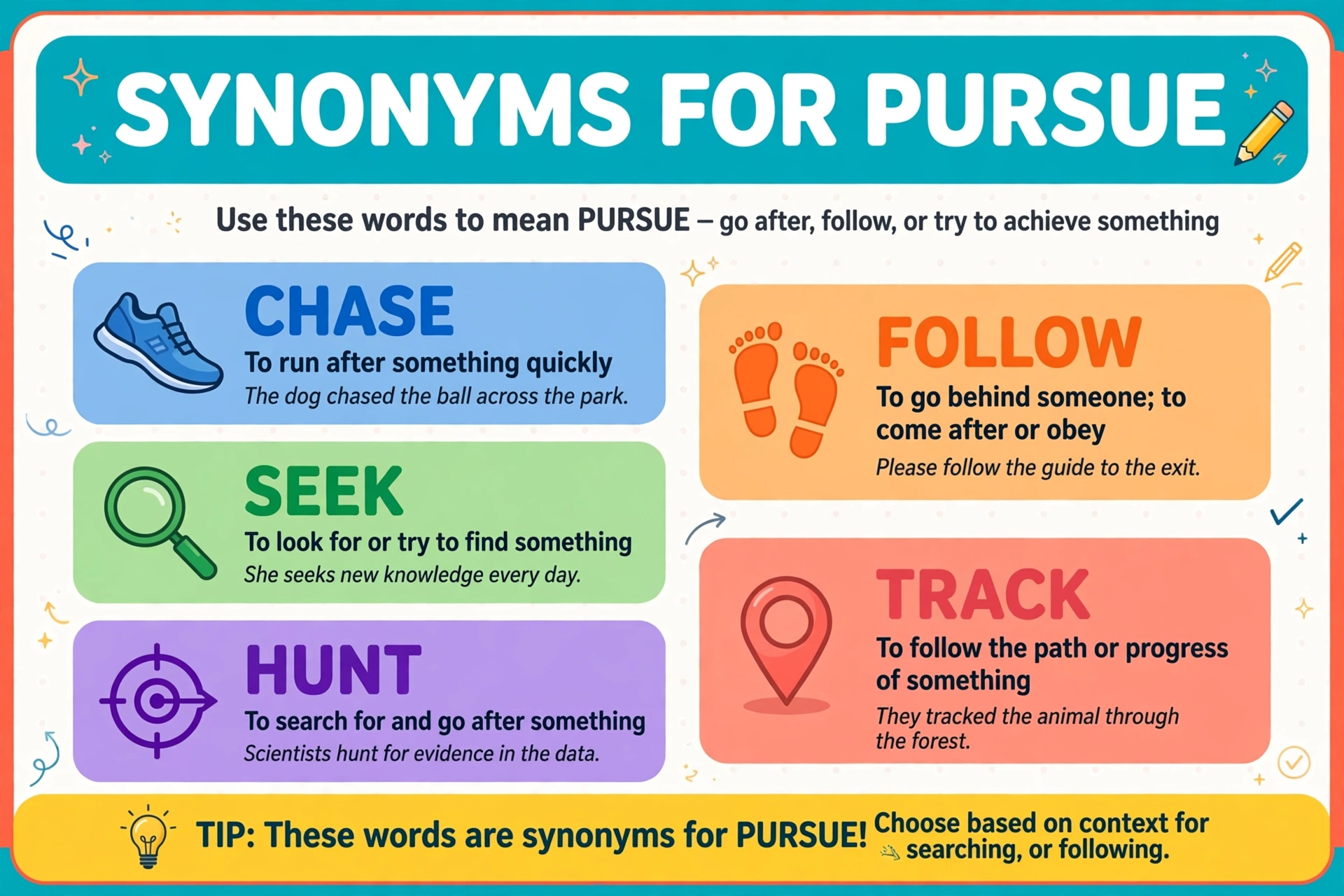
Because “pursue” covers so many situations, its synonyms split into different flavors. Some describe searching, some describe chasing, and some describe steady hard work. The five below are the most useful and common, each with its own natural habitat.
It appears in graduation speeches, job interviews, and love songs alike. “Pursue your dreams” is the classic advice; “the police pursued the suspect” is the classic news line. Same verb, wildly different scenes. That range is exactly why the synonyms matter — “chase” belongs in the news line, “follow” belongs in the speech, and swapping them would sound wrong in both.
English even has a vivid idiom for close chasing: “in hot pursuit.” It means following someone or something very closely, right on their heels — “The guards were in hot pursuit of the escaped prisoner.” Idioms like this show how deeply the idea of pursuit runs in the language. But notice that the idiom keeps the physical, urgent sense of “chase,” not the calm sense of “follow your dreams.” Every synonym guards its own territory.
Seek
Meaning: To try to find, get, or achieve something you want.
Example: Many graduates seek jobs that match their skills and interests.
Another example: The lost hikers sought shelter in a nearby cave.
Chase
Meaning: To run after or follow something quickly in order to catch or reach it.
Example: The children chased the ice cream truck down the street, laughing loudly.
Another example: The puppy chased its own tail around the garden.
Follow
Meaning: To continue along a chosen path, dream, or course of action.
Example: She followed her passion for music and became a piano teacher.
Another example: They followed the river until they reached the village.
Strive
Meaning: To work very hard over time to reach something you want.
Example: The team strives to deliver the best customer service in the city.
Another example: She strives to be kind even to her most difficult customers.
Aim for
Meaning: To choose something as your goal and direct your efforts toward it.
Example: He is aiming for a promotion before the end of the year.
Another example: The club is aiming for its first championship title this season.
How to Use These Words
“Chase” fits physical or urgent pursuit; “seek” fits searching for opportunities or help; “follow” fits dreams and careers; “strive” fits long, hard effort; “aim for” fits clear targets. Using “chase” for a career (“chase a career in law”) sounds aggressive, while “follow a career” sounds natural. Choosing the right shade is the heart of good vocabulary.
Pay attention to what follows each verb. “Seek” pairs with nouns like advice, help, and opportunity. “Strive” pairs with “to” plus a verb: “strive to improve.” “Aim for” needs a clear target: “aim for a promotion.” Learning these little partnerships — which words travel together — is what separates fluent speakers from textbook speakers. The same precision helps with tricky pairs like chose vs choose and passed vs past.
Also notice the time each verb implies. “Chase” is fast and immediate — it happens now. “Seek” is calm and can stretch over weeks. “Strive” is the longest of all: it suggests months or years of effort. “Aim for” points at a future moment. When you match the verb’s speed to your situation, your writing gains a natural rhythm that readers feel even if they cannot name it.
Common Mistakes to Avoid
- Using “chase” for careers and dreams. “Chase a career in law” sounds aggressive and desperate. Say “follow a career” or “pursue a career” for a calm, professional tone.
- Forgetting “to” after “strive.” The pattern is “strive to” plus a verb: “strive to improve,” “strive to win.” “Strive success” is incorrect.
- Using “aim for” without a clear target. “Aim for” needs something specific: “aim for a promotion,” “aim for the top score.” A vague “aim for success” wastes the phrase’s precision.
- Confusing “pursue” with “sue.” They look related but are completely different: “pursue” means to chase or follow, while “sue” means to take someone to court. “Pursue a claim” (continue with it) is fine; “sue a claim” is nonsense.
Quick Practice
Choose the best word or phrase for each sentence: seek, chase, strive, aim for.
- Students should ___ help before the exam, not after it.
- The young runner is ___ a new national record this year.
- They ___ to keep their prices low for regular customers.
Answer key: 1. seek — 2. aiming for — 3. strive
Related Words Worth Learning
FAQs
What is the most common synonym for “pursue”?
“Seek” and “follow” are the most common in everyday English: “seek help,” “follow your dreams.” “Chase” is common too, but mostly for physical or playful pursuit. All three appear constantly in motivational writing, which is why they are worth mastering first.
Is “pursue” formal?
Somewhat. In casual speech people often say “go after” or “go for” instead: “Go for your dreams!” In essays and business writing, “pursue” sounds polished and professional.
What is the difference between “seek” and “chase”?
“Seek” is calm and deliberate — you seek advice or opportunity. “Chase” is fast and energetic — you chase a bus or a dream. One searches; the other runs.
Can “strive” be used for small goals?
Yes. “Strive” works for any goal requiring real effort, big or small: “I strive to read twenty pages every night.” It simply stresses the hard work involved.
What does “in hot pursuit” mean?
It means chasing someone or something very closely — right on their heels. “The police were in hot pursuit of the stolen car.” It keeps the urgent, physical sense of “chase,” so use it for exciting scenes, not for calm goals like careers.
Is “pursue” used in legal contexts?
Yes. “To pursue a claim” or “to pursue a case” means to continue with legal action. It is the formal way of saying you are keeping a legal matter alive. Do not confuse this with “sue,” which means starting the legal action in the first place.
Conclusion
“Pursue” is about motion toward something you want, and these five synonyms give that motion its proper name: “seek” for searching, “chase” for running after, “follow” for staying on a path, “strive” for hard effort, and “aim for” for clear targets. Learn which fits where, and your English will move with purpose — just like the goals these words describe.
Pick one goal you are working on right now and describe it with each of these five verbs. Which one feels truest? The answer tells you something about your goal — and about how well you now command these words.

James Reed is a writer and English language enthusiast with a passion for making vocabulary simple and fun. He writes about words, meanings, and everyday English to help learners speak and write with confidence.