To adapt means to change yourself, your plans, or your behavior so you can handle a new situation successfully. Students adapt when they move to a new school, employees adapt when their company introduces new software, and travelers adapt when they visit a country with different customs. It is one of the most useful words in English because change is a constant part of life.
History rewards those who adapt. Companies that adjust to new technology survive; those that refuse, quietly fade. The pattern is personal too: a student who modifies her study habits after a poor grade recovers fast, while one who repeats the same routine struggles again. Adaptation is not a gift you are born with — it is a habit built one small adjustment at a time, and the five words below will help you name every stage of it.
The problem is that “adapt” gets repeated too often. Reaching for a synonym lets you express the exact kind of change you mean — a small adjustment, a deliberate redesign, or a slow personal transformation. The five words below will help you do exactly that. (And if you ever mix this word up with a close neighbor, our guide to adapt vs adopt clears up that classic confusion.)
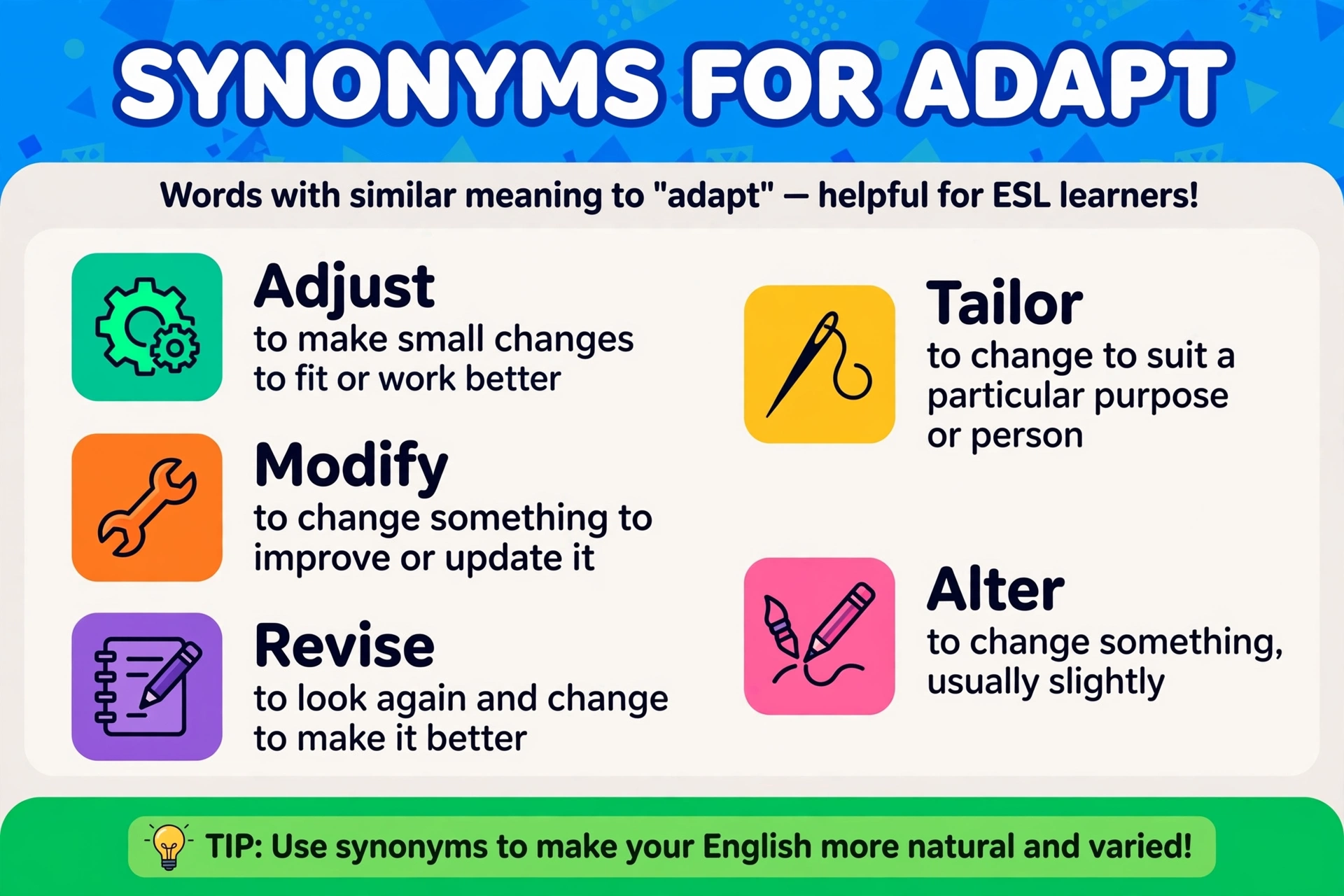
Adjust
Meaning: To make small changes so something works better or feels more comfortable in a new situation.
Example: It took me two weeks to adjust to the early morning schedule at my new job.
Example 2: She adjusted the brightness on her laptop before starting the presentation.
Modify
Meaning: To change something deliberately, usually in a small or partial way, to improve it or suit a new purpose.
Example: The teacher modified the quiz so it would be fair for students with extra needs.
Example 2: Engineers modified the engine design to reduce fuel consumption.
Alter
Meaning: To change the form, appearance, or nature of something from what it was before.
Example: We had to alter our travel plans when the flight was cancelled.
Example 2: The tailor altered the jacket so it would fit perfectly.
Acclimate
Meaning: To gradually become comfortable with a new environment, climate, or set of conditions.
Example: New players need time to acclimate to the high altitude before the match.
Example 2: It took the rescue dog a full month to acclimate to its new home.
Transform
Meaning: To change something completely, turning it into something very different from before.
Example: Regular practice transformed her from a shy speaker into a confident presenter.
Example 2: The empty warehouse was transformed into a lively art gallery.
Adapt at a Glance
A quick comparison to lock in the differences:
| Word | Tone | Use it when… |
|---|---|---|
| Adjust | Neutral | making small, everyday tweaks |
| Modify | Neutral | deliberately improving or redesigning something |
| Alter | Neutral | changing the form of something or changing plans |
| Acclimate | Neutral | a person is slowly getting used to new conditions |
| Transform | Strong | the change is complete and dramatic |
How to Use These Words
Choose your word based on the size and speed of the change. Use adjust for small, everyday tweaks, modify and alter when someone intentionally redesigns something, acclimate when a person slowly gets used to new surroundings, and transform only when the change is dramatic and complete. Saying a schedule was “transformed” when you merely “adjusted” it will sound exaggerated, so match the word to the scale. In academic writing, these precise choices matter even more — just as spelling does, which is why learners also check analyze or analyse before submitting essays.
A practical trick: test your sentence by swapping in each candidate. “The company adjusted its strategy” sounds natural, but “the company acclimated its strategy” sounds odd — because acclimate needs a person settling into conditions, not a strategy being tweaked. Reading your sentence aloud with each option is the fastest way to feel which shade fits. Over time, you will stop translating from “adapt” and start thinking directly in the precise word, which is exactly how fluent vocabulary is built.
Register matters as well. In a formal report you might write “the policy was modified to meet new regulations,” while in a text to a friend you would simply say “I adjusted my plans.” Both are correct; they just dress for different occasions. Also notice the partnerships native speakers favor: we adjust settings, attitudes, and schedules; we modify designs, behavior, and rules; we alter plans, appearances, and arrangements; acclimate applies to people and animals; and we transform spaces, lives, and industries. Learning these pairings is as important as learning the words themselves.
Common Mistakes to Avoid
- Using “transform” for tiny changes. Moving your desk an inch did not “transform” your office — it “adjusted” it. Save transform for complete, dramatic change, or your writing will sound inflated.
- Acclimating objects. People and animals acclimate; things do not. A company adjusts its policy — it never “acclimates” it.
- Mixing up adapt and adopt. You adapt yourself to new conditions, but you adopt a method or idea from someone else. Similar sounds, opposite jobs.
- Wrong preposition. We adapt to new conditions — not “adapt with” or “adapt on.” Lock in the partnership adapt + to.
Related Words Worth Learning
- Synonyms for Flexible — the mindset that makes adapting easier
- Synonyms for Resilience — bouncing back when change is hard
- Synonyms for Determination — staying the course through transitions
Quick Practice
Choose the best word for each sentence:
- The chef ___ the recipe to use less salt. (adjusted / transformed)
- After moving abroad, it took her months to ___ to the new culture. (acclimate / alter)
- The old factory was ___ into a busy shopping mall. (transformed / adjusted)
- Could you ___ the volume? I can barely hear the dialogue. (adjust / acclimate)
Answer key: 1. adjusted — 2. acclimate — 3. transformed — 4. adjust
FAQs
What is the closest synonym for adapt?
Adjust is the closest everyday synonym. Both describe changing to fit new conditions, though “adjust” usually suggests smaller, quicker changes than “adapt.”
What is the difference between adapt and adjust?
To adapt often means a deeper or longer change — like adapting to a new country. To adjust usually means a smaller fix — like adjusting your chair. They overlap, but adapt sounds more significant.
Can “transform” always replace “adapt”?
No. Transform means a complete, dramatic change, while adapt can be gradual and partial. Use transform only when something becomes truly different.
Is “acclimate” formal or informal?
It is slightly formal and most common in writing about travel, work relocations, or sports. In casual speech, people often say “get used to” instead.
Can “adapt” be used without “to”?
Yes. “Adapt to” is the usual pattern for conditions (“adapt to change”), but the verb can stand alone: “Species that cannot adapt die out.” When the object is a thing being reshaped, no “to” appears: “She adapted the novel for the stage.”
What is the noun form of adapt?
“Adaptation” — the process or result of adapting. “The film is an adaptation of the famous novel.” Watch the spelling: adap-t-a-tion, not the common misspelling “adaption.”
Conclusion
Adapting is about meeting change with the right response, and choosing the right word is part of that skill. Adjust for small tweaks, modify and alter for deliberate redesigns, acclimate for slowly settling into new conditions, and transform for total reinvention. Practice these five in your emails, essays, and conversations, and you will describe change with far more precision than “adapt” alone ever could.

Thomas Allen is a language writer and editor who loves exploring the subtle differences between words. He creates clear, practical guides that help readers understand English better — one word pair at a time.