Have you ever written “awakened” or “awoken” and wondered which one is correct? You are not alone. Many English learners, writers, students, and professionals often search for “awakened or awoken” because both words appear in books, articles, and everyday conversations.
The confusion comes from the fact that both forms are related to the verb awake. Unlike many English verbs that have only one standard past participle, awake has multiple accepted forms. This can make it difficult to know which word fits best in a sentence.
People often want to know whether awakened and awoken mean the same thing, whether one is more formal than the other, and whether British and American English prefer different forms.
The good news is that both words are correct. However, they are not always used in exactly the same way. Understanding the differences can help you write more naturally and confidently.
In this guide, you’ll learn the meanings, origins, usage differences, regional preferences, common mistakes, examples, FAQs, and professional advice for choosing between awakened and awoken.
Awakened or Awoken – Quick Answer
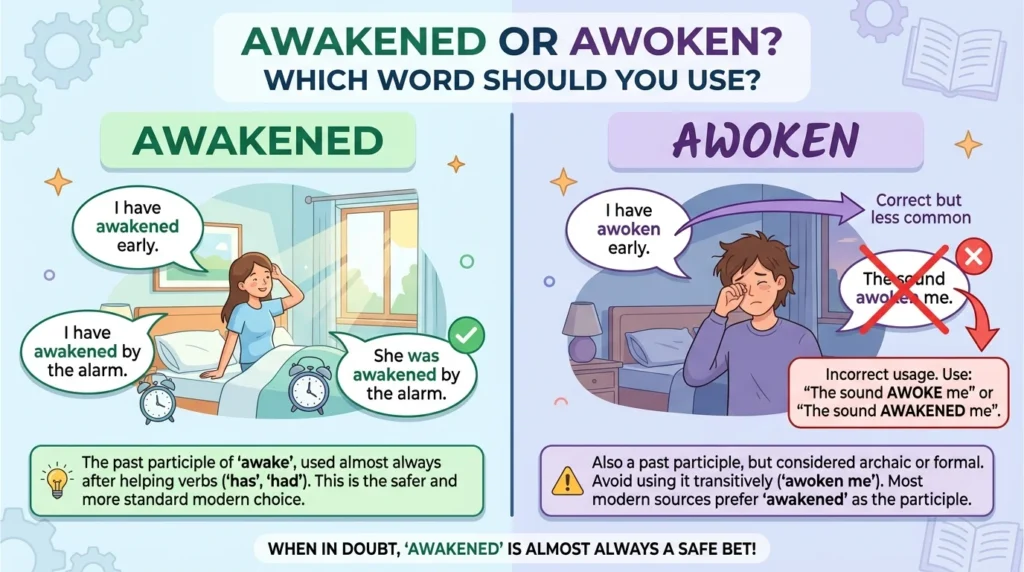
Both awakened and awoken are correct.
Quick Rule
- Awakened is commonly used as both a past tense and a past participle.
- Awoken is mainly used as a past participle.
Examples
✅ I awakened early this morning.
✅ She was awakened by a loud noise.
✅ I had awoken before sunrise.
✅ They were suddenly awoken by the alarm.
In modern English, awakened is generally more common, while awoken often sounds slightly more literary or traditional.
The Origin of Awakened or Awoken
The verb awake comes from Old English awæcnan, meaning “to wake up” or “become alert.”
Over centuries, English developed several forms of the verb:
- Awake
- Awakes
- Awoke
- Awakened
- Awoken
Historically, English allowed multiple past and participle forms for many verbs. Similar examples include:
- Break → Broke → Broken
- Speak → Spoke → Spoken
- Wake → Woke → Woken
The word awakened developed through the regular addition of -ed, while awoken followed an older strong-verb pattern.
Because both forms survived, modern English continues to accept both.
British English vs American English Spelling
This is not really a spelling difference. Instead, it is a usage difference.
Both British and American English recognize awakened and awoken.
Comparison Table
| English Version | Awakened | Awoken |
|---|---|---|
| American English | Very common | Less common |
| British English | Common | Common |
| Formal Writing | Common | Common |
| Everyday Speech | More common | Less common |
Examples
| Region | Example |
|---|---|
| United States | She was awakened by the phone. |
| United Kingdom | She had awoken before dawn. |
| Australia | The child was awakened by thunder. |
American English tends to favor awakened, while British English uses both forms more freely.
Which Spelling Should You Use?
Since both words are correct, your choice depends on your audience and writing style.
For US Audiences
Use awakened in most situations.
Example:
- He was awakened by the alarm.
For UK Audiences
Both awakened and awoken are widely accepted.
Example:
- She had awoken before the rest of the family.
For Commonwealth Countries
Australia, New Zealand, Canada, and South Africa generally accept both forms.
For Global Audiences
If you want the safest and most widely understood option, choose awakened.
It sounds natural in both formal and informal writing.
Common Mistakes with Awakened or Awoken
Because both forms are correct, mistakes usually happen when writers use them in the wrong grammatical structure.
Common Errors
| Incorrect | Correct |
|---|---|
| I awoken at 6 a.m. | I awoke at 6 a.m. |
| She has awakened before dawn yesterday. | She awakened before dawn yesterday. |
| They have awoke already. | They have awoken already. |
| He was awokened by the noise. | He was awoken by the noise. |
Key Rule
- Past tense: awoke or awakened
- Past participle: awoken or awakened
Awakened or Awoken in Everyday Examples
In Emails
- I was awakened by an urgent call this morning.
- We had awoken before the meeting started.
In News Articles
- Residents were awakened by a loud explosion.
- The town had awoken to severe weather conditions.
On Social Media
- Just awakened and already need coffee!
- I had awoken before my alarm today.
In Formal Writing
- The findings awakened public interest.
- The nation had awoken to a new political reality.
Notice that awakened often appears more frequently in modern writing.
Awakened or Awoken – Google Trends & Usage Data
Search interest for “awakened or awoken” remains steady because both words are correct and commonly encountered.
Usage Trends
- Awakened is more common in everyday writing and journalism.
- Awoken appears frequently in literature and formal writing.
- English learners often search the phrase to understand grammar differences.
Popular Countries for Searches
The keyword is commonly searched in:
- United States
- United Kingdom
- Canada
- Australia
- India
- Pakistan
Most searches come from writers, students, and professionals checking which form fits their sentence.
Awakened vs Awoken Comparison Table
| Feature | Awakened | Awoken |
|---|---|---|
| Correct English | Yes | Yes |
| Past Tense Use | Yes | No |
| Past Participle Use | Yes | Yes |
| Common in American English | Very Common | Less Common |
| Common in British English | Common | Common |
| Formal Writing | Yes | Yes |
| Everyday Conversation | Very Common | Less Common |
Frequently Asked Questions (FAQs)
1. Is awakened or awoken correct?
Both are correct English words.
2. Which is more common, awakened or awoken?
Awakened is generally more common in modern English.
3. Can awakened be a past tense?
Yes. Example: “I awakened early.”
4. Can awoken be a past tense?
No. Awoken is mainly used as a past participle.
5. Is awoken old-fashioned?
Not exactly. It is still widely used but often sounds more literary or formal.
6. Do British and American English use different forms?
American English tends to prefer awakened, while British English commonly uses both.
7. Which word should I use in professional writing?
Awakened is usually the safest and most universally accepted choice.
Conclusion
The choice between awakened and awoken can seem confusing because both words are correct and belong to the verb awake. However, understanding their grammatical roles makes the decision much easier. Awakened works as both a past tense and a past participle, making it the more flexible and commonly used option in modern English. Awoken, on the other hand, is mainly used as a past participle and often appears in literary or formal contexts.
There is no major spelling difference between British and American English. Both forms are accepted, although American English tends to favor awakened more often. If you are writing for a global audience or want the safest choice, awakened is usually the better option.
Whether you are writing emails, reports, articles, or social media posts, both words can be correct when used properly. Remember the simple rule: use awakened for maximum flexibility and awoken mainly as a past participle.