Have you ever heard someone say “I was conversating with my friend” and wondered if that was correct? Many people search for conversing or conversating because they are unsure which word belongs in standard English. The two terms sound similar, and both relate to talking with another person. However, they are not treated the same way by grammar experts, dictionaries, and style guides.
The confusion often comes from everyday speech, social media, music, and informal conversations where “conversating” is sometimes used. Meanwhile, “conversing” has long been accepted as the standard form in formal and professional English. Because both words appear in modern communication, many writers and speakers want to know which one they should use.
This guide explains the difference between conversing and conversating, explores their history, compares usage across regions, highlights common mistakes, and provides practical examples. By the end, you will know which word is generally preferred and how to use it correctly in different situations.
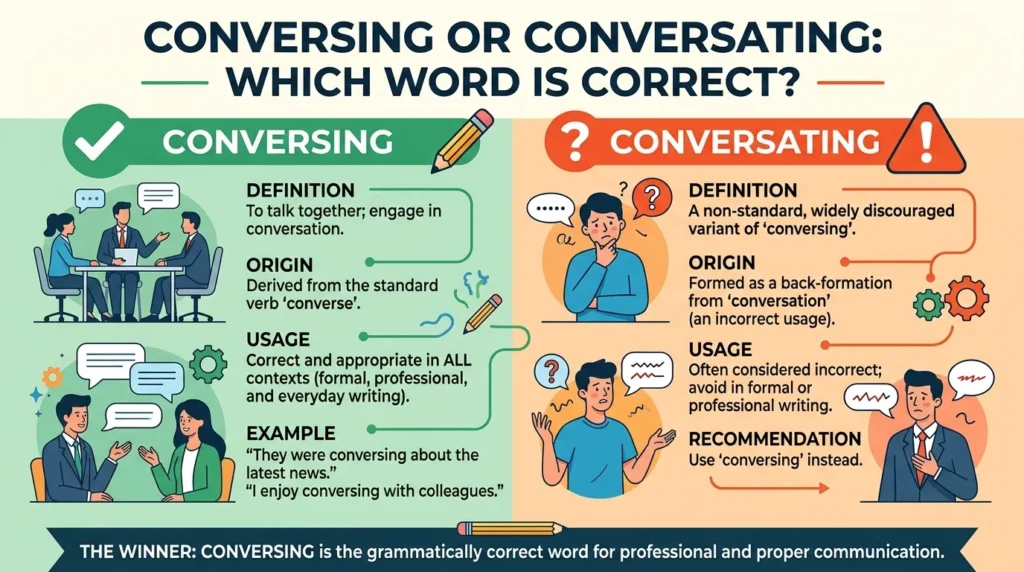
Conversing or Conversating – Quick Answer
The quick answer is simple:
- Conversing is the standard and widely accepted word.
- Conversating is considered nonstandard by many grammar experts.
Examples
Correct:
- We were conversing about travel plans.
- She enjoys conversing with new people.
Less Preferred:
- We were conversating about travel plans.
Quick Rule
| Word | Status |
|---|---|
| Conversing | Standard English |
| Conversating | Nonstandard or informal |
For professional, academic, and business writing, conversing is usually the better choice.
The Origin of Conversing or Conversating
Understanding the history helps explain the confusion.
Origin of Conversing
The word converse comes from Latin roots meaning “to turn around” or “to associate with others.” Over time, it developed the meaning of talking or communicating.
The verb forms include:
- Converse
- Converses
- Conversed
- Conversing
These forms have been accepted in English for centuries.
Origin of Conversating
The word conversating appeared later as a variation created from the noun “conversation.”
Many speakers naturally formed:
- Conversation → Conversate → Conversating
Although it became common in some communities and informal speech, major grammar guides generally continue to prefer converse and conversing.
Why Both Forms Exist
Language changes over time.
People often create new verbs from nouns, which is why “conversating” developed even though “conversing” already existed.
British English vs American English Spelling
Unlike words such as “color” and “colour,” there is no spelling difference between British and American English.
The main issue is acceptance rather than spelling.
Comparison Table
| Word | American English | British English |
|---|---|---|
| Conversing | Accepted | Accepted |
| Conversating | Informal/Nonstandard | Informal/Nonstandard |
Examples
American English:
- We were conversing after the meeting.
British English:
- We were conversing after the meeting.
Both countries generally prefer conversing.
Which Spelling Should You Use?
The safest choice depends on your audience.
For US Audiences
Use:
- Conversing
Example:
- The guests were conversing quietly.
For UK Audiences
Use:
- Conversing
Example:
- They spent the evening conversing.
For Global Audiences
Use:
- Conversing
It is understood and accepted worldwide.
Professional Recommendation
If you are writing:
- Articles
- Business emails
- Academic papers
- Reports
- News content
Use conversing.
Common Mistakes with Conversing or Conversating
Mistake 1: Assuming Conversating Is Standard English
Incorrect:
- Conversating is the formal version.
Correct:
- Conversing is the standard form.
Mistake 2: Using Conversating in Academic Writing
Incorrect:
- The participants were conversating during the study.
Correct:
- The participants were conversing during the study.
Mistake 3: Mixing Formal and Informal Styles
Incorrect:
- The report stated employees were conversating.
Correct:
- The report stated employees were conversing.
Mistake 4: Confusing Conversation with Conversing
Remember:
| Word | Meaning |
|---|---|
| Conversation | A discussion |
| Conversing | Taking part in a discussion |
Mistake 5: Believing Conversating Is Always Wrong
While many style guides discourage it, some speakers use “conversating” naturally in informal speech.
Conversing or Conversating in Everyday Examples
In Emails
Correct:
We were conversing about the project timeline.
In News Writing
Correct:
Officials were seen conversing before the event.
On Social Media
Informal:
Just conversating with friends all night.
Formal Alternative:
Just conversing with friends all night.
In Academic Writing
Correct:
Participants were conversing in small groups.
In Business Communication
Correct:
Team members were conversing during the workshop.
Conversing or Conversating – Google Trends & Usage Data
The keyword conversing or conversating receives steady search interest because many people are unsure which term is correct.
Countries Showing Interest
Searches often come from:
- United States
- United Kingdom
- Canada
- Australia
- South Africa
Why People Search It
Users often want to know:
- Which word is grammatically correct.
- Whether conversating is acceptable.
- Which term to use in formal writing.
- Whether dictionaries recognize conversating.
Contexts of Usage
The discussion frequently appears in:
- Grammar websites
- Writing blogs
- Social media posts
- Educational content
- Workplace communication guides
Overall Trend
Modern grammar resources overwhelmingly recommend conversing as the preferred choice.
Conversing vs Conversating Comparison Table
| Feature | Conversing | Conversating |
|---|---|---|
| Standard English | Yes | Usually No |
| Dictionary Acceptance | Yes | Limited |
| Academic Writing | Recommended | Not Recommended |
| Business Writing | Recommended | Not Recommended |
| Everyday Speech | Common | Sometimes Used |
| Global Understanding | Excellent | Moderate |
| Professional Use | Strong | Weak |
Frequently Asked Questions
1. Is conversating a real word?
Some dictionaries recognize it, but many grammar experts consider it nonstandard.
2. Which is correct, conversing or conversating?
Conversing is the standard and preferred form.
3. Can I use conversating in casual conversation?
Yes. Many people use it informally.
4. Should I use conversating in business writing?
No. Use conversing instead.
5. Is conversating grammatically wrong?
Many style guides discourage it, but it appears in informal speech.
6. Why do people say conversating?
Many speakers create it from the word “conversation.”
7. Do British and American English use different forms?
No. Both generally prefer conversing.
Conclusion
The debate over conversing or conversating is mainly about standard versus informal usage. While both words can be heard in everyday speech, conversing remains the preferred choice in modern English. It is accepted by grammar experts, widely recognized by dictionaries, and commonly used in academic, professional, journalistic, and business writing.
The word conversating developed over time through natural language evolution and continues to appear in casual conversations, social media posts, and some cultural contexts. However, many editors and style guides still view it as informal or nonstandard.
For most situations, especially when writing for a broad audience, using conversing is the safest and most professional option. It communicates your message clearly and avoids criticism from readers who follow traditional grammar rules.
If your goal is effective communication, professionalism, and grammatical accuracy, choose conversing. It is the form most readers expect and understand across different English-speaking regions.