Have you ever wondered whether you should write “frolick” or “frolic”? You’re not alone. Many English learners, students, writers, and professionals search for this keyword because both spellings look believable. Since English contains many words that change spelling when adding endings like -ed or -ing, it’s easy to assume that frolick might also be a correct base word.
The confusion usually comes from forms such as frolicked and frolicking, where the letter k appears before the ending. This leads many people to believe that the original word is frolick, when in fact it is frolic. Understanding this spelling rule helps you avoid common writing mistakes and improves your grammar.
In this guide, you’ll learn the correct spelling, the history of the word, British and American English usage, common mistakes, real-life examples, Google usage trends, and practical advice on when to use each form. By the end, you’ll know exactly why frolic is the correct base spelling and when the extra k appears.
Frolick or Frolic – Quick Answer
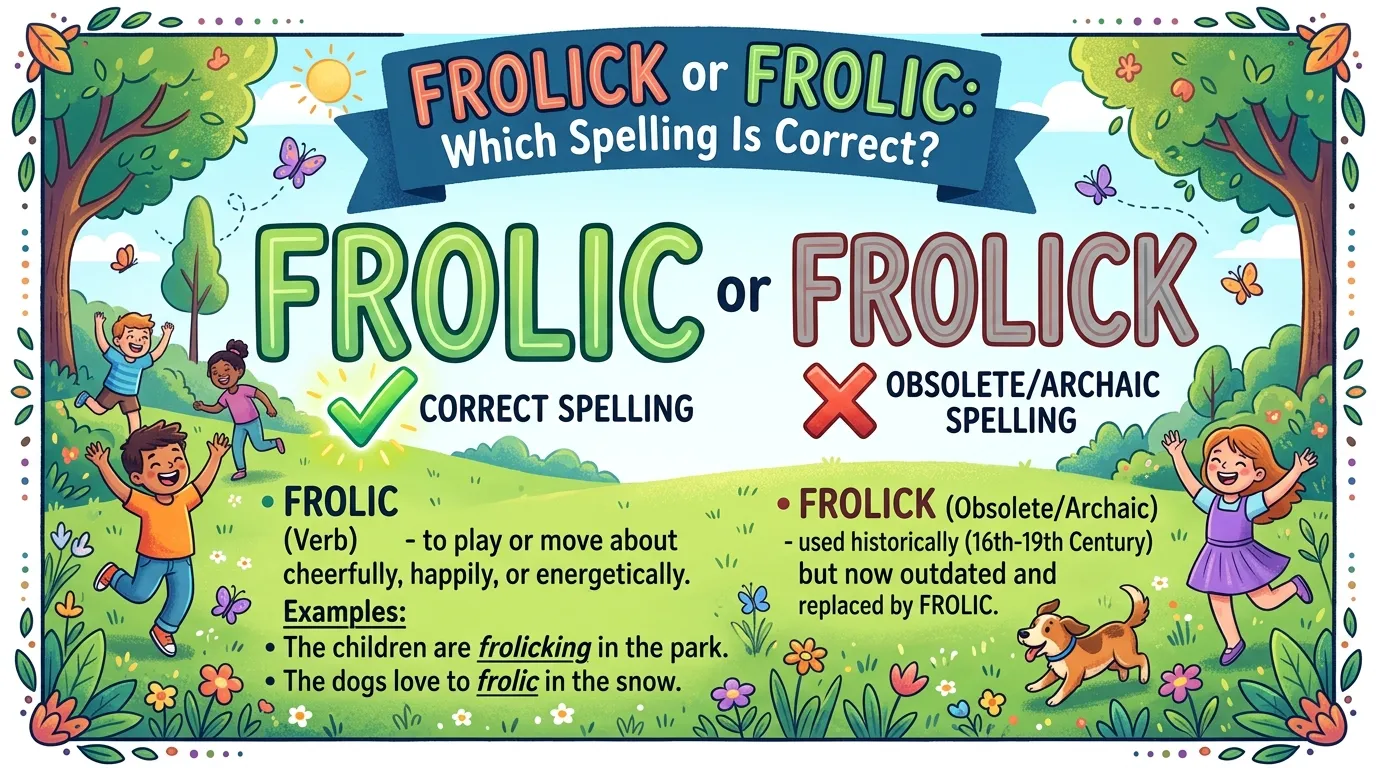
The correct base spelling is frolic.
Frolick is not a correct standalone English word.
However, the letter k appears in words like frolicked and frolicking because of English spelling rules.
Examples
✅ The children frolic in the park every afternoon.
✅ We watched the puppies frolic on the beach.
✅ The children frolicked in the snow yesterday.
✅ They were frolicking in the garden.
❌ The children love to frolick.
The Origin of Frolick or Frolic
The word frolic has existed in English for several centuries.
It comes from the Dutch word vrolijk, meaning happy, cheerful, or joyful. Over time, English speakers adapted the spelling and pronunciation until it became frolic.
Originally, the word described cheerful play, lively movement, and carefree fun. Today, it can be used as both a noun and a verb.
Examples:
- The lambs frolic in the field.
- The picnic became a joyful frolic.
Why Does “Frolicked” Have a K?
English spelling often adds k before endings like -ed and -ing to keep the hard c sound.
Examples:
- Frolic → Frolicked
- Frolic → Frolicking
- Panic → Panicked
- Picnic → Picnicked
The extra k is added only when attaching certain endings. It is not part of the base word.
British English vs American English Spelling
There is no spelling difference between British English and American English.
Both varieties use:
- Frolic
- Frolicked
- Frolicking
Neither uses frolick as the dictionary form.
Examples
British English
- Children frolic in the garden.
American English
- Kids frolic in the backyard.
Both follow the same spelling rules.
Comparison Table
| Form | British English | American English |
|---|---|---|
| Base verb | Frolic | Frolic |
| Past tense | Frolicked | Frolicked |
| Present participle | Frolicking | Frolicking |
| Standalone “frolick” | Incorrect | Incorrect |
Which Spelling Should You Use?
Always choose frolic when writing the base word.
Use frolicked and frolicking only when the grammar requires those forms.
Audience-Based Advice
| Audience | Recommended Spelling |
|---|---|
| United States | Frolic |
| United Kingdom | Frolic |
| Canada | Frolic |
| Australia | Frolic |
| Global audience | Frolic |
Remember:
- Base word → Frolic
- Past tense → Frolicked
- Continuous form → Frolicking
Never write frolick by itself.
Common Mistakes with Frolick or Frolic
Many writers add an unnecessary k because they have seen frolicking or frolicked.
Mistake 1
❌ The puppies love to frolick.
✅ The puppies love to frolic.
Mistake 2
❌ We watched them frolick around the yard.
✅ We watched them frolic around the yard.
Mistake 3
❌ Yesterday they froliced in the snow.
✅ Yesterday they frolicked in the snow.
Mistake 4
❌ They are frolicing outside.
✅ They are frolicking outside.
Easy Tip
- No ending = Frolic
- Add -ed or -ing = Add k
Frolick or Frolic in Everyday Examples
Here are common examples in real writing.
The children can frolic in the playground after lunch.
News
Visitors watched dolphins frolic near the shore.
Social Media
Our puppy loves to frolic in the fresh snow!
Formal Writing
Young animals often frolic during the early stages of development.
Story Writing
The lambs frolicked across the green field.
Nature Blog
Butterflies frolicked among the colorful flowers all morning.
Frolick or Frolic – Google Trends & Usage Data
Search data shows that frolic is searched far more often than frolick because it is the correct dictionary word.
People often search frolick because they are unsure about the spelling after seeing words like frolicking and frolicked.
Popular Countries
| Country | Common Search |
|---|---|
| United States | Frolic |
| United Kingdom | Frolic |
| Canada | Frolic |
| Australia | Frolic |
| India | Frolic |
Common Search Intent
People search for:
- Frolic meaning
- Frolic definition
- Frolic in a sentence
- Frolicking meaning
- Frolicked spelling
- Frolick or frolic
Frolick vs Frolic Comparison Table
| Feature | Frolic | Frolick |
|---|---|---|
| Dictionary word | Yes | No |
| Correct base verb | Yes | No |
| Used in formal writing | Yes | No |
| Used in books | Yes | Rare (usually misspelling) |
| Used in grammar | Yes | Only appears inside frolicked/frolicking |
FAQs
Is frolick a real word?
No. Frolick is not the correct standalone spelling. The correct base word is frolic.
Why does frolicking have a K?
The k is added before -ing to keep the hard c sound in English spelling.
Is frolic a noun or a verb?
It can be both. It means playful activity as a noun and to play happily as a verb.
Is there a British spelling of frolic?
No. British and American English both use frolic.
How do you spell the past tense of frolic?
The correct spelling is frolicked.
How do you spell the continuous form?
The correct spelling is frolicking.
Can I use frolick in formal writing?
No. Use frolic as the base word and frolicked or frolicking only when required by grammar.
Conclusion
Knowing the difference between frolick or frolic is easier once you understand the spelling rule. Frolic is the only correct base word and should be used whenever you mean to play, move, or behave in a happy and lively way. The spelling frolick is not accepted as a standalone English word, even though it may look correct at first glance. The confusion comes from words like frolicked and frolicking, where an extra k is added before the ending to preserve the hard c sound.
This rule is the same in both British and American English, so you do not need to choose different spellings for different audiences. Whether you are writing an email, school assignment, blog post, news article, or professional document, remember this simple rule: use frolic as the base form, and only add the k when attaching -ed or -ing. Following this pattern will help you write more accurately, avoid common spelling mistakes, and communicate clearly in every situation.