Have you ever written a sentence and stopped to wonder whether you should use furthest or farthest? You are not alone. Many English learners, students, writers, and professionals search for this keyword because the two words look very similar and often seem interchangeable.
The confusion comes from the fact that both furthest and farthest are superlative forms of the word far. Both can mean “at the greatest distance” or “to the greatest degree.” In many situations, either word is correct. However, some style guides and grammar experts suggest slight differences in usage.
Understanding when to use furthest or farthest can make your writing clearer and more professional. It can also help you communicate more effectively in academic, business, and everyday situations.
This guide explains the difference, origin, usage rules, regional preferences, common mistakes, and practical examples. By the end, you will know exactly which word to choose and why.
Furthest or Farthest – Quick Answer
The short answer is simple:
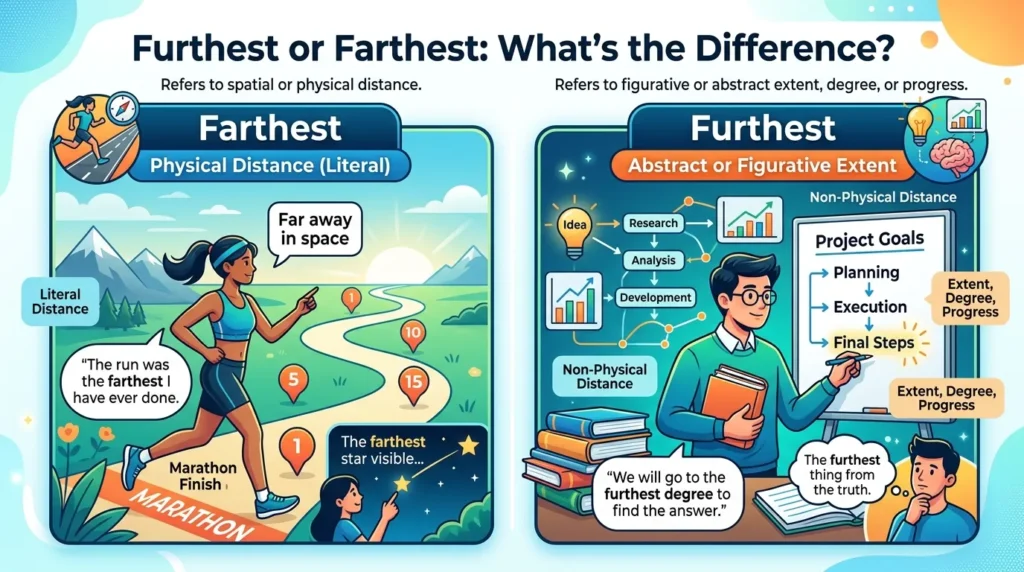
- Farthest is often used for physical distance.
- Furthest is often used for figurative or abstract distance.
Examples
Farthest (physical distance)
- Alaska is the farthest state from Florida.
- She threw the ball the farthest.
Furthest (figurative distance)
- We need to discuss this further before making a decision.
- His idea was the furthest from the original plan.
Quick Rule
| Word | Common Use |
|---|---|
| Farthest | Physical distance |
| Furthest | Figurative or abstract distance |
In modern English, both words are often interchangeable.
The Origin of Furthest or Farthest
The words furthest and farthest come from the Old English word feorr, meaning “far away.”
Development of the Words
Over time, English speakers developed different forms:
- Far
- Farther
- Farthest
Another variation also appeared:
- Further
- Furthest
These forms evolved together and became accepted in English.
Why Two Forms Exist
English often keeps multiple versions of similar words.
For example:
- Toward / Towards
- Among / Amongst
- While / Whilst
Similarly, farthest and furthest survived because speakers continued using both.
Modern Usage
Today, dictionaries generally recognize both words as correct.
The difference is mainly a matter of style and preference rather than strict grammar.
British English vs American English Spelling
Unlike words such as color and colour, there is no spelling difference between British and American English.
Both countries use:
- Furthest
- Farthest
The difference is more about preference than spelling.
Usage Comparison
| English Variety | Furthest | Farthest |
|---|---|---|
| American English | Common | Very Common |
| British English | Very Common | Common |
| Australian English | Common | Common |
| Canadian English | Common | Common |
Examples
American English
- Texas is the farthest destination on our trip.
British English
- This proposal is the furthest from our original idea.
Both sentences are considered correct.
Which Spelling Should You Use?
Since both spellings are correct, your choice depends on your audience.
For US Audiences
Use farthest when discussing physical distance.
Example:
- That city is the farthest from here.
For UK Audiences
Many writers prefer furthest for figurative meanings.
Example:
- Her argument is the furthest from the facts.
For Global Audiences
Either word is acceptable.
The safest approach is:
- Use farthest for measurable distance.
- Use furthest for ideas, progress, or abstract concepts.
This follows the preference of many style guides.
Common Mistakes with Furthest or Farthest
Mistake 1: Thinking One Word Is Wrong
Incorrect:
- Furthest is wrong.
- Farthest is wrong.
Correct:
- Both words are correct.
Mistake 2: Using Them Inconsistently
Incorrect:
- The farthest point in the project was reached. The furthest city was London.
Correct:
- Use a consistent style throughout your writing.
Mistake 3: Ignoring Context
Example:
- The furthest planet from Earth.
This is acceptable, but many writers prefer:
- The farthest planet from Earth.
because the distance is physical.
Mistake 4: Confusing Further and Farther
Many writers mix these terms.
Quick guide:
| Word | Common Use |
|---|---|
| Further | Additional |
| Farther | Physical distance |
| Furthest | Greatest abstract distance |
| Farthest | Greatest physical distance |
Mistake 5: Following Myths
Some people believe strict grammar rules separate the words.
In reality, major dictionaries often treat them as interchangeable.
Furthest or Farthest in Everyday Examples
In Emails
- Our office is the farthest from headquarters.
- This option takes us the furthest toward our goals.
In News Writing
- The hurricane reached the farthest point of the coastline.
- The policy change is the furthest step yet in the reform effort.
On Social Media
- I traveled to the farthest place I’ve ever visited.
- This is the furthest I’ve run all year.
In Academic Writing
- The farthest sample site was 100 miles away.
- The study reached the furthest stage of development.
In Business Writing
- The project progressed the furthest during the second quarter.
- The farthest warehouse serves international customers.
Furthest or Farthest – Google Trends & Usage Data
Search interest for furthest or farthest remains steady because it is a common grammar question.
Countries With High Search Interest
The topic is popular in:
- United States
- United Kingdom
- Canada
- Australia
- New Zealand
Why People Search It
People often want to know:
- Which word is correct.
- Whether one is American or British.
- Which form sounds more professional.
- Which version grammar experts recommend.
Contexts Where It Appears
Common areas include:
- School assignments
- Business communication
- Journalism
- Academic writing
- Online content creation
Usage Trend
Modern dictionaries generally accept both words, making the debate less strict than in the past.
Furthest vs Farthest Comparison Table
| Feature | Furthest | Farthest |
|---|---|---|
| Meaning | Greatest distance or degree | Greatest distance or degree |
| Physical Distance | Yes | Yes |
| Abstract Distance | Common | Less Common |
| American Usage | Common | Very Common |
| British Usage | Very Common | Common |
| Formal Writing | Accepted | Accepted |
| Everyday Speech | Accepted | Accepted |
| Dictionary Status | Correct | Correct |
Frequently Asked Questions
1. Is furthest or farthest correct?
Both are correct in modern English.
2. What is the main difference between furthest and farthest?
Many writers use farthest for physical distance and furthest for abstract distance.
3. Do Americans use farthest more often?
Yes. American English tends to favor farthest, especially for physical distance.
4. Do British people use furthest more often?
British English often shows a stronger preference for furthest, especially in figurative contexts.
5. Can I use furthest and farthest interchangeably?
In most situations, yes.
6. Which word is better for formal writing?
Both are acceptable in formal writing.
7. Which word should students use?
Students can safely use either word, but consistency throughout a document is important.
Conclusion
The debate over furthest or farthest is less complicated than many people think. Both words are correct, both appear in respected dictionaries, and both are widely used in modern English. The main difference comes from style preferences rather than strict grammar rules.
A useful guideline is to use farthest when discussing measurable physical distance and furthest when discussing ideas, progress, plans, or other abstract concepts. This distinction is common in many style guides and helps create clearer communication.
Regional preferences also play a role. American writers often favor farthest, while British writers frequently use furthest in figurative contexts. However, readers in both regions will understand either form without confusion.
The most important rule is consistency. Choose one style that fits your audience and use it throughout your writing. Whether you select furthest or farthest, your message will be grammatically correct and easy to understand when used appropriately.