Historic vs historical is a common English word choice problem. Both words come from the same root, and both relate to history, but they do not always mean the same thing. The difference is small, yet it can change the tone and meaning of a sentence.
Historic usually describes something that is important or significant in history. For example, “The country signed a historic agreement” means the agreement is important enough to be remembered in history.
Historical has a broader meaning. It usually describes anything related to history or the past. For example, “The museum contains many historical documents” means the documents are connected with history.
People often search for historic vs historical because the words can sometimes both appear before the same noun. This is especially common in news articles, academic writing, business reports, and everyday English.
This guide explains historic vs historical in simple language. You will learn their meanings, origins, British and American usage, common mistakes, pronunciation, everyday examples, and easy ways to remember the difference. By the end, you will know when to use historic and when historical is the better choice.
Historic vs Historical – Quick Answer
The simplest difference is:
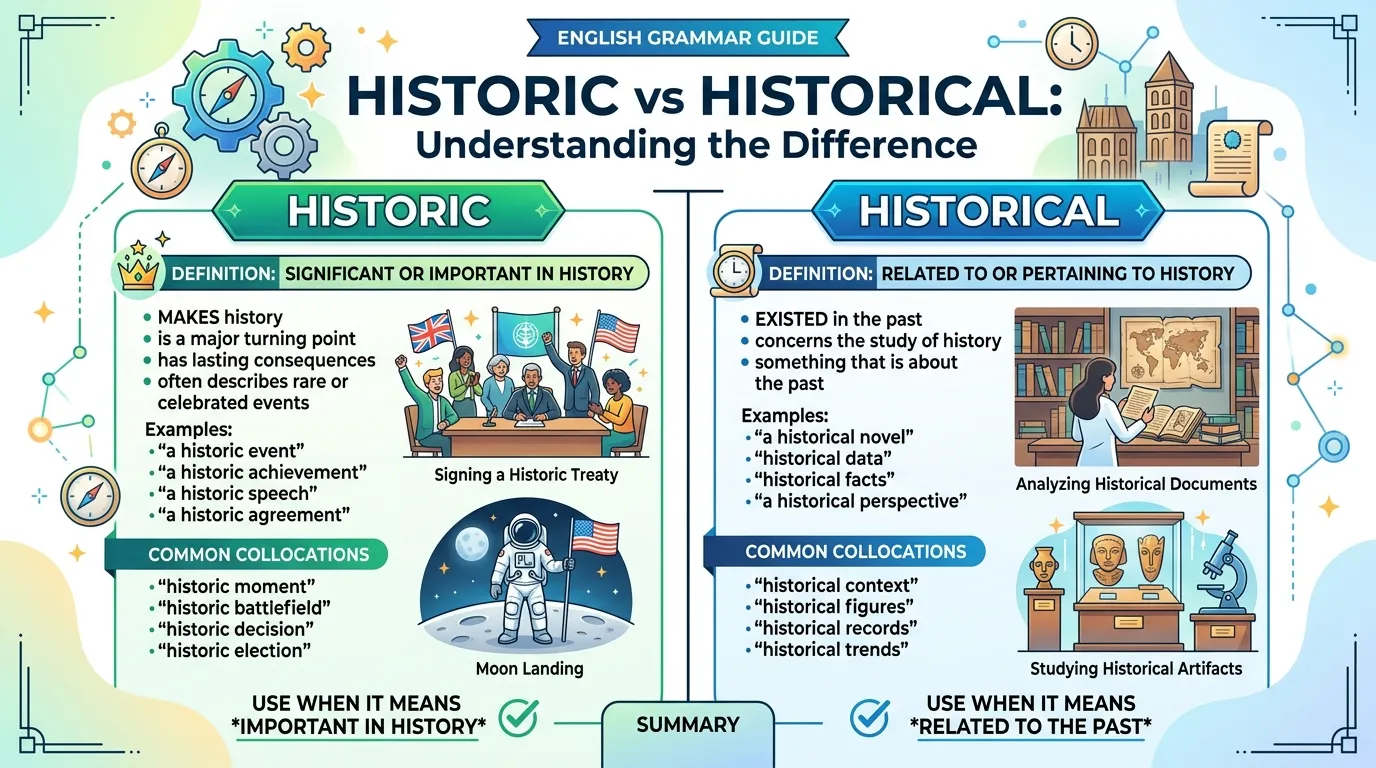
- Historic = important or significant in history.
- Historical = related to history or the past.
Historic Examples
The country made a historic decision.
This means the decision was very important and may be remembered in history.
She won a historic election.
This suggests the election result was unusual or important.
The two nations signed a historic agreement.
The agreement had major historical importance.
Historical Examples
We visited a historical site.
The site is connected with history.
He studies historical documents.
The documents are related to the past.
The book provides historical information about the region.
The information concerns history.
Easy Memory Trick
Think:
Historic = History-making
Historical = History-related
For example:
A historic event changes or shapes history.
A historical document gives information about history.
The Origin of Historic vs Historical
Both historic and historical come from the same root: history.
The word history comes through Latin and Old French from the Greek word historia, which was connected with inquiry, investigation, and knowledge gained by asking or finding out about events.
Origin of Historic
Historic developed from history and came to mean something important or notable in history.
For example:
The first human landing on the Moon was a historic achievement.
The event was historically significant.
Origin of Historical
Historical also comes from history, but its meaning developed more broadly.
It generally means:
- Related to history
- Connected with the past
- Concerning historical events
- Based on historical evidence
For example:
Researchers examined historical records.
The records are connected with the past.
Why Are They Confused?
The words share the same root and often describe similar subjects.
Compare:
a historic building
a historical building
The first usually suggests that the building is important or notable in history. The second simply means that the building is connected with history or belongs to the past.
British English vs American English Spelling
There is no major spelling difference between British and American English for historic and historical.
Both forms use:
- historic
- historical
However, there is an important difference in how the article “a” or “an” may appear before historic.
“A Historic” vs “An Historic”
In modern English, especially in American English, a historic is very common:
It was a historic moment.
British English may also use a historic, and this is now widely accepted.
However, an historic can still be found, especially in more traditional British writing or when the initial h is pronounced weakly.
It was an historic moment.
The choice depends on pronunciation and style. For most modern writing, a historic is a clear and natural choice.
Comparison Table
| Meaning | British English | American English | Example |
|---|---|---|---|
| Important in history | historic | historic | A historic victory |
| Related to history | historical | historical | Historical records |
| Significant event | historic | historic | A historic agreement |
| Connected with the past | historical | historical | Historical research |
British English Examples
It was a historic decision.
The museum contains important historical records.
American English Examples
It was a historic decision.
The museum contains important historical records.
The main distinction between the two words remains the same in both varieties.
Which Spelling Should You Use?
The choice depends on what you want to say.
Use Historic for Importance
Use historic when something is notable, remarkable, or important enough to be remembered.
Common phrases include:
- Historic event
- Historic victory
- Historic agreement
- Historic decision
- Historic achievement
- Historic moment
- Historic election
Examples:
The team achieved a historic victory.
Leaders reached a historic agreement.
It was a historic moment for the country.
Use Historical for Connection to the Past
Use historical when you simply mean something related to history.
Common phrases include:
- Historical records
- Historical research
- Historical evidence
- Historical documents
- Historical facts
- Historical events
- Historical study
Examples:
Researchers examined historical records.
The book contains detailed historical information.
We studied historical evidence.
When Both Can Work
Sometimes both words are grammatically possible, but the meaning changes.
The museum is located in a historic building.
This suggests the building is important or notable.
The museum is located in a historical building.
This means the building is connected with history or belongs to the past, but it does not strongly say that the building is historically important.
For US Readers
American English uses the same basic distinction.
For UK and Commonwealth Readers
British and Commonwealth English also use both words in the same general way.
For Global English
A useful rule is:
Historic = important in history.
Historical = related to history.
Common Mistakes with Historic vs Historical
Mistake 1: Using Historical for Every Important Event
Incorrect or less precise:
The country achieved a historical victory.
If you mean the victory was remarkable and important, use:
The country achieved a historic victory.
Mistake 2: Using Historic for General History
Less natural:
The student researched historic documents.
If you simply mean documents related to the past, use:
The student researched historical documents.
Mistake 3: “A Historical Moment”
This can be grammatically correct, but if you mean an important moment that will be remembered, historic is usually stronger.
It was a historic moment.
Mistake 4: “Historical Decision”
If the decision is important enough to change or shape history:
It was a historic decision.
If you are simply discussing a decision from the past:
The report examines the historical decision.
Mistake 5: Confusing Historical With Ancient
Historical does not always mean ancient.
A historical event can have happened many years ago, while some historical research can focus on relatively recent events.
The researchers studied historical records from the 20th century.
Historic vs Historical in Everyday Examples
In Emails
Historic:
Today marks a historic milestone for our company.
Historical:
Please review the historical sales data before the meeting.
In News
Historic:
The team celebrated a historic championship victory.
Historical:
The report examines historical voting patterns.
On Social Media
Historic:
What a historic night for the team!
Historical:
Here are some historical photos from the city’s early years.
In Formal Writing
Historic:
The agreement represents a historic step toward cooperation.
Historical:
The study examines historical patterns of migration.
In Academic Writing
Historic:
The discovery marked a historic moment in modern science.
Historical:
The researchers analyzed historical evidence from several archives.
In Travel Writing
Historic:
Visitors can explore the city’s historic center.
Historical:
The museum offers historical information about the region.
Historic vs Historical – Comparison Table
| Word | Part of Speech | Main Meaning | Common Uses | Example |
|---|---|---|---|---|
| Historic | Adjective | Important in history | Historic event | It was a historic event. |
| Historic | Adjective | Notable or significant | Historic victory | They won a historic victory. |
| Historical | Adjective | Related to history | Historical records | We studied historical records. |
| Historical | Adjective | Connected with the past | Historical research | She conducts historical research. |
| Historical | Adjective | Based on past events | Historical evidence | The claim lacks historical evidence. |
Historic vs Historical Pronunciation
The two words are easy to pronounce once you know their syllables.
Historic
Historic is commonly pronounced:
his-TOR-ik
Example:
It was a historic moment.
Historical
Historical is commonly pronounced:
his-TOR-ih-kul
Example:
The museum contains historical records.
Pronunciation Table
| Word | Approximate Sound | Meaning |
|---|---|---|
| Historic | his-TOR-ik | Important in history |
| Historical | his-TOR-ih-kul | Related to history |
The pronunciation is not usually the main source of confusion. The bigger issue is understanding the difference in meaning.
How to Remember Historic vs Historical
Historic = History-Making
Think:
Historic = History-making
A historic event is important enough to become part of an important story in history.
A historic election
A historic discovery
A historic victory
Historical = History-Related
Think:
Historical = History-related
Something historical is connected with the past.
Historical records
Historical research
Historical information
The Simple Question Test
Ask:
Is it important or remarkable in history?
Use historic.
Is it simply connected with history or the past?
Use historical.
For example:
The country signed a historic agreement.
The agreement is important.
The researchers studied historical agreements.
The agreements are documents or events from the past.
Historic vs Historical – Google Trends & Usage Data
Search interest for historic vs historical is mainly linked to English vocabulary, grammar, academic writing, history, journalism, and language learning.
Historic is common in news and media because journalists often describe major events, achievements, elections, agreements, discoveries, and victories.
Common phrases include:
- Historic victory
- Historic decision
- Historic agreement
- Historic moment
- Historic achievement
Historical is common in academic and educational contexts because it describes information, records, research, evidence, documents, and events connected with the past.
Common phrases include:
- Historical research
- Historical records
- Historical evidence
- Historical documents
- Historical information
Search interest can vary by country and over time. Exact Google Trends figures should be checked directly before publishing specific numerical claims because search behavior changes.
The main search intent is usually to understand whether something should be described as historic because it is important, or historical because it is related to history.
FAQs About Historic vs Historical
1. What is the difference between historic and historical?
Historic means important or significant in history.
Historical means related to history or the past.
A historic victory.
Historical records.
2. Is it “historic event” or “historical event”?
Both can be correct, but they have different meanings.
Historic event = an event that is important or significant.
Historical event = an event that belongs to or concerns history.
3. Is it “historic moment” or “historical moment”?
If the moment is important and memorable, use:
Historic moment
If you are simply discussing a moment from the past, historical moment may be appropriate.
4. Is it “historic building” or “historical building”?
Both can be used.
Historic building usually means a building that has important historical value.
Historical building means a building connected with history or the past.
5. Is “a historic” or “an historic” correct?
Both forms exist. A historic is very common in modern English, especially when the h is clearly pronounced.
It was a historic event.
An historic also appears, especially in traditional British usage or when the initial h is weakly pronounced.
6. Does historical mean old?
Not necessarily. Historical means related to history or the past. Something does not have to be ancient to be historical.
7. What is an easy way to remember historic vs historical?
Remember:
Historic = history-making.
Historical = history-related.
If something is important in history, use historic. If it is connected with the past, use historical.
Conclusion
The difference between historic vs historical is mainly about importance versus connection. Historic describes something that is important, remarkable, or significant in history. Historical describes something that is related to history, the past, or the study of past events.
For example, a historic victory is a victory that is important enough to be remembered. A historical record is a record that contains information about the past. This simple distinction works in most everyday situations.
A useful memory trick is historic = history-making and historical = history-related. If you are describing a major achievement, important agreement, memorable election, or remarkable discovery, historic is usually the right choice. If you are discussing records, documents, research, evidence, or information about the past, historical is usually better.
British and American English use the same spellings and meanings. One small style point is the article before historic: both a historic and an historic can be found, but a historic is very common in modern English.
Understanding this difference can make your writing more precise. Whether you are writing an email, news article, academic paper, social media post, or business report, choosing the right word helps readers understand exactly what you mean.