Have you ever seen the words “inate” and “innate” and wondered which one is correct? You are not alone. Many students, writers, job seekers, and English learners search for “inate or innate” because the words sound similar when spoken. This confusion often appears in essays, emails, business documents, and online content.
Spelling mistakes can affect how professional and trustworthy your writing looks. When a word is commonly used in education, psychology, biology, and everyday communication, using the correct spelling becomes even more important. The word innate describes qualities, abilities, or characteristics that someone is born with rather than learns later in life.
This article provides a clear and complete answer to the inate or innate question. You will learn which spelling is correct, where the word comes from, how it is used in American and British English, common mistakes people make, real-life examples, and practical advice for professional writing. By the end, you will know exactly which spelling to use and why.
Inate or Innate – Quick Answer
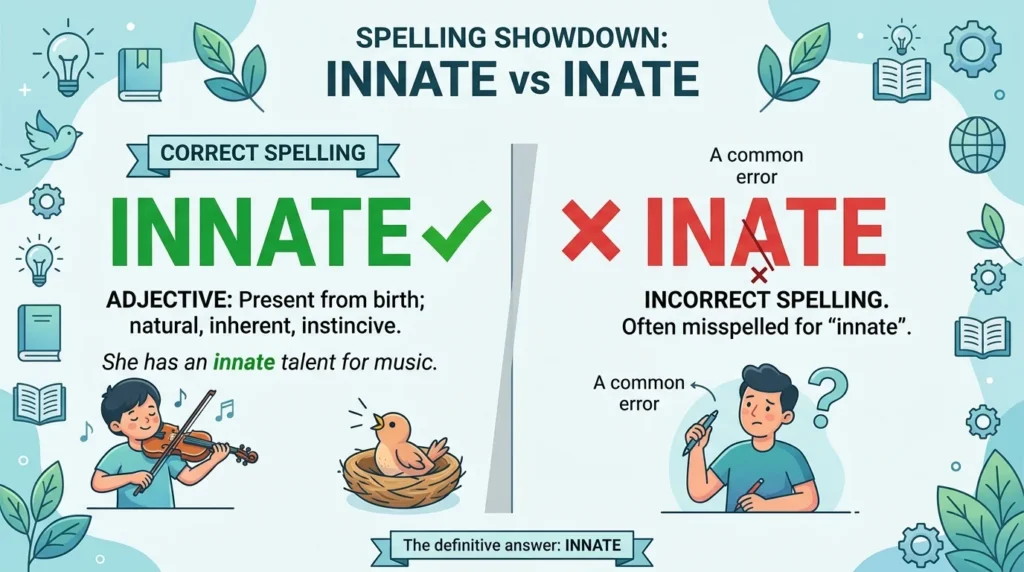
The correct spelling is innate.
Inate is a misspelling and is not recognized as a standard English word.
Correct Examples
- She has an innate ability to solve problems.
- He showed innate leadership skills from a young age.
- Some animals have innate survival instincts.
Incorrect Example
- She has an inate talent for music. ❌
Quick Rule
Always use innate when referring to a natural quality, ability, or characteristic that exists from birth.
The Origin of Inate or Innate
The word innate comes from the Latin word innatus, which means “born in” or “natural.”
Historical Development
The term entered English during the late Middle Ages and has long been used to describe qualities that are naturally present rather than acquired through learning or experience.
Examples include:
- Innate intelligence
- Innate talent
- Innate instincts
- Innate abilities
Why the Confusion Exists
The confusion happens because the double n in innate is sometimes overlooked during typing or spelling. As a result, people mistakenly write inate, dropping one of the letters.
However, only innate is correct.
British English vs American English Spelling
Unlike many English words, there is no spelling difference between British and American English for innate.
American English
- Innate
British English
- Innate
Both language varieties use the same spelling and meaning.
Comparison Table
| Feature | American English | British English |
|---|---|---|
| Correct Spelling | Innate | Innate |
| Meaning | Natural or inborn | Natural or inborn |
| Formal Usage | Yes | Yes |
| Inate | Incorrect | Incorrect |
Which Spelling Should You Use?
The answer is simple.
For US Audiences
Use:
Innate
Examples:
- Academic papers
- Business reports
- Professional emails
For UK and Commonwealth Audiences
Use:
Innate
The spelling remains exactly the same.
For Global Audiences
Use:
Innate
It is universally accepted across English-speaking countries.
Professional Recommendation
Always use innate. There is no situation where inate is considered the correct standard spelling.
Common Mistakes with Inate or Innate
Many writers make similar spelling errors.
Mistake 1: Dropping One “N”
❌ He has an inate sense of direction.
✅ He has an innate sense of direction.
Mistake 2: Confusing Innate with Learned Skills
❌ Driving is an innate skill.
✅ Driving is a learned skill.
Innate abilities are natural, not acquired through training.
Mistake 3: Using Innate Incorrectly
❌ She developed innate piano skills after years of practice.
✅ She developed piano skills after years of practice.
Practice creates learned abilities, not innate ones.
Inate or Innate in Everyday Examples
Emails
- Her innate communication skills make her an excellent manager.
- The candidate demonstrated innate leadership qualities.
News Articles
- Researchers studied innate human behavior.
- Scientists explored innate immune responses.
Social Media
- She has an innate talent for storytelling.
- Some people seem to have innate athletic ability.
Academic Writing
- The study examined innate cognitive traits.
- Researchers analyzed innate behavioral patterns.
Business Writing
- Successful leaders often possess innate confidence.
- Employers value innate problem-solving abilities.
Inate or Innate – Google Trends & Usage Data
Search data shows that many users search for “inate or innate” because they are unsure about the correct spelling.
Most Common Usage
The spelling innate is overwhelmingly dominant in:
- Academic writing
- Medical literature
- Psychology research
- Business communication
Why People Search for Inate
Common reasons include:
- Typing errors
- Pronunciation confusion
- Unfamiliarity with the word
Popular Contexts
People often search this keyword when discussing:
- Natural talent
- Human behavior
- Genetics
- Education
- Leadership skills
Keyword Comparison Table
| Word | Correct? | Meaning |
|---|---|---|
| Innate | Yes | Natural, inborn quality |
| Inate | No | Misspelling |
| Innately | Yes | Naturally |
| Innateness | Yes | State of being innate |
| Natural | Yes | Existing by nature |
| Inborn | Yes | Present from birth |
Frequently Asked Questions (FAQs)
1. Is inate a real word?
No. Inate is considered a misspelling of innate.
2. Which is correct: inate or innate?
Innate is the correct spelling.
3. What does innate mean?
Innate means natural, inborn, or present from birth.
4. Is innate used in both British and American English?
Yes. Both varieties use the same spelling: innate.
5. Can talents be innate?
Yes. Many people describe natural abilities as innate talents.
6. What is an example of innate behavior?
A baby’s reflexes and many animal instincts are often considered innate behaviors.
7. How can I remember the correct spelling?
Remember that innate has two “n” letters, just like many natural qualities have deep roots from birth.
Conclusion
The question of inate or innate has a clear answer: innate is the correct spelling, while inate is simply a spelling mistake. The word innate refers to qualities, abilities, instincts, or characteristics that are naturally present from birth rather than learned through experience.
Because the spelling remains the same in both American and British English, writers do not need to worry about regional differences. Whether you are writing an essay, business report, research paper, email, or social media post, innate is always the correct choice.
Understanding this distinction helps improve writing accuracy and professionalism. Since the word often appears in education, psychology, science, leadership, and personal development discussions, using the correct spelling is especially important. If you remember that innate comes from a word meaning “born in,” it becomes easier to recall the correct form.
Whenever you want to describe a natural ability, instinct, or characteristic, choose innate with confidence.