Have you ever typed “loosing” when you meant “losing”? If yes, you are not alone. This is one of the most common spelling mistakes in English. Many people become confused because the two words look very similar. They share the same root letters, but they have completely different meanings.
The confusion often appears in emails, social media posts, school assignments, and workplace communication. Someone may write, “I am loosing my keys,” when they actually mean, “I am losing my keys.” While readers may understand the intended message, the mistake can make writing seem careless or unprofessional.
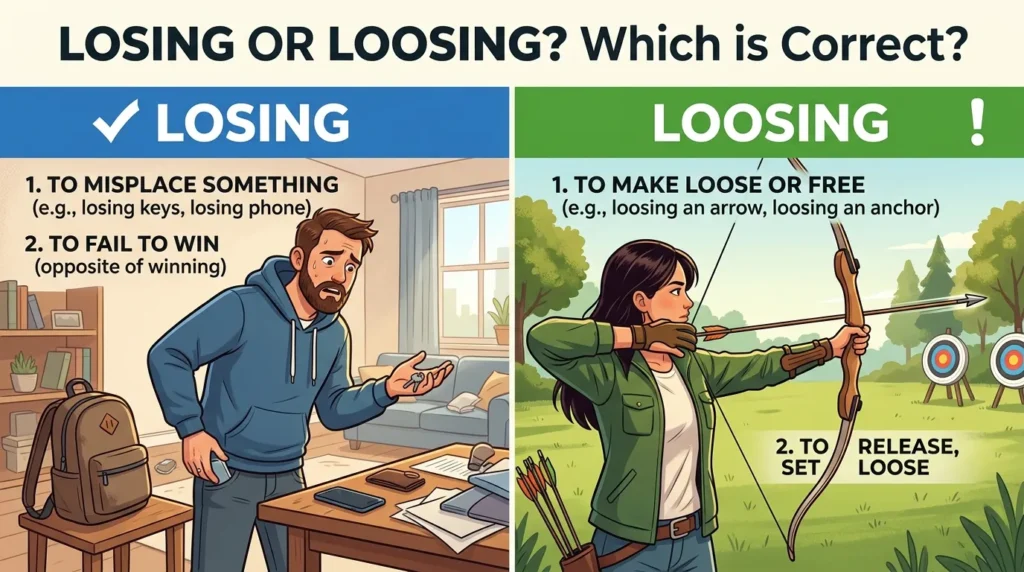
The good news is that the difference is easy to understand. Losing means failing to keep something, being defeated, or no longer having it. Loosing, on the other hand, means releasing, setting free, or making something less tight.
This guide explains the difference between loosing or losing, their origins, common mistakes, usage examples, and practical advice. By the end, you will know exactly which word to choose every time.
Loosing or Losing – Quick Answer
Quick answer: Use losing when you mean failing to keep something or being defeated. Use loosing when you mean releasing or loosening something.
Examples
- ✔️ I am losing my patience.
- ✔️ Our team is losing the match.
- ✔️ The sailor was loosing the ropes.
- ❌ I am loosing my wallet.
- ❌ She keeps loosing her phone.
Most of the time, people actually mean losing.
The Origin of Loosing or Losing
Although the words look alike, they have different histories.
Losing
Losing comes from the verb lose, which has roots in Old English. It means to fail to keep possession of something, suffer defeat, or miss an opportunity.
Loosing
Loosing comes from the verb loose, meaning to release, untie, free, or make less tight.
Because the spellings differ by only one letter, many writers accidentally use the wrong word. Modern spell-check tools often catch the mistake, but it still appears frequently online.
British English vs American English Spelling
There is no spelling difference between British and American English for these words.
Both forms use losing and loosing in the same way.
Comparison Table
| Meaning | British English | American English |
|---|---|---|
| Fail to keep something | Losing | Losing |
| Release or untie | Loosing | Loosing |
| Everyday usage | Losing | Losing |
| Formal writing | Losing | Losing |
| Rare usage | Loosing | Loosing |
Examples
British English
- The club is losing members.
American English
- He is losing confidence.
Both countries follow the same rules.
Which Spelling Should You Use?
The correct choice depends on what you want to say.
If You Mean “Failing to Keep”
Use losing.
Examples:
- Losing money
- Losing weight
- Losing a game
- Losing your keys
If You Mean “Releasing or Untying”
Use loosing.
Examples:
- Loosing the arrows
- Loosing the ropes
- Loosing the dogs from their chains
Professional Advice
In most modern writing situations, losing is the word you need.
Before submitting important work, ask yourself:
“Am I talking about defeat or misplacing something?”
If yes, choose losing.
Common Mistakes with Loosing or Losing
Many English learners and native speakers confuse these words.
| Incorrect Usage | Correct Usage |
|---|---|
| I am loosing my phone. | I am losing my phone. |
| They are loosing the game. | They are losing the game. |
| She keeps loosing weight. | She keeps losing weight. |
| The crew was losing the sails. | The crew was loosing the sails. |
| We are loosing money. | We are losing money. |
Tips to Remember
- Lose → Losing = defeat or misplace.
- Loose → Loosing = release or untie.
- If you mean “not winning,” use losing.
- If you mean “setting free,” use loosing.
Loosing or Losing in Everyday Examples
Emails
- We are losing customers due to delays.
- The workers began loosing the ropes before unloading.
News
- The team is losing by two points.
- Farmers were loosing livestock into the fields.
Social Media
- I keep losing my sunglasses!
- My dog escaped after I accidentally loosed the gate latch.
Formal Writing
- The company is losing market share.
- Historical records describe soldiers loosing arrows at the enemy.
Loosing or Losing – Google Trends & Usage Data
Search trends reveal interesting patterns.
Usage Trends
- Losing is searched far more often.
- Many searches for loosing are actually spelling corrections.
- Educational websites frequently explain this confusion.
- The true meaning of loosing appears mostly in historical or literary contexts.
Popularity by Region
| Country/Region | Most Common Search Intent |
|---|---|
| United States | Losing |
| United Kingdom | Losing |
| Canada | Losing |
| Australia | Losing |
| India | Losing |
| Global Users | Losing |
This shows that most people intend to use losing, not loosing.
Comparison Table: Loosing vs Losing
| Feature | Loosing | Losing |
|---|---|---|
| Is it a real word? | Yes | Yes |
| Common usage | Rare | Very common |
| Meaning | Releasing or untightening | Failing to keep or being defeated |
| Business writing | Rarely used | Frequently used |
| Academic writing | Limited use | Common |
| Everyday conversation | Uncommon | Very common |
| Best choice for most writers | Usually avoid | Usually correct |
FAQs
1. Is loosing a real word?
Yes. It means releasing, freeing, or making something less tight.
2. Which is correct: loosing or losing?
Both are correct words, but they have different meanings.
3. Why do people confuse loosing and losing?
The words look similar, and many people assume they mean the same thing.
4. Is “I am loosing my keys” correct?
No. The correct sentence is, “I am losing my keys.”
5. When should I use loosing?
Use it when talking about releasing, untieing, or setting something free.
6. Is losing more common than loosing?
Yes. Losing is used much more frequently in modern English.
7. Can using loosing instead of losing affect professional writing?
Yes. It may appear as a spelling mistake and reduce credibility.
Conclusion
The difference between loosing or losing is simple once you understand their meanings. Losing refers to failing to keep something, suffering defeat, or no longer having possession of something. It is the word most people need in daily communication. In contrast, loosing means releasing, untieing, or setting something free. Although it is a real word, it appears far less often in modern writing.
Because the two words differ by only one letter, they are easy to confuse. However, remembering that lose becomes losing can help you avoid one of the most common English mistakes. Before you hit send on an email, publish a blog post, or submit an assignment, take a moment to check which meaning fits your sentence.
If you mean defeat, misplacement, or no longer having something, choose losing. If you mean releasing or loosening, choose loosing. Using the correct word will make your writing clearer, stronger, and more professional.