Personal vs personnel is a common English word confusion, especially in workplace writing. The two words look and sound similar, but they have very different meanings. Using the wrong word can make a sentence confusing, particularly in emails, resumes, business documents, and job applications.
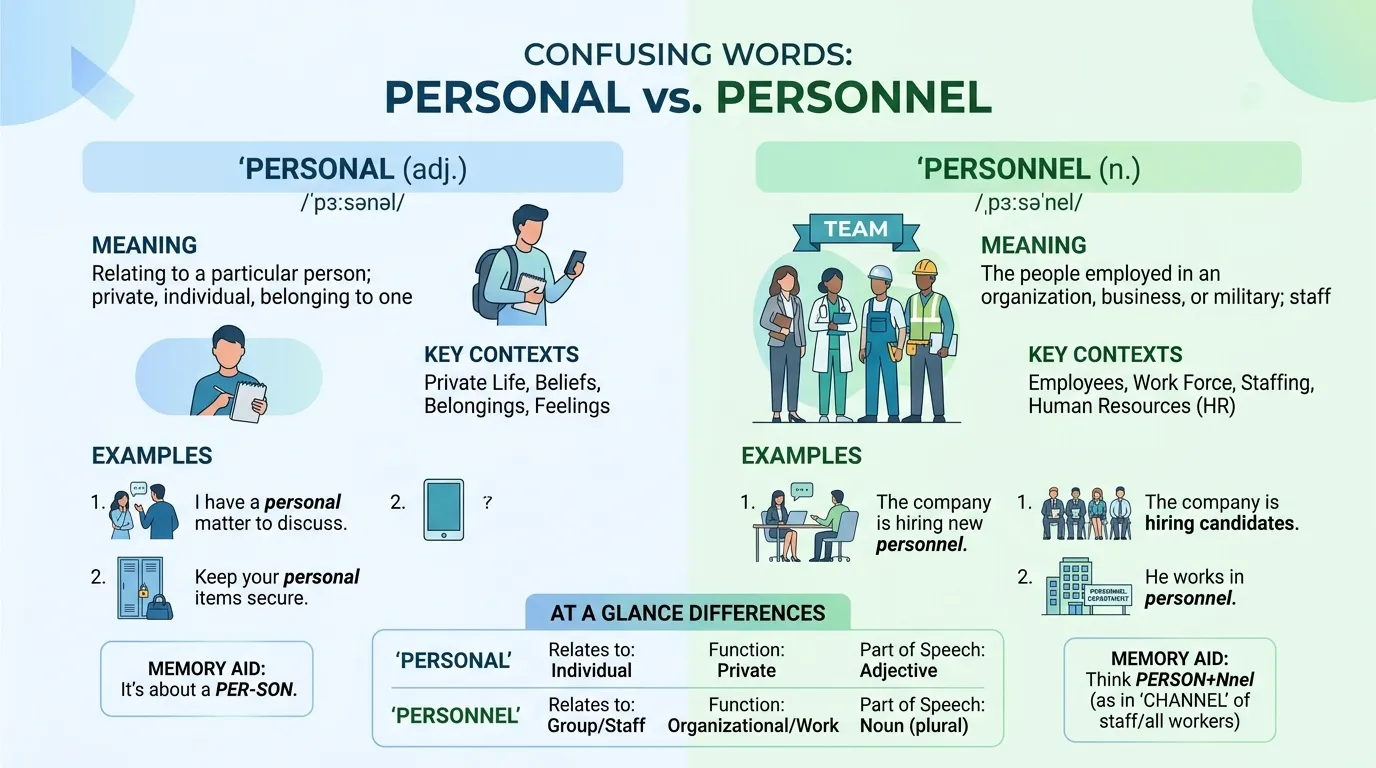
Personal usually means something related to an individual person, private life, or individual choice. For example, “This is my personal opinion” means the opinion belongs to the individual speaker. It can also describe private matters, such as personal information, personal goals, or personal belongings.
Personnel, on the other hand, refers to the people who work for an organization, company, military unit, or other group. For example, “All personnel must follow the safety rules” means all employees or staff must follow the rules.
People search for personal vs personnel because the words share several letters and can sound similar in some accents. This guide explains the difference with simple rules, examples, common mistakes, pronunciation tips, and practical advice for professional writing.
Personal vs Personnel – Quick Answer
The easiest way to remember the difference is:
- Personal = related to an individual person.
- Personnel = employees or staff of an organization.
Personal Examples
This is my personal opinion.
Please keep my personal information private.
She has a personal goal to improve her skills.
He brought his personal laptop to work.
Here, personal refers to an individual or something belonging to that individual.
Personnel Examples
All personnel must wear safety equipment.
The company has trained its personnel.
Maintenance personnel inspected the equipment.
Here, personnel refers to people working for an organization.
Easy Memory Trick
Think:
Personal = person
Personnel = people at work
For example:
Personal belongings = belongings that belong to one person.
Personnel department = department dealing with employees.
The Origin of Personal vs Personnel
Although personal and personnel look similar, they entered English through different paths.
Origin of Personal
Personal comes from Latin personalis, meaning related to a person. It passed into English through French and developed its modern meaning of something connected with an individual.
Today, personal can describe:
- Private matters
- Individual opinions
- Individual belongings
- Individual choices
- Information about a person
- Relationships or experiences
For example:
This is a personal decision.
Origin of Personnel
Personnel comes from French personnel, meaning people or staff belonging to an organization. English adopted the word as a term for the people employed by an organization or serving in a particular group.
For example:
Military personnel arrived at the location.
Hospital personnel helped the patients.
Why Are They Confused?
The words share the same basic root related to person, but their meanings developed differently.
| Word | Main Meaning |
|---|---|
| Personal | Related to an individual |
| Personnel | Employees or staff |
The extra -nel in personnel can help remind you that it refers to a group of workers.
British English vs American English Spelling
There is no major spelling difference between British and American English for personal and personnel.
Both varieties use:
- personal = individual or private
- personnel = employees or staff
Comparison Table
| Meaning | British English | American English | Example |
|---|---|---|---|
| Individual or private | personal | personal | This is my personal opinion. |
| Belonging to an individual | personal | personal | Bring your personal documents. |
| Employees or staff | personnel | personnel | All personnel must attend. |
| Workers in an organization | personnel | personnel | Maintenance personnel arrived. |
| Military staff | personnel | personnel | Military personnel were deployed. |
British English Examples
Please protect your personal information.
All personnel must attend the meeting.
American English Examples
Please protect your personal information.
All personnel must attend the meeting.
The spelling and basic usage are the same.
Which Spelling Should You Use?
Your choice depends on the meaning, not the country where you are writing.
Use Personal for an Individual
Use personal when something belongs to or relates to one person.
personal opinion
personal information
personal belongings
personal experience
personal goals
Use Personnel for Employees
Use personnel when referring to employees or staff.
company personnel
maintenance personnel
security personnel
medical personnel
military personnel
For Workplace Writing
This distinction is especially important in professional documents.
Correct:
All maintenance personnel must wear protective equipment.
Incorrect:
All maintenance personal must wear protective equipment.
Here, the sentence refers to workers, so personnel is correct.
For US Readers
American English follows the same distinction.
For UK and Commonwealth Readers
British and Commonwealth English also use the same basic meanings.
For Global English
Use this simple rule:
Personal = one person’s private or individual matter.
Personnel = workers or staff.
Common Mistakes with Personal vs Personnel
Mistake 1: “Maintenance Personal”
Incorrect:
Maintenance personal inspected the machine.
Correct:
Maintenance personnel inspected the machine.
The sentence refers to maintenance workers.
Mistake 2: “Personnel Information”
Incorrect:
Please provide your personnel information.
Correct:
Please provide your personal information.
If you mean information about an individual, use personal.
Mistake 3: “Personal Department”
Incorrect:
Contact the personal department.
Correct:
Contact the personnel department.
A personnel department deals with employees and staffing.
Mistake 4: “Military Personal”
Incorrect:
Military personal arrived at the base.
Correct:
Military personnel arrived at the base.
The sentence refers to military staff or members.
Mistake 5: “Personal Manager”
Be careful with this phrase.
If you mean a manager who works directly with or supervises someone, personal manager may be correct depending on the context.
But if you mean a manager responsible for employees or staffing, another term such as personnel manager may be intended.
Always consider the meaning before choosing the word.
Personal vs Personnel in Everyday Examples
In Emails
Personal:
I would like to discuss a personal matter with you.
Personnel:
All personnel are requested to attend the safety meeting.
In News
Personal:
The candidate shared his personal views on the issue.
Personnel:
Emergency personnel arrived at the scene.
On Social Media
Personal:
This is my personal account.
Personnel:
The company thanked its personnel for their hard work.
In Formal Writing
Personal:
Employees should protect their personal information.
Personnel:
All personnel must comply with workplace safety requirements.
In Technical Writing
Personal:
Workers should not use personal devices to access restricted systems.
Personnel:
Authorized maintenance personnel should inspect the equipment before operation.
Personal vs Personnel – Comparison Table
| Word | Meaning | Common Uses | Example |
|---|---|---|---|
| Personal | Related to an individual | Personal information | Keep your personal information safe. |
| Personal | Private | Personal matter | I have a personal matter to discuss. |
| Personal | Individual | Personal opinion | That is my personal opinion. |
| Personal | Belonging to someone | Personal belongings | Take your personal belongings. |
| Personnel | Employees or staff | Company personnel | Company personnel attended the meeting. |
| Personnel | Workers | Maintenance personnel | Maintenance personnel repaired the machine. |
| Personnel | Staff members | Medical personnel | Medical personnel treated the injured people. |
| Personnel | Members of a military group | Military personnel | Military personnel were present. |
Personal vs Personnel Pronunciation
Pronunciation is another reason these words can be confusing.
Personal
Personal is commonly pronounced approximately:
PUR-suh-nuhl
Example:
This is my personal opinion.
Personnel
Personnel is commonly pronounced approximately:
pur-suh-NEL
The final syllable is more clearly stressed.
Example:
All personnel must report to the office.
Quick Pronunciation Trick
Listen for the ending:
- personal → sounds like person + al
- personnel → ends with a sound similar to nel
The meanings are also different, so context is important.
How to Remember Personal vs Personnel
Use this simple memory trick:
Personal = Person
The word personal contains the idea of person.
personal opinion
personal belongings
personal information
These relate to an individual.
Personnel = People at Work
Think of personnel as the people working for an organization.
company personnel
hospital personnel
maintenance personnel
security personnel
Ask One Question
Ask:
Am I talking about something belonging to or relating to one person?
Use personal.
Am I talking about workers or staff?
Use personnel.
Personal vs Personnel – Google Trends & Usage Data
Search interest for personal vs personnel is mainly related to English vocabulary, spelling, pronunciation, workplace writing, and grammar.
The confusion is common because both words begin with person and have similar spellings. However, their usage differs strongly by context.
Personal appears frequently in everyday language, including personal information, personal goals, personal opinions, personal accounts, and personal experiences.
Personnel is more common in professional, business, military, medical, government, and technical contexts. Phrases such as personnel department, maintenance personnel, security personnel, and military personnel are widely used.
Search interest can vary by country and time. Exact Google Trends numbers should be checked directly because search popularity changes over time and between regions.
The main search intent remains consistent: people want to know whether personal or personnel is correct when describing a person, private matter, employee, or staff member.
FAQs About Personal vs Personnel
1. What is the difference between personal and personnel?
Personal means related to an individual person. Personnel means employees or staff.
This is my personal opinion.
All personnel must follow the rules.
2. Is it personal information or personnel information?
The correct phrase is usually personal information when you mean private information about an individual.
Please protect your personal information.
3. Is it maintenance personal or maintenance personnel?
The correct phrase is:
Maintenance personnel
It means workers who perform maintenance tasks.
4. Is it personnel department or personal department?
The standard term for a department that manages employees is:
Personnel department
However, many modern organizations use Human Resources (HR) instead.
5. Is military personal or military personnel correct?
The correct phrase is:
Military personnel
It means members of the military.
6. Can personnel mean one person?
Usually, personnel refers to the staff or employees of an organization as a group. If you mean one individual, use person, employee, worker, or another specific noun.
7. What is an easy way to remember personal vs personnel?
Remember:
Personal = person
Personnel = people who work for an organization
If it is private or individual, choose personal. If it means staff or workers, choose personnel.
Conclusion
The difference between personal vs personnel is simple once you focus on meaning. Personal describes something related to an individual person, such as personal information, personal belongings, personal goals, or a personal opinion. Personnel refers to the people who work for an organization, company, military unit, hospital, or other group.
For example, “Please protect your personal information” refers to private information about an individual. In contrast, “All personnel must wear safety equipment” refers to employees or staff.
A useful memory trick is personal = person and personnel = people at work. This can help you choose the correct word quickly. The distinction is especially important in workplace and technical writing, where phrases such as maintenance personnel, security personnel, and company personnel are common.
British and American English use the same spellings and basic meanings, so there is no regional spelling problem. The key is understanding the context.
When you are unsure, ask yourself: Am I describing something private or individual, or am I talking about workers? Individual or private means personal. Workers or staff means personnel. This simple test will prevent most common mistakes.