Have you ever heard someone say “No problemo!” and wondered if it is the same as “No problema!” Many English speakers use both expressions casually, but they are not equally correct in Spanish. This often creates confusion for language learners, travelers, and anyone who enjoys using Spanish-inspired phrases in everyday conversation.
People search for “problemo or problema” because they want to know which word is correct, whether one is slang, and how each term should be used. While “problema” is the proper Spanish word for “problem,” “problemo” is an informal, humorous expression popularized in English-speaking countries. It is not considered standard Spanish.
This guide explains the difference between problemo and problema, their origins, correct usage, common mistakes, real-life examples, popularity, and answers to frequently asked questions. By the end, you’ll know exactly when to use each expression and avoid common language errors.
Problemo or Problema – Quick Answer
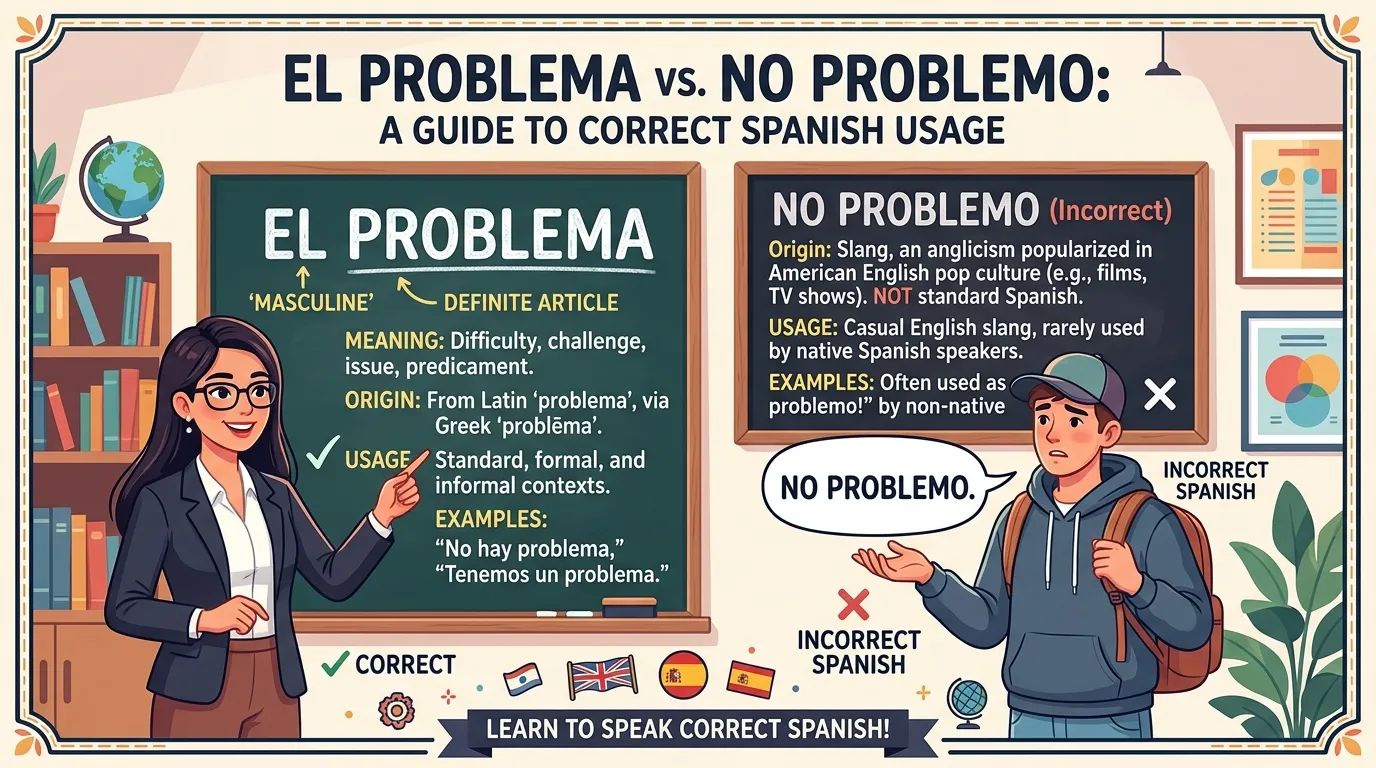
The correct Spanish word is problema, which means “problem.”
Problemo is not a standard Spanish word. It is an informal, humorous expression used mainly in English.
Quick Examples
✅ Spanish:
- Tengo un problema. (I have a problem.)
- No hay problema. (No problem.)
✅ Informal English:
- “No problemo!”
- “That’s no problemo.”
Although many English speakers understand “no problemo,” native Spanish speakers normally say “no hay problema.”
The Origin of Problemo or Problema
The word problema comes from the Latin problema, which itself originated from the ancient Greek word problēma, meaning something put forward or an obstacle.
Over time, problema became the standard Spanish word for problem.
The word problemo has a different history. It developed as a humorous imitation of Spanish by English speakers, especially in movies, television, and pop culture. It was never adopted into standard Spanish dictionaries.
Because of this, problemo is considered playful slang rather than correct Spanish.
British English vs American English Spelling
Unlike words such as colour/color or centre/center, there is no spelling difference between British English and American English.
Both varieties of English use:
- Problema when referring to the Spanish word.
- Problemo only as an informal humorous expression.
Comparison Table
| Feature | British English | American English |
|---|---|---|
| Problema | Used as the Spanish word | Used as the Spanish word |
| Problemo | Informal slang | Informal slang |
| Official Spanish | Problema | Problema |
| Standard English Word | Problem | Problem |
Neither British nor American English treats problemo as a formal English word.
Which Word Should You Use?
The best choice depends on your audience and purpose.
When Speaking Spanish
Always use problema.
Example:
- No hay problema.
Casual English Conversation
You may hear people jokingly say “No problemo.”
This is acceptable only in informal situations.
Professional Writing
Avoid problemo.
Instead, write:
- No problem.
- There is no problem.
Academic or Formal Communication
Use the correct Spanish word problema only when writing in Spanish or referring to the Spanish language.
Common Mistakes with Problemo or Problema
Mistake 1
❌ Thinking “problemo” is correct Spanish.
✅ Correct:
“Problema” is the correct Spanish word.
Mistake 2
❌ Writing “No problemo” in formal documents.
✅ Better:
“No problem.”
Mistake 3
❌ Assuming Spanish speakers commonly say “No problemo.”
✅ Native speakers usually say:
“No hay problema.”
Mistake 4
❌ Using “problemo” in language exams.
✅ Use problema.
Problemo or Problema in Everyday Examples
Casual Conversation
“No problemo! I’ll help you tomorrow.”
“There is no problem with your order.”
News
“The company reported no major problems.”
Social Media
“No problemo 😄”
Spanish Conversation
No hay problema.
All these examples show that problema belongs to Spanish, while problemo is mainly humorous English slang.
Problemo or Problema – Google Trends & Usage Data
Searches for “problemo or problema” are common among language learners and people curious about popular expressions.
People usually search this keyword to:
- Learn Spanish
- Understand slang
- Check correct grammar
- Improve writing
- Prepare for travel
- Translate common phrases
Countries with notable search interest include:
- United States
- United Kingdom
- Spain
- Mexico
- Australia
- Canada
Search interest often increases during language-learning courses and cultural discussions.
Problemo vs Problema Comparison Table
| Feature | Problemo | Problema |
|---|---|---|
| Standard Spanish | No | Yes |
| Formal Writing | No | Yes (Spanish) |
| Informal English | Yes | Rare |
| Meaning | Humorous expression | Problem |
| Dictionary Spanish | No | Yes |
| Common Phrase | No problemo | No hay problema |
Frequently Asked Questions
1. Is “problemo” a real Spanish word?
No. It is an informal expression used mainly by English speakers.
2. What does “problema” mean?
Problema means “problem” in Spanish.
3. Is “No problemo” correct?
It is acceptable as informal English slang, but it is not correct Spanish.
4. What do native Spanish speakers say instead?
They usually say:
No hay problema.
5. Can I use “problemo” in formal writing?
No. Use “no problem” in English or “no hay problema” in Spanish.
6. Why do people say “No problemo”?
The phrase became popular through movies, television, and pop culture as a playful imitation of Spanish.
7. Which word should language learners use?
Language learners should use problema, as it is the correct Spanish word.
Conclusion
The difference between problemo or problema is simple once you understand their origins and usage. Problema is the correct Spanish word for “problem” and should be used whenever you are speaking or writing in Spanish. Problemo, on the other hand, is an informal English slang expression that became popular through movies and everyday conversation. While many people recognize phrases like “No problemo,” they are not considered proper Spanish and should be avoided in formal writing or language learning. If your goal is accurate communication, choose problema for Spanish and no problem for standard English. Understanding this distinction will help you communicate more naturally and avoid common language mistakes.