Have you ever written a sentence and stopped to wonder whether it should be “sewed” or “sowed”? You are not alone. Many English learners, students, writers, and even native speakers search for “sewed or sowed” because the words sound very similar but have completely different meanings.
The confusion often happens because both words are past tense verbs and share a similar pronunciation. However, they come from different base verbs and are used in different situations. Using the wrong one can change the meaning of a sentence and make your writing unclear.
Fortunately, the difference is simple once you understand it. Sewed relates to stitching fabric with a needle and thread, while sowed relates to planting seeds in soil. Knowing when to use each word will help you write more accurately in emails, school assignments, articles, social media posts, and professional documents.
In this guide, you’ll learn the meanings, origins, spelling rules, common mistakes, examples, and usage tips for sewed and sowed. By the end, you’ll know exactly which word belongs in your sentence.
Sewed or Sowed – Quick Answer
Both sewed and sowed are correct words, but they have different meanings.
Sewed
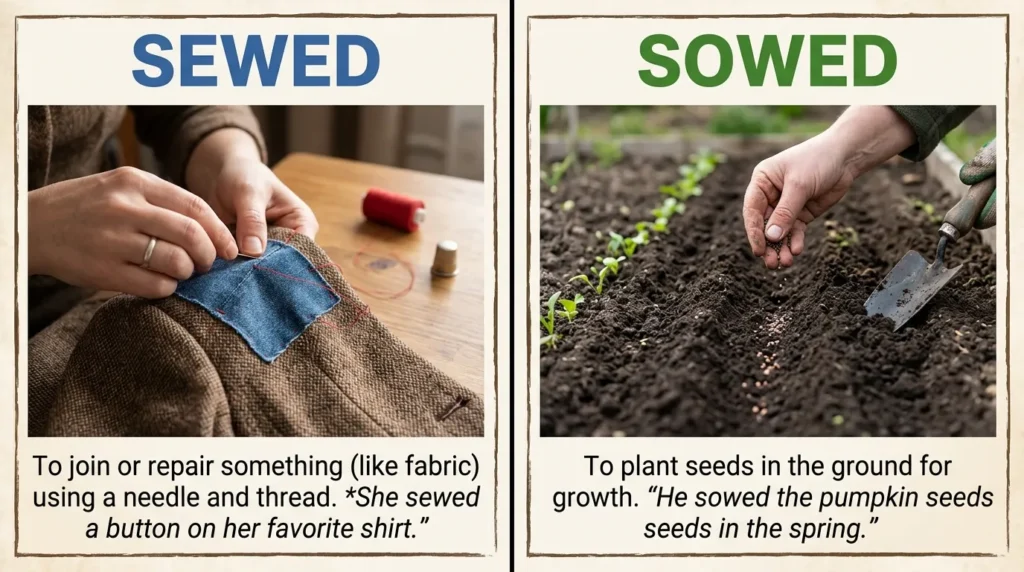
Sewed is the past tense of sew, which means to join fabric using a needle and thread.
Examples:
- She sewed a button onto the shirt.
- My grandmother sewed a beautiful dress.
Sowed
Sowed is the past tense of sow, which means to plant seeds.
Examples:
- The farmer sowed wheat in the field.
- They sowed grass seeds in the garden.
Quick Rule
- Sewed = stitching fabric
- Sowed = planting seeds
The Origin of Sewed or Sowed
Although the words sound alike, they come from different Old English verbs.
Origin of Sewed
The verb sew comes from the Old English word siwian, meaning to stitch or mend cloth.
Over time, the past tense became sewed.
Origin of Sowed
The verb sow comes from the Old English word sāwan, meaning to plant seeds.
Its past tense developed as sowed.
Why the Confusion Exists
The confusion occurs because:
- The words differ by only one letter.
- Their pronunciation is similar.
- Both are past tense verbs.
However, their meanings are completely unrelated.
British English vs American English Spelling
There is no spelling difference between British and American English for these words.
Comparison Table
| Meaning | British English | American English |
|---|---|---|
| Past tense of sew | sewed | sewed |
| Past tense of sow | sowed | sowed |
Examples
British English
- She sewed the torn jacket.
- The farmer sowed barley in spring.
American English
- He sewed a patch on his backpack.
- They sowed corn across the field.
The spellings remain the same in both language varieties.
Which Spelling Should You Use?
Your choice depends entirely on the meaning of the sentence.
Use “Sewed” When:
- Talking about stitching.
- Referring to clothing repairs.
- Discussing fabric, thread, or tailoring.
Example:
- She sewed the curtains herself.
Use “Sowed” When:
- Talking about farming.
- Referring to planting seeds.
- Discussing gardens or agriculture.
Example:
- The gardener sowed flower seeds.
Audience-Based Advice
| Audience | Recommended Choice |
|---|---|
| US readers | Depends on meaning |
| UK readers | Depends on meaning |
| Commonwealth readers | Depends on meaning |
| Global audience | Depends on meaning |
The correct word depends on context, not location.
Common Mistakes with Sewed or Sowed
Many writers accidentally mix up these words.
Mistake 1: Using Sewed for Planting
❌ The farmer sewed wheat in April.
✅ The farmer sowed wheat in April.
Mistake 2: Using Sowed for Stitching
❌ She sowed a button onto the shirt.
✅ She sewed a button onto the shirt.
Mistake 3: Assuming They Are Alternate Spellings
❌ Sewed and sowed mean the same thing.
✅ They are different words with different meanings.
Quick Corrections Table
| Incorrect | Correct |
|---|---|
| sowed a dress | sewed a dress |
| sewed seeds | sowed seeds |
| sowed a shirt | sewed a shirt |
| sewed corn | sowed corn |
Sewed or Sowed in Everyday Examples
In Emails
- I sewed the company logo onto the uniform.
In News Articles
- Farmers sowed crops earlier than expected this year.
On Social Media
- Just sewed my first handmade bag!
In Gardening Blogs
- We sowed vegetable seeds last weekend.
In Formal Writing
- The tailor sewed the garment by hand.
In Agricultural Reports
- Local farmers sowed thousands of acres of wheat.
Sewed or Sowed – Google Trends & Usage Data
Search interest for sewed or sowed is common because writers often confuse the two words.
Countries with High Search Interest
- United States
- United Kingdom
- Canada
- Australia
- India
Common Search Questions
Users often ask:
- Is it sewed or sowed?
- What is the past tense of sew?
- What is the past tense of sow?
- Which word refers to planting seeds?
Usage Comparison
| Word | Main Meaning | Popularity |
|---|---|---|
| sewed | Stitched fabric | High |
| sowed | Planted seeds | High |
Both words remain common because sewing and agriculture are widely discussed topics.
Sewed vs Sowed Comparison Table
| Feature | Sewed | Sowed |
|---|---|---|
| Correct English word | Yes | Yes |
| Past tense verb | Yes | Yes |
| Related to fabric | Yes | No |
| Related to farming | No | Yes |
| Means stitching | Yes | No |
| Means planting seeds | No | Yes |
| Commonly confused | Yes | Yes |
FAQs
1. Which is correct: sewed or sowed?
Both are correct, but they are used in different situations.
2. What does sewed mean?
Sewed is the past tense of sew, meaning to stitch fabric with thread.
3. What does sowed mean?
Sowed is the past tense of sow, meaning to plant seeds.
4. Can sewed and sowed be used interchangeably?
No. They have different meanings.
5. Is sowed used only in farming?
Mostly, yes. It is commonly used for planting seeds in fields and gardens.
6. Do British and American English spell these words differently?
No. The spellings are the same in both varieties of English.
7. How can I remember the difference?
Think of sew = needle and thread and sow = seeds and soil.
Conclusion
The difference between sewed or sowed is simple once you know the meaning of each word. Sewed is the past tense of sew and relates to stitching fabric, repairing clothes, or creating garments. Sowed is the past tense of sow and relates to planting seeds in gardens, farms, or fields.
Although the words sound similar, they are not interchangeable. Using the wrong one can completely change the meaning of a sentence. If you are talking about thread, cloth, or tailoring, choose sewed. If you are discussing seeds, crops, or agriculture, choose sowed.
Another helpful point is that there is no British-versus-American spelling difference here. Both English varieties use the same spellings and meanings. By focusing on the context of your sentence, you can easily select the correct word and avoid a common grammar mistake. Remember: sewed is for stitching, sowed is for planting.