Breath vs breathe is a common English word confusion. The two words look almost the same, but they have different meanings, parts of speech, and pronunciations. The difference is mainly the final “e,” but that small change matters.
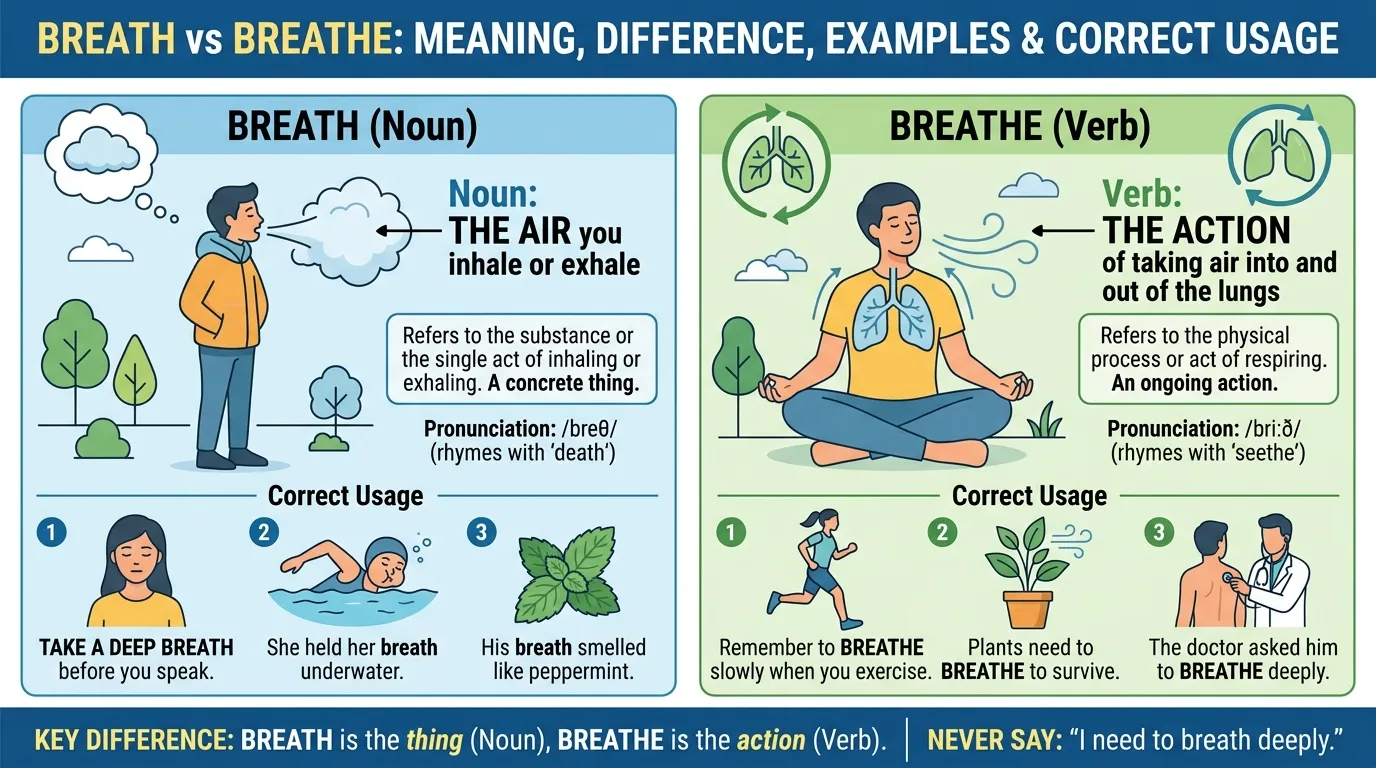
Breath is a noun. It refers to the air that you take into or let out of your lungs. For example, “Take a deep breath” means to take air into your lungs.
Breathe is a verb. It describes the action of taking air into and sending air out of your lungs. For example, “Try to breathe slowly” describes an action.
People often search for breath vs breathe because the words are closely related and look very similar. English learners may also find their pronunciation confusing. In simple terms, breath is the thing you take, while breathe is the action you do.
This guide explains breath vs breathe in simple English. You will learn their meanings, pronunciation, origins, common mistakes, everyday examples, and easy memory tricks. By the end, you should know which word to use in emails, essays, conversations, and professional writing.
Breath vs Breathe – Quick Answer
The easiest rule is:
- Breath = air you take in or let out; a noun.
- Breathe = the action of taking in and releasing air; a verb.
Breath Examples
Take a deep breath.
He held his breath.
I could feel her warm breath.
In these sentences, breath is a thing or concept.
Breathe Examples
Remember to breathe slowly.
Plants need carbon dioxide to breathe?
More naturally:
Humans breathe air.
Try to breathe deeply.
Here, breathe describes an action.
Easy Memory Trick
Think:
Breath = noun
Breathe = verb
A useful shortcut is:
You take a breath.
You breathe.
The extra e in breathe helps signal the verb.
The Origin of Breath vs Breathe
Breath and breathe are closely related words. Both have very old Germanic roots connected with air, breathing, and life.
Origin of Breath
Breath comes from Old English brǣþ, which referred to breath, air, or odor.
Over time, the spelling changed into the modern English word breath.
Today, it can mean the air moving in and out of the lungs.
She took a deep breath.
It can also be used in phrases such as:
Hold your breath.
Catch your breath.
Out of breath.
Origin of Breathe
Breathe comes from the Old English verb brēþan, related to breathing.
The modern spelling developed over time and became breathe.
Today, it is the verb describing the action of taking air into and releasing it from the lungs.
We need to breathe to stay alive.
Why Are They Confused?
The words share the same basic root and differ by only one letter.
Compare:
breath
breathe
The additional e in breathe is one of the easiest ways to recognize the verb.
British English vs American English Spelling
There is no major spelling difference between British and American English for breath and breathe.
Both varieties use:
- breath as the noun
- breathe as the verb
The meanings are also the same.
Comparison Table
| Meaning | British English | American English | Example |
|---|---|---|---|
| Air taken into lungs | breath | breath | Take a deep breath. |
| Action of breathing | breathe | breathe | Try to breathe slowly. |
| Noun | breath | breath | His breath was cold. |
| Verb | breathe | breathe | We breathe air. |
| Breathing condition | breathless | breathless | She was breathless after running. |
British English Examples
Take a deep breath.
Try to breathe slowly.
American English Examples
Take a deep breath.
Try to breathe slowly.
The spellings and basic rules are the same.
Which Spelling Should You Use?
Your choice between breath and breathe depends on the role of the word in the sentence.
Use Breath as a Noun
Use breath when you are talking about the air itself or one act of taking air in or releasing it.
Take a breath.
He held his breath.
She was out of breath.
His breath smelled like coffee.
Use Breathe as a Verb
Use breathe when describing the action.
Breathe slowly.
Try to breathe deeply.
It is difficult to breathe in the smoke.
A Simple Grammar Test
Try putting to before the word.
to breathe
This works because breathe is a verb.
But:
to breath ❌
This is usually incorrect.
Another test is to use a before the word:
a breath
This works because breath is a noun.
a breathe ❌
This is incorrect.
For US Readers
American English uses the same distinction.
For UK and Commonwealth Readers
British and Commonwealth English also use the same distinction.
For Global English
Remember:
A breath = a thing.
Breathe = an action.
Common Mistakes with Breath vs Breathe
Mistake 1: “Take a Deep Breathe”
Incorrect:
Take a deep breathe.
Correct:
Take a deep breath.
You are naming the thing you take, so use the noun breath.
Mistake 2: “I Can’t Breath”
Incorrect:
I can’t breath.
Correct:
I can’t breathe.
You are describing an action, so use breathe.
Mistake 3: “Breathe of Fresh Air”
Incorrect:
A breathe of fresh air.
Correct:
A breath of fresh air.
The expression uses the noun breath.
Mistake 4: “Hold Your Breathe”
Incorrect:
Hold your breathe.
Correct:
Hold your breath.
You hold a breath, so the noun is needed.
Mistake 5: “Breathe Easy” vs “Breath Easy”
Correct:
Breathe easy.
Here, breathe is a verb.
Mistake 6: “Out of Breathe”
Incorrect:
I am out of breathe.
Correct:
I am out of breath.
The phrase uses the noun breath.
Breath vs Breathe in Everyday Examples
In Emails
Breath:
Please take a moment to catch your breath before continuing.
Breathe:
Remember to breathe slowly during the exercise.
In News
Breath:
The runner was out of breath after the race.
Breathe:
The device helps patients breathe more easily.
On Social Media
Breath:
Finally, I can catch my breath!
Breathe:
Stop, breathe, and take things one step at a time.
In Formal Writing
Breath:
The patient reported difficulty holding their breath.
Breathe:
The system allows the patient to breathe more comfortably.
In Everyday Conversation
Take a breath.
Breathe slowly.
I need to catch my breath.
It is hard to breathe in this smoke.
Breath vs Breathe – Comparison Table
| Word | Part of Speech | Meaning | Example |
|---|---|---|---|
| Breath | Noun | Air taken into or released from lungs | Take a breath. |
| Breath | Noun | A single act of breathing | He took a deep breath. |
| Breath | Noun | Air or scent from the mouth | His breath smelled fresh. |
| Breathe | Verb | Take air into the lungs | Breathe slowly. |
| Breathe | Verb | Send air out of the lungs | She breathed deeply. |
| Breathing | Verb/noun form | The act of breathing | Breathing slowly can help. |
| Breathed | Past tense | Took air in and out | He breathed deeply. |
Breath vs Breathe Pronunciation
Pronunciation is one of the biggest reasons these words cause confusion.
Breath
Breath usually has a short “e” sound.
It sounds approximately like:
breth
The final th is unvoiced, like the sound in think.
Take a breath.
Breathe
Breathe has a long “ee” sound.
It sounds approximately like:
breeth
The final th is voiced, like the sound in this.
Breathe slowly.
Quick Pronunciation Comparison
| Word | Approximate Sound | Meaning |
|---|---|---|
| Breath | breth | Noun |
| Breathe | breeth | Verb |
The pronunciation difference can help you identify the correct word when speaking.
How to Remember Breath vs Breathe
Breath = Thing
You can think of breath as something you take.
Take a breath.
Hold your breath.
Catch your breath.
Breathe = Action
Think of breathe as something you do.
Breathe slowly.
Breathe deeply.
Breathe normally.
The “E” Trick
The extra e in breathe can remind you of the verb.
breath → noun
breathe → verb
A simple sentence can also help:
I take a breath so I can breathe.
This sentence shows the difference perfectly.
Breath vs Breathe – Google Trends & Usage Data
Search interest for breath vs breathe is mainly connected to English grammar, spelling, pronunciation, vocabulary, and language learning.
Both words are common in everyday English. Breath appears often in phrases such as take a breath, hold your breath, catch your breath, and out of breath.
Breathe is common in instructions, health and fitness writing, sports content, meditation, and everyday conversation. Phrases such as breathe deeply, breathe slowly, and learn to breathe are widely used.
The topic can attract search interest from students, English learners, writers, bloggers, and people improving their grammar.
Google Trends interest changes by country, language, and time period. For exact current search-volume figures, it is best to check Google Trends directly rather than use fixed numbers.
The main search intent remains simple: users want to know whether breath or breathe is correct in a particular sentence.
FAQs About Breath vs Breathe
1. What is the difference between breath and breathe?
Breath is a noun that means the air you take in or release. Breathe is a verb that means to take in and release air.
Take a breath.
Breathe slowly.
2. Is it “take a breath” or “take a breathe”?
The correct phrase is:
Take a breath.
Breath is the noun.
3. Is it “I can’t breath” or “I can’t breathe”?
The correct sentence is:
I can’t breathe.
Breathe is the verb.
4. Is it “hold your breath” or “hold your breathe”?
The correct phrase is:
Hold your breath.
5. Is it “breathe of fresh air” or “breath of fresh air”?
The correct expression is:
A breath of fresh air.
6. Are breath and breathe pronounced differently?
Yes.
Breath sounds approximately like breth.
Breathe sounds approximately like breeth.
The final th sound is also different.
7. What is an easy way to remember breath vs breathe?
Remember:
Breath = thing.
Breathe = action.
You take a breath, but you breathe.
Conclusion
The difference between breath vs breathe is simple when you understand their grammatical roles. Breath is a noun. It refers to the air you take into or release from your lungs, or to one act of breathing. Breathe is a verb. It describes the action of taking air in and letting it out.
For example, “Take a deep breath” uses the noun because a breath is the thing you take. “Try to breathe slowly” uses the verb because breathing is the action.
A useful memory trick is: you take a breath, but you breathe. The extra e in breathe can also help you remember that it is the verb. Pronunciation gives another clue: breath sounds like “breth,” while breathe sounds like “breeth.”
British and American English use the same spellings and meanings, so there is no regional spelling difference. Once you learn the noun-versus-verb rule, most mistakes become easy to avoid.
When you are unsure, ask yourself: Am I talking about a thing or an action? If it is a thing, use breath. If it is an action, use breathe.