Have you ever typed “defences” into a document and wondered if it should actually be “defenses”? You are not alone. Thousands of people search for “defences or defenses” every month because they want to know which spelling is correct and when to use it.
The confusion comes from the differences between British English and American English. Both words have the same meaning, but their spelling changes depending on the country and style of English being used. This can create uncertainty for students, writers, business professionals, bloggers, and anyone who communicates in English.
Understanding the correct spelling is important because using the wrong version for your audience can make your writing look inconsistent. Whether you are writing an email, creating website content, publishing academic work, or posting on social media, choosing the right spelling helps maintain professionalism.
In this guide, you will learn the difference between defences and defenses, where the spellings came from, which countries use each version, common mistakes to avoid, and how to choose the right spelling for your audience.
Defences or Defenses – Quick Answer
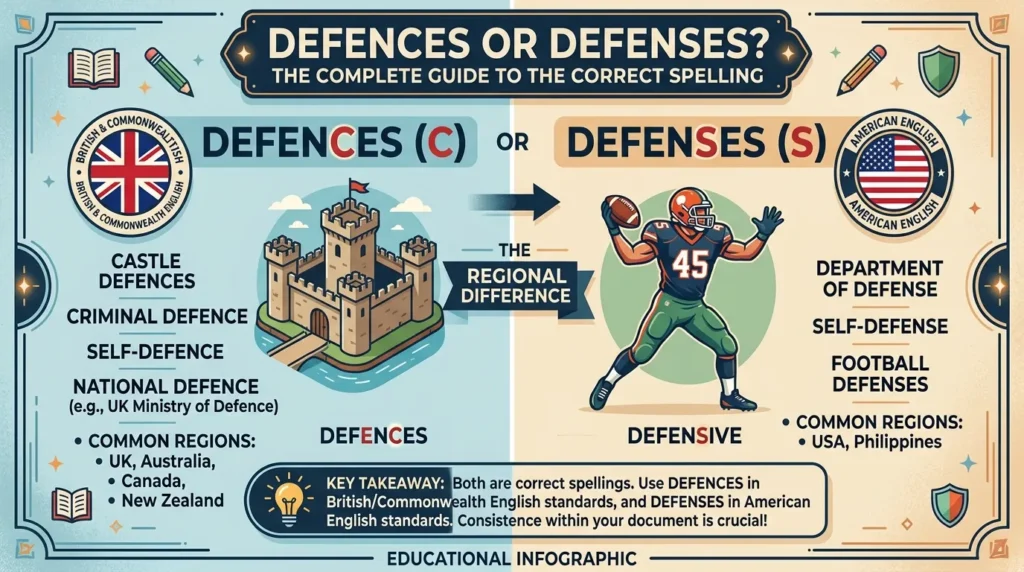
The quick answer is simple:
- Defences is the correct spelling in British English.
- Defenses is the correct spelling in American English.
Both words mean the same thing.
Examples
British English:
- The country’s military defences were strengthened.
- The lawyer prepared several defences for the case.
American English:
- The country’s military defenses were strengthened.
- The lawyer prepared several defenses for the case.
The only difference is the spelling.
The Origin of Defences or Defenses
The word comes from the Latin word defendere, which means “to ward off” or “to protect.”
Over time, the word entered Old French and later became part of the English language. As English evolved, spelling differences developed between regions.
When American English became more standardized during the 18th and 19th centuries, many spellings were simplified. One common change was replacing -ce endings with -se endings in certain nouns.
This is why:
- British English kept defence
- American English adopted defense
The same pattern appears in several other words.
Similar Examples
| British English | American English |
|---|---|
| Defence | Defense |
| Licence | License |
| Offence | Offense |
| Pretence | Pretense |
Both spellings have historical roots and are considered correct within their respective language systems.
British English vs American English Spelling
The difference between British and American spelling affects many words.
British English generally follows traditional spelling patterns, while American English often uses simplified forms.
Examples
| British English | American English |
|---|---|
| Defence | Defense |
| Offence | Offense |
| Licence | License |
| Pretence | Pretense |
| Travelling | Traveling |
| Colour | Color |
| Favourite | Favorite |
Why the Difference Exists
American dictionaries and language reformers aimed to simplify spelling. Over time, these spellings became standard in the United States.
Meanwhile, the United Kingdom and many Commonwealth countries retained the older forms.
Countries That Use Each Version
Defences
- United Kingdom
- Australia
- New Zealand
- South Africa
- Ireland
- Canada (often British style)
Defenses
- United States
Which Spelling Should You Use?
The correct choice depends on your audience.
For American Audiences
Use defenses.
Examples:
- American websites
- US businesses
- US schools
- US publications
For British Audiences
Use defences.
Examples:
- UK newspapers
- British universities
- UK government documents
For Commonwealth Countries
Most Commonwealth countries prefer defences.
Examples include:
- Australia
- New Zealand
- South Africa
For Global Audiences
Choose one spelling style and stay consistent.
If most readers are American, use defenses.
If readers are international or British-based, use defences.
Consistency is more important than the specific choice.
Common Mistakes with Defences or Defenses
Many writers make simple mistakes when using these spellings.
Mistake 1: Mixing Both Spellings
Incorrect:
- The military defences were improved, and the new defenses were effective.
Correct:
- The military defences were improved.
- The military defenses were improved.
Choose one style.
Mistake 2: Switching Styles in One Document
Using British spelling in one paragraph and American spelling in another creates inconsistency.
Always follow one language style throughout the document.
Mistake 3: Assuming One Version Is Wrong
Some people believe only one spelling is correct.
In reality:
- Defences = correct in British English
- Defenses = correct in American English
Mistake 4: Ignoring Audience Location
A UK audience may expect British spelling.
An American audience may expect American spelling.
Know who will read your content.
Defences or Defenses in Everyday Examples
The word appears in many types of writing.
In Emails
British English:
Our cyber defences have been upgraded.
American English:
Our cyber defenses have been upgraded.
In News Articles
British English:
The government announced stronger border defences.
American English:
The government announced stronger border defenses.
In Social Media
British English:
Strong defences win championships.
American English:
Strong defenses win championships.
In Academic Writing
British universities often prefer:
National defences
American universities usually prefer:
National defenses
In Business Reports
Choose the spelling that matches your company’s style guide.
Consistency improves professionalism.
Defences or Defenses – Google Trends & Usage Data
Search data and language usage patterns show a clear geographical divide.
Defences
More commonly used in:
- United Kingdom
- Australia
- New Zealand
- South Africa
Common contexts include:
- Government reports
- Education
- News media
- Legal writing
Defenses
More commonly used in:
- United States
Common contexts include:
- Military discussions
- Sports coverage
- Legal documents
- Business communication
Usage Comparison
| Feature | Defences | Defenses |
|---|---|---|
| Region | UK and Commonwealth | United States |
| Meaning | Protection or guarding | Protection or guarding |
| Pronunciation | Same | Same |
| Grammar | Same | Same |
| Formal Use | Yes | Yes |
| Informal Use | Yes | Yes |
The spelling changes, but the meaning remains identical.
Defences vs Defenses Comparison Table
| Feature | Defences | Defenses |
|---|---|---|
| Correct in British English | Yes | No |
| Correct in American English | No | Yes |
| Meaning | Protection | Protection |
| Pronunciation | Same | Same |
| Grammar Rules | Same | Same |
| Academic Acceptance | Yes | Yes |
| Business Use | Yes | Yes |
| International Recognition | Yes | Yes |
Frequently Asked Questions (FAQs)
Is it defences or defenses?
Both are correct. Defences is British English, while defenses is American English.
Which spelling is more common worldwide?
Defenses is common because of American influence, but defences remains widely used in many countries.
Do they have different meanings?
No. Both words have exactly the same meaning.
Which spelling should I use in academic writing?
Follow your institution’s style guide. British institutions usually prefer defences, while American institutions prefer defenses.
Is defences incorrect in the United States?
It is not technically incorrect, but it may appear unusual to American readers.
Is defenses wrong in the United Kingdom?
It is understood, but British readers generally expect defences.
How do I choose the right spelling?
Consider your audience and remain consistent throughout your writing.
Conclusion
The debate over defences or defenses is not really about right versus wrong. Both spellings are correct, but they belong to different versions of English. Defences is the standard spelling in British English and is widely used across the United Kingdom, Australia, New Zealand, and other Commonwealth countries. Defenses is the preferred spelling in American English and is the standard form used throughout the United States.
The most important rule is consistency. Once you choose a spelling style, use it throughout your document, website, report, or article. Mixing the two forms can confuse readers and make your writing appear less professional. Always consider your audience before deciding which version to use.
If your readers are primarily American, choose defenses. If your audience is British or international, defences may be the better option. Understanding this simple spelling difference will help you write with greater confidence and accuracy.