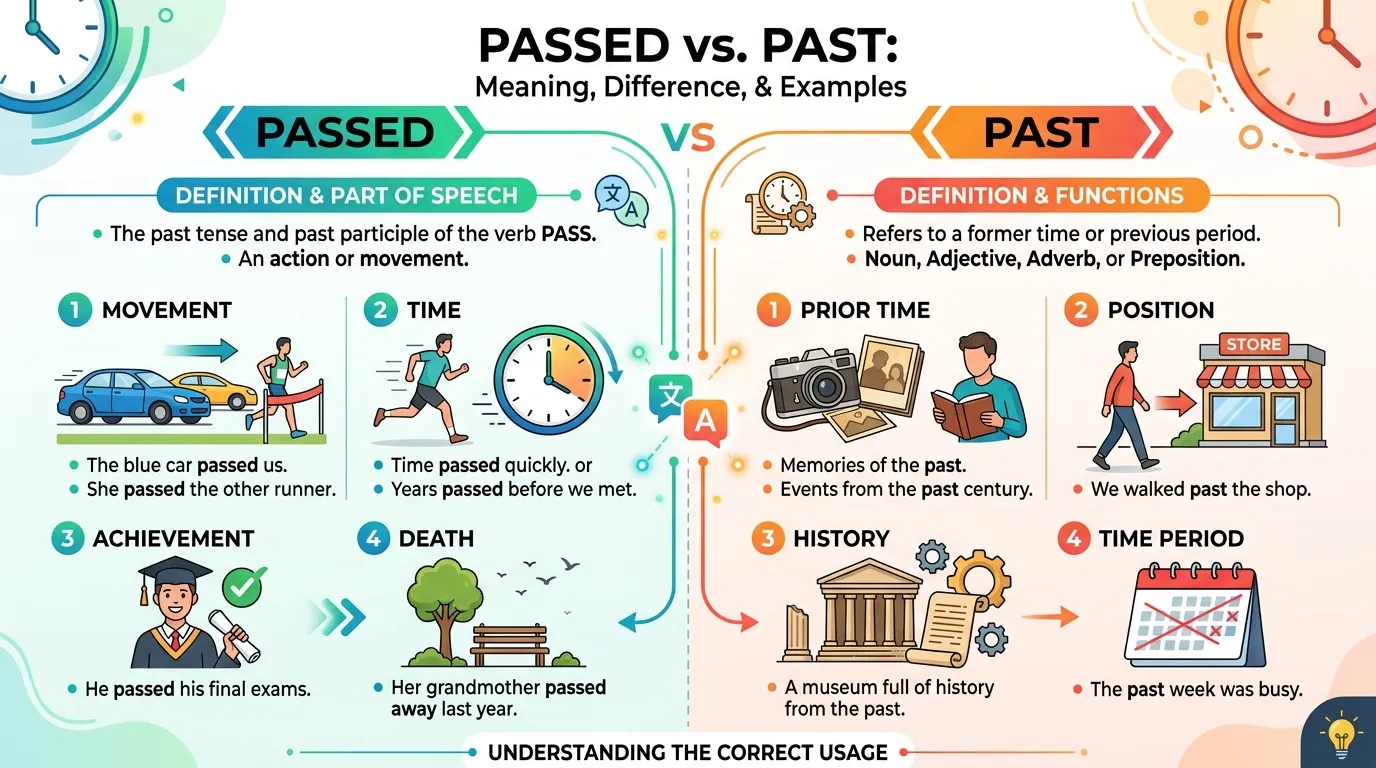
Passed vs past is a common English word confusion. The two words sound very similar, but they have different meanings and grammatical roles. Using the wrong one can change the meaning of a sentence, especially in emails, essays, reports, and everyday writing.
Passed is usually the past tense of the verb “pass.” It describes an action that happened before now. For example, “She passed the exam” means she successfully completed the exam. It can also mean moving beyond something, such as “The car passed the house.”
Past can be a noun, adjective, adverb, or preposition. It often refers to an earlier time or something beyond a particular point. For example, “We talked about the past” refers to an earlier time. You can also say, “The train went past the station.”
People search for passed vs past because the words are pronounced alike in many accents. This makes them easy to confuse when writing. This guide explains their meanings, grammar, pronunciation, common mistakes, everyday examples, and simple memory tricks so you can choose the correct word with confidence.
Passed vs Past – Quick Answer
The simplest difference is:
- Passed = an action that happened; past tense of pass.
- Past = an earlier time or something beyond a point.
Passed Examples
She passed the exam.
The car passed the truck.
He passed me the ball.
Time passed quickly.
Here, passed describes an action.
Past Examples
We learned about the past.
The school is past the bank.
She walked past me.
The past year was difficult.
Here, past refers to earlier time or something beyond a place or point.
Easy Memory Trick
Remember:
Passed = did something
Past = time or beyond
For example:
I passed the store.
I walked past the store.
The first sentence focuses on the action of passing. The second describes movement beyond the store.
The Origin of Passed vs Past
Although passed and past are closely related in meaning, they have different grammatical histories.
Origin of Passed
Passed comes from the verb pass, which developed through Old French and Latin roots associated with stepping, moving, or going.
The verb pass can have several meanings:
- Move beyond something
- Go from one place to another
- Hand something to someone
- Successfully complete a test
- Spend time
The past tense is passed.
She passed the exam.
He passed the ball.
The train passed the station.
Origin of Past
Past developed from forms related to the verb pass and came to describe something that has gone by or lies beyond a particular point.
Today, past can refer to:
- Earlier time
- A previous period
- A location beyond something
- A point beyond a specific time
Examples:
The past is important.
It is past midnight.
Walk past the building.
Why Are They Confused?
The words are closely related and are often pronounced the same.
Compare:
passed
past
The spelling difference is small, but the grammatical function is important.
| Word | Main Function | Example |
|---|---|---|
| Passed | Verb | She passed the test. |
| Past | Noun | We studied the past. |
| Past | Preposition | Walk past the store. |
| Past | Adjective | Past events matter. |
| Past | Adverb | He walked past. |
British English vs American English Spelling
There is no major spelling difference between British and American English for passed and past.
Both varieties use:
- passed as the past tense of pass
- past for earlier time or something beyond a point
Comparison Table
| Meaning | British English | American English | Example |
|---|---|---|---|
| Completed an exam | passed | passed | She passed the exam. |
| Moved beyond | passed | passed | The car passed us. |
| Earlier time | past | past | The past matters. |
| Beyond a place | past | past | Walk past the store. |
| Previous | past | past | Past events can teach us. |
British English Examples
He passed the exam.
She walked past the station.
American English Examples
He passed the exam.
She walked past the station.
The spelling is the same in both forms of English.
Which Spelling Should You Use?
Your choice depends on the meaning and grammar of the sentence.
Use Passed as a Verb
Use passed when describing an action.
She passed the exam.
The bus passed our house.
He passed the message to his manager.
Time passed quickly.
A useful test is to replace passed with another action verb.
She passed the exam.
She completed the exam successfully.
This confirms that passed is functioning as a verb.
Use Past for Earlier Time
Use past when referring to time before now.
We cannot change the past.
The past few years have been challenging.
He has a difficult past.
Use Past for Movement Beyond Something
Use past when describing movement beyond a place or object.
Walk past the bank.
The children ran past me.
We drove past the school.
Use Past with Time
Past is also common when talking about time.
It is half past five.
It is ten past six.
She arrived past midnight.
For US Readers
American English follows the same distinction.
For UK and Commonwealth Readers
British and Commonwealth English also use the same basic rules.
For Global English
Remember:
Passed = action
Past = time, previous events, or beyond
Common Mistakes with Passed vs Past
Mistake 1: “I Past the Exam”
Incorrect:
I past the exam.
Correct:
I passed the exam.
Passing an exam is an action, so use the verb passed.
Mistake 2: “Walk Passed the School”
Incorrect:
Walk passed the school.
Correct:
Walk past the school.
Here, past means beyond the school.
Mistake 3: “In the Passed”
Incorrect:
In the passed, people traveled differently.
Correct:
In the past, people traveled differently.
You are referring to an earlier time, so use past.
Mistake 4: “The Car Past Me”
Incorrect:
The car past me.
Correct:
The car passed me.
The car performed the action of passing, so use passed.
Mistake 5: “Past the Test”
Incorrect:
She past the test.
Correct:
She passed the test.
Again, passed is the past tense of the verb pass.
Mistake 6: “Half Passed Five”
Incorrect:
It is half passed five.
Correct:
It is half past five.
When telling time, use past.
Passed vs Past in Everyday Examples
In Emails
Passed:
I am pleased to inform you that I passed the certification exam.
Past:
Please review the past reports before the meeting.
In News
Passed:
The bill passed the final vote.
Past:
The country is looking back at its past.
On Social Media
Passed:
I finally passed my driving test!
Past:
Leave the past behind and focus on the future.
In Formal Writing
Passed:
The proposal passed the committee review.
Past:
Historical records provide information about the past.
In Everyday Conversation
The bus passed us.
Walk past the store.
I passed my exam.
We should learn from the past.
Passed vs Past – Comparison Table
| Word | Part of Speech | Main Meaning | Example |
|---|---|---|---|
| Passed | Verb | Moved beyond | The car passed me. |
| Passed | Verb | Successfully completed | She passed the exam. |
| Passed | Verb | Handed something | He passed me the book. |
| Passed | Verb | Went by | Time passed quickly. |
| Past | Noun | Earlier time | We cannot change the past. |
| Past | Adjective | Previous | Past events matter. |
| Past | Preposition | Beyond | Walk past the school. |
| Past | Adverb | Beyond a point | The train went past. |
Passed vs Past Pronunciation
In most standard varieties of English, passed and past are pronounced very similarly and are often homophones.
Passed
Passed sounds approximately like:
past
She passed the exam.
Past
Past is also pronounced approximately:
past
We studied the past.
The similar pronunciation is one major reason people confuse these words in writing.
Use Grammar to Tell Them Apart
Because pronunciation does not always help, look at the sentence.
If you need a verb, passed may be correct:
The car passed the building.
If you mean earlier time or beyond, past is usually correct:
The car went past the building.
How to Remember Passed vs Past
Passed = Action
Think of passed as something someone or something did.
She passed the exam.
The car passed me.
He passed the ball.
Past = Time or Beyond
Think of past as:
- Earlier time
- Previous events
- Beyond a point
In the past
Past mistakes
Walk past the house
The “Pass” Test
If you can replace the word with a form of pass, use passed.
She passed the exam.
The base verb is pass.
But:
Walk past the school.
You cannot say:
Walk pass the school. ❌
This shows that past is correct.
Passed vs Past – Google Trends & Usage Data
Search interest for passed vs past is mainly connected to English grammar, spelling, vocabulary, pronunciation, and writing.
The confusion is common because the two words are often pronounced alike. However, their grammatical roles are different.
Passed appears frequently in education, exams, laws, sports, travel, and everyday actions. Examples include passed the exam, passed the test, passed the ball, and passed the house.
Past is common in discussions of history, time, movement, and previous events. Common phrases include in the past, past mistakes, past the building, and half past five.
Search interest can vary by country and over time. Exact Google Trends numbers should be checked directly before publishing numerical claims because search patterns change.
The main search intent is straightforward: users want to know whether passed or past is correct in a particular sentence.
FAQs About Passed vs Past
1. What is the difference between passed and past?
Passed is usually the past tense of the verb pass. Past refers to earlier time, previous events, or something beyond a point.
She passed the exam.
We learned about the past.
2. Is it “I passed the exam” or “I past the exam”?
The correct sentence is:
I passed the exam.
Passing an exam is an action.
3. Is it “walk passed” or “walk past”?
The correct phrase is:
Walk past the building.
Past means beyond the building.
4. Is “in the passed” correct?
No.
The correct phrase is:
In the past
It refers to an earlier time.
5. Is it “the car passed me” or “the car past me”?
The correct sentence is:
The car passed me.
Here, passed is the verb describing the action.
6. Is it “half past five” or “half passed five”?
The correct expression is:
Half past five.
Use past when telling time.
7. Are passed and past pronounced the same?
In most English accents, they are pronounced the same or very similarly. This is why context and grammar are important when choosing the correct spelling.
Conclusion
The difference between passed vs past becomes much easier when you focus on their roles in a sentence. Passed is usually the past tense of the verb pass. It describes an action, such as successfully completing an exam, moving beyond something, handing something to someone, or going by.
Past, on the other hand, usually refers to an earlier time, previous events, or something beyond a particular point. For example, “We should learn from the past” refers to earlier time, while “Walk past the school” means move beyond the school.
A useful memory trick is passed = action and past = time or beyond. If you can use another action verb in its place, passed may be the correct choice. If you are talking about history, earlier time, or movement beyond something, past is usually correct.
British and American English use the same spellings, so this is not a regional spelling issue. The main challenge is that passed and past often sound alike.
When you are unsure, look at the grammar and meaning. Ask yourself: Is this an action, or am I talking about time or something beyond a point? That simple question will help you choose the correct word.