Eminent vs imminent is a common English word confusion. The two words look and sound very similar, but their meanings are completely different. A single letter can change the meaning of a sentence, so knowing when to use each word is important for clear and professional writing.
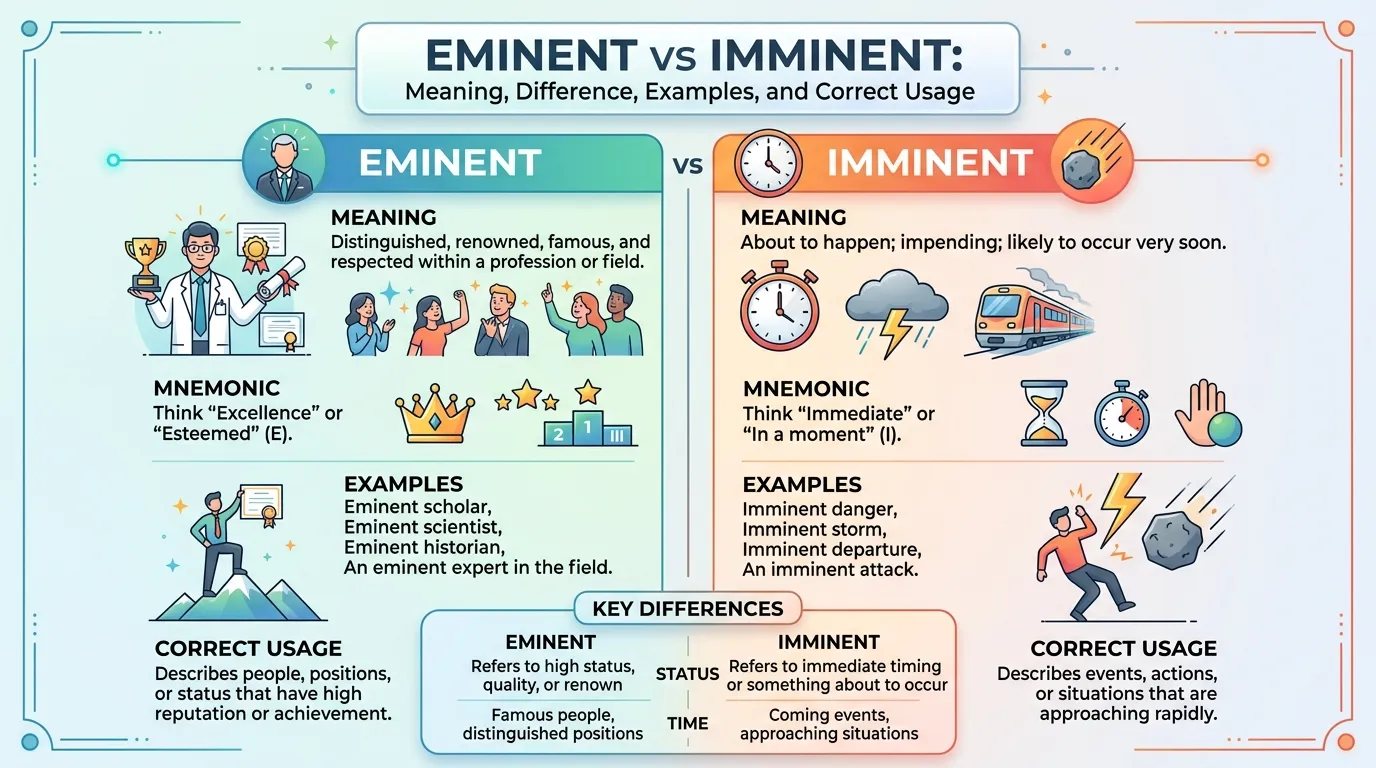
Eminent means famous, respected, or important, especially because of someone’s achievements or position. For example, “She is an eminent scientist” means she is a highly respected or distinguished scientist.
Imminent means about to happen very soon. For example, “The storm is imminent” means the storm is expected to happen soon.
People often search for eminent vs imminent because both words contain similar letters and have related-looking pronunciations. They are especially easy to confuse in formal writing, news reports, academic articles, and professional documents.
This guide explains eminent vs imminent in simple English. You will learn their meanings, origins, pronunciation, British and American usage, common mistakes, everyday examples, and easy memory tricks. By the end, you will know exactly which word to use when describing an important person or something that is about to happen.
Eminent vs Imminent – Quick Answer
The easiest way to remember the difference is:
- Eminent = famous, respected, or important.
- Imminent = about to happen soon.
Eminent Examples
He is an eminent professor.
The award was presented to an eminent scientist.
She became an eminent leader in her field.
Here, eminent describes a person who is distinguished or highly respected.
Imminent Examples
A storm is imminent.
The company warned of an imminent shortage.
The patient’s condition suggested that danger was imminent.
Here, imminent describes something expected to happen very soon.
Easy Memory Trick
Think:
Eminent = Excellent and respected
Imminent = Immediate
For example:
An eminent scientist is highly respected.
An imminent storm is coming soon.
The Origin of Eminent vs Imminent
Although eminent and imminent look similar, they developed from different Latin words.
Origin of Eminent
Eminent comes from the Latin word eminēre, meaning “to stand out” or “to project.”
The word entered English through French and developed the meaning of standing out because of excellence, importance, reputation, or achievement.
Today, eminent is often used for:
- Scientists
- Professors
- Writers
- Leaders
- Judges
- Experts
- Artists
For example:
An eminent historian wrote the book.
The historian is distinguished and respected.
Origin of Imminent
Imminent comes from the Latin imminēre, meaning “to project” or “to overhang.”
It developed the sense of something hanging over a person or situation and therefore being about to happen.
Today, imminent means something is likely to happen very soon.
Heavy rain is imminent.
An announcement is imminent.
Why Are They Confused?
The words have very similar spellings:
eminent
imminent
The main difference is the first vowel.
| Word | Main Meaning |
|---|---|
| Eminent | Important or highly respected |
| Imminent | About to happen |
British English vs American English Spelling
There is no major spelling difference between British and American English for eminent and imminent.
Both varieties use:
- eminent = distinguished or respected
- imminent = about to happen
Comparison Table
| Meaning | British English | American English | Example |
|---|---|---|---|
| Highly respected | eminent | eminent | An eminent professor spoke. |
| Distinguished | eminent | eminent | She is an eminent expert. |
| About to happen | imminent | imminent | A storm is imminent. |
| Likely to happen soon | imminent | imminent | An announcement is imminent. |
British English Examples
She is an eminent medical researcher.
Heavy rain is imminent.
American English Examples
She is an eminent medical researcher.
Heavy rain is imminent.
The spellings and meanings are the same in both forms of English.
Which Spelling Should You Use?
Your choice depends entirely on what you want to describe.
Use Eminent for Important People
Use eminent when describing someone who is famous, distinguished, or highly respected.
an eminent scientist
an eminent lawyer
an eminent professor
an eminent author
an eminent leader
Example:
The university invited an eminent scientist to speak.
Use Imminent for Future Events
Use imminent when something is expected to happen very soon.
imminent danger
imminent arrival
imminent storm
imminent decision
imminent change
Example:
The police warned residents that danger was imminent.
A Simple Question Test
Ask:
Am I describing a respected person or thing?
Use eminent.
Am I describing something that is about to happen?
Use imminent.
For US Readers
American English uses the same distinction.
For UK and Commonwealth Readers
British and Commonwealth English also use the same meanings.
For Global English
Remember:
Eminent = important.
Imminent = immediate.
Common Mistakes with Eminent vs Imminent
Mistake 1: “An Imminent Scientist”
Incorrect:
He is an imminent scientist.
Correct:
He is an eminent scientist.
The sentence describes a respected scientist.
Mistake 2: “Eminent Danger”
Incorrect when you mean danger is about to happen:
Eminent danger is approaching.
Better:
Imminent danger is approaching.
Danger that is about to happen is imminent.
Mistake 3: “An Eminent Storm”
Incorrect:
An eminent storm is coming.
Correct:
An imminent storm is coming.
A storm that is about to happen is imminent.
Mistake 4: “Imminent Professor”
Incorrect:
She is an imminent professor.
Correct:
She is an eminent professor.
The person is distinguished or respected.
Mistake 5: Confusing “Imminent” with “Eminent”
Incorrect:
The company expects an eminent announcement.
Correct:
The company expects an imminent announcement.
The announcement is expected soon.
Eminent vs Imminent in Everyday Examples
In Emails
Eminent:
We are pleased to welcome an eminent expert to our conference.
Imminent:
Please prepare for the imminent arrival of the inspection team.
In News
Eminent:
An eminent historian discussed the country’s past.
Imminent:
Officials warned that severe weather was imminent.
On Social Media
Eminent:
Proud to meet such an eminent leader in the industry.
Imminent:
The storm looks imminent. Stay safe!
In Formal Writing
Eminent:
The research was reviewed by several eminent scholars.
Imminent:
The organization took action because of the imminent risk.
In Academic Writing
Eminent:
The theory was developed by an eminent researcher.
Imminent:
The study focused on the imminent effects of climate change.
Eminent vs Imminent – Comparison Table
| Word | Part of Speech | Meaning | Common Uses | Example |
|---|---|---|---|---|
| Eminent | Adjective | Famous or respected | Eminent scientist | He is an eminent scientist. |
| Eminent | Adjective | Distinguished | Eminent scholar | She is an eminent scholar. |
| Imminent | Adjective | About to happen | Imminent danger | Danger is imminent. |
| Imminent | Adjective | Expected soon | Imminent arrival | His arrival is imminent. |
| Imminent | Adjective | Near in time | Imminent change | An imminent change is expected. |
Eminent vs Imminent Pronunciation
The pronunciation of eminent and imminent is similar, which can make them confusing.
Eminent
Eminent is commonly pronounced approximately:
EM-uh-nent
The first syllable sounds like em.
She is an eminent scientist.
Imminent
Imminent is commonly pronounced approximately:
IM-uh-nent
The first syllable begins with an im sound.
A storm is imminent.
Pronunciation Table
| Word | Approximate Sound | Meaning |
|---|---|---|
| Eminent | EM-uh-nent | Respected or distinguished |
| Imminent | IM-uh-nent | About to happen |
The pronunciation is close, so context is often the best way to identify the correct word.
How to Remember Eminent vs Imminent
Eminent = Excellent
Think:
Eminent = Excellent and respected
An eminent person stands out because of knowledge, achievements, or reputation.
an eminent professor
an eminent scientist
Imminent = Immediate
Think:
Imminent = Immediate
Something imminent is about to happen.
imminent danger
imminent storm
imminent arrival
The One-Letter Trick
Look at the first letters:
Eminent → Expert
Imminent → Immediate
This is not a perfect spelling rule, but it is a useful memory aid.
Eminent vs Imminent – Google Trends & Usage Data
Search interest for eminent vs imminent is mainly related to English vocabulary, spelling, grammar, pronunciation, academic writing, and professional communication.
Eminent is often used in formal contexts to describe distinguished people. Common phrases include eminent scientist, eminent scholar, eminent professor, and eminent leader.
Imminent is commonly used to describe events, risks, changes, or situations expected to happen soon. Common phrases include imminent danger, imminent threat, imminent arrival, and imminent change.
Both words are used in British and American English, although eminent tends to appear more often in formal or academic writing.
Google Trends interest can change by country and over time. Exact search-volume numbers should be checked directly before publishing specific statistics.
The main search intent is simple: users want to know whether eminent or imminent is correct when describing an important person or an event that is about to happen.
FAQs About Eminent vs Imminent
1. What is the difference between eminent and imminent?
Eminent means famous, respected, or distinguished.
Imminent means about to happen very soon.
She is an eminent scientist.
A storm is imminent.
2. Is it “eminent danger” or “imminent danger”?
The correct phrase is:
Imminent danger
It means danger that is about to happen or is very near.
3. Is it “imminent scientist” or “eminent scientist”?
The correct phrase is:
Eminent scientist
It describes a scientist who is highly respected or distinguished.
4. Does imminent mean certain?
Not necessarily. Imminent means something is expected to happen very soon. It does not always mean that the event is absolutely certain.
5. Can eminent describe a place or organization?
Yes, although it is most often used for people or their achievements. It can describe something distinguished or prominent in an appropriate context.
6. Are eminent and imminent pronounced the same?
No, but their pronunciations are very similar. Eminent starts with an “em” sound, while imminent starts with an “im” sound.
7. What is an easy way to remember eminent vs imminent?
Remember:
Eminent = excellent, respected, or distinguished.
Imminent = immediate or about to happen.
Conclusion
The difference between eminent vs imminent is easy to understand when you focus on meaning. Eminent describes someone or something that is distinguished, famous, important, or highly respected. Imminent describes something that is expected to happen very soon.
For example, “She is an eminent scientist” means she is a respected and distinguished scientist. On the other hand, “A storm is imminent” means the storm is likely to arrive soon.
A simple memory trick is eminent = excellent or respected and imminent = immediate. You can also ask yourself whether you are describing a person’s reputation or an upcoming event. A respected expert is eminent, while approaching danger is imminent.
British and American English use the same spellings and meanings, so there is no regional spelling difference to worry about. The main challenge is their similar appearance and pronunciation.
These words are especially important in formal, academic, business, and news writing. Using eminent when you mean “respected” and imminent when you mean “about to happen” keeps your writing precise and professional.
When you are unsure, remember the two key ideas: eminent people stand out, while imminent events are close in time. This simple distinction will help you avoid one of the most common vocabulary mistakes in English.