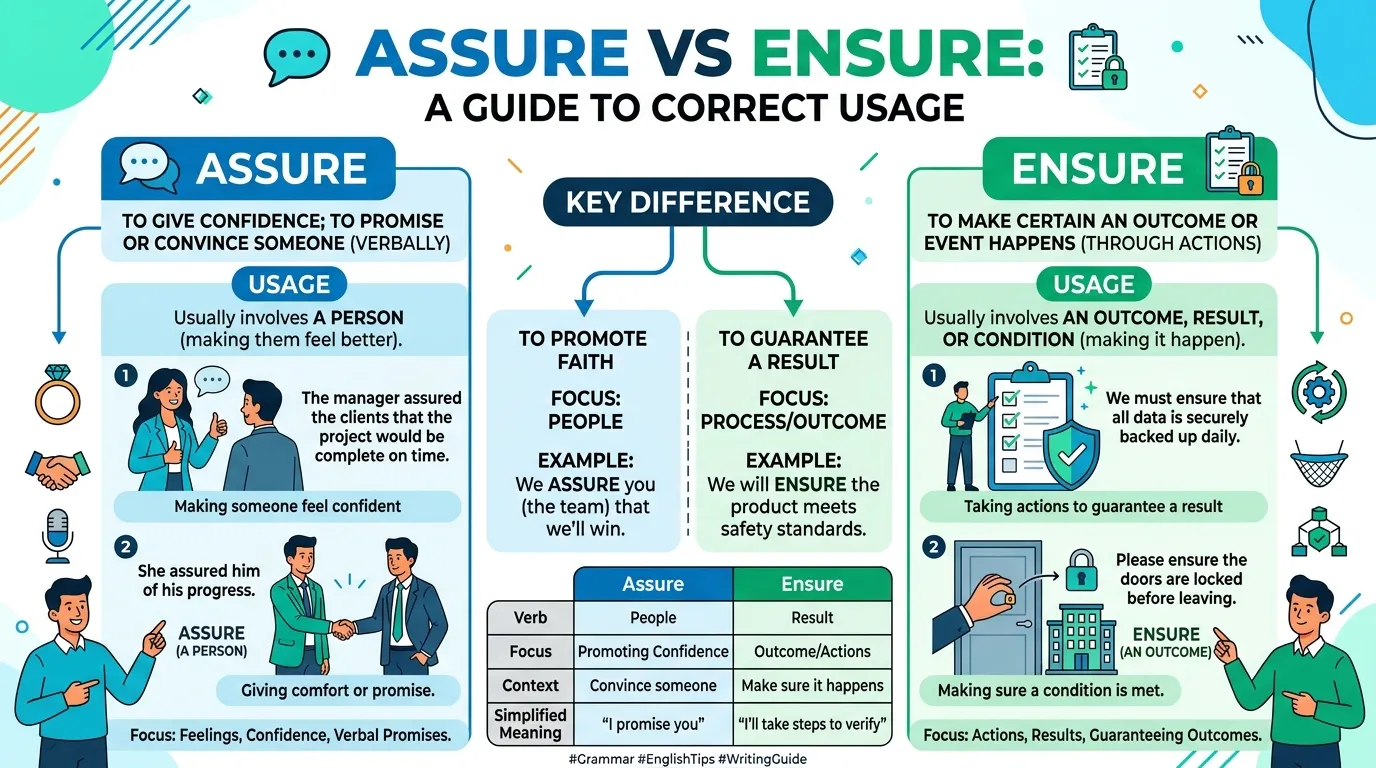
Assure vs ensure is a common English word confusion. The two words look and sound similar, and both are connected with making something certain. However, they are used in different ways. Knowing the difference is important for clear writing, especially in emails, business documents, academic work, and professional communication.
Assure usually means to tell someone confidently that something is true or will happen. It is normally used when speaking to a person. For example, “I assure you that we will solve the problem.” Here, the speaker is giving confidence to another person.
Ensure means to make certain that something happens or is true. It usually focuses on an action, result, or condition. For example, “Please ensure that all doors are locked.” Here, the person is being asked to make certain that the doors are locked.
People search for assure vs ensure because the words are close in meaning but have different grammar and usage. This guide explains the difference with simple definitions, examples, common mistakes, pronunciation tips, and practical rules.
Assure vs Ensure – Quick Answer
The easiest way to remember the difference is:
- Assure = give someone confidence or remove someone’s doubt.
- Ensure = make certain that something happens.
Assure Examples
I assure you that everything is fine.
She assured me that the report was ready.
The manager assured the customer that help was coming.
Assure normally has a person as its object.
assure someone
Ensure Examples
Please ensure that the door is locked.
We must ensure the equipment is safe.
These rules help ensure quality.
Ensure focuses on making something certain.
ensure something
Easy Memory Trick
Think:
Assure = a person
Ensure = an outcome
For example:
I assure you that we will help.
We will ensure that the problem is fixed.
The Origin of Assure vs Ensure
Assure and ensure have related Latin and French roots, which helps explain why they look similar.
Origin of Assure
Assure came into English through Old French and is related to the Latin root securus, meaning safe or secure.
Over time, assure developed the meaning of giving someone confidence or removing doubt.
I assure you that the information is correct.
The focus is often on a person’s feelings or belief.
Origin of Ensure
Ensure developed from French and is related to the idea of making something sure or certain.
Today, it means making certain that a result or condition occurs.
We must ensure that the system works correctly.
The focus is on the result rather than a person’s confidence.
Why Are They Confused?
Both words contain the idea of certainty.
| Word | Main Idea |
|---|---|
| Assure | Give a person confidence |
| Ensure | Make something certain |
This small difference is the key to using them correctly.
British English vs American English Spelling
There is no major spelling difference between British and American English for assure and ensure.
Both varieties use:
- assure = give someone confidence
- ensure = make certain
Comparison Table
| Meaning | British English | American English | Example |
|---|---|---|---|
| Give someone confidence | assure | assure | I assure you it is safe. |
| Remove someone’s doubt | assure | assure | She assured me everything was fine. |
| Make certain | ensure | ensure | Ensure that the door is locked. |
| Make something happen | ensure | ensure | Rules ensure safety. |
British English Examples
I assure you that the work will be completed.
Please ensure that all documents are signed.
American English Examples
I assure you that the work will be completed.
Please ensure that all documents are signed.
The spelling and basic distinction are the same.
Which Spelling Should You Use?
The correct word depends on what you are making certain.
Use Assure When Talking to a Person
Use assure when you are giving confidence to someone.
I assure you that everything is ready.
She assured him that there was no problem.
The manager assured the customer that the issue would be resolved.
A useful pattern is:
assure + person + that
I assure you that the information is correct.
Use Ensure for a Result
Use ensure when you mean to make something certain.
Ensure that the machine is switched off.
We must ensure that all employees receive training.
The inspection will ensure safety.
A useful pattern is:
ensure + thing/result
Compare the Two
I assure you that the machine is safe.
This gives confidence to you.
I will ensure that the machine is safe.
This means I will take steps to make it safe.
For US Readers
American English follows the same basic distinction.
For UK and Commonwealth Readers
British and Commonwealth English also use the same distinction.
For Global English
Remember:
Assure a person.
Ensure a result.
Common Mistakes with Assure vs Ensure
Mistake 1: “I Ensure You”
Incorrect in standard usage when you mean to reassure someone:
I ensure you that everything is fine.
Better:
I assure you that everything is fine.
You are speaking directly to a person.
Mistake 2: “I Assure That the Door Is Locked”
Usually incorrect or unnatural when you mean to make certain that something happens.
Better:
I ensure that the door is locked.
Mistake 3: “Please Assure the Door Is Locked”
Incorrect when the intended meaning is to make certain.
Correct:
Please ensure that the door is locked.
Mistake 4: “The Rules Assure Safety”
This may be possible in a special context, but ensure is usually the clearer choice when the meaning is “make certain.”
Better:
The rules ensure safety.
Mistake 5: “She Ensured Me”
Incorrect when you mean she gave you confidence.
Correct:
She assured me that everything was ready.
Mistake 6: “The Manager Assured That the System Was Safe”
If the manager is speaking to someone and giving confidence, name the person:
The manager assured us that the system was safe.
If the meaning is that the manager made certain of the result:
The manager ensured that the system was safe.
Assure vs Ensure in Everyday Examples
In Emails
Assure:
I assure you that your request is being reviewed.
Ensure:
Please ensure that you attach all required documents.
In News
Assure:
The minister assured the public that supplies were available.
Ensure:
Officials introduced new measures to ensure public safety.
On Social Media
Assure:
I assure you, the final result will be worth the wait!
Ensure:
We are working hard to ensure every customer gets good service.
In Formal Writing
Assure:
The director assured employees that their concerns would be considered.
Ensure:
The procedure is designed to ensure consistent results.
In Workplace Communication
Assure:
I assure you that the equipment will be inspected today.
Ensure:
Please ensure that the equipment is switched off before inspection.
Assure vs Ensure – Comparison Table
| Word | Part of Speech | Main Meaning | Common Pattern | Example |
|---|---|---|---|---|
| Assure | Verb | Give confidence | assure someone | I assure you. |
| Assure | Verb | Remove doubt | assure someone that… | She assured me that it was safe. |
| Ensure | Verb | Make certain | ensure something | Ensure safety. |
| Ensure | Verb | Make sure something happens | ensure that… | Ensure that the door is locked. |
Related Word: Insure
There is a third word that is sometimes confused with assure and ensure:
Insure usually relates to financial protection against risk, especially through insurance.
We insured the car.
So remember:
- Assure = give confidence to a person.
- Ensure = make something certain.
- Insure = provide or obtain insurance.
Assure vs Ensure Pronunciation
The words are pronounced differently.
Assure
Assure is commonly pronounced approximately:
uh-SHUR
The stress is on the second syllable.
I assure you.
Ensure
Ensure is commonly pronounced approximately:
en-SHUR
The stress is also on the second syllable.
Please ensure that everything is ready.
Pronunciation Table
| Word | Approximate Sound | Meaning |
|---|---|---|
| Assure | uh-SHUR | Give confidence |
| Ensure | en-SHUR | Make certain |
Although the words sound similar, the first syllable helps distinguish them when speaking.
How to Remember Assure vs Ensure
Assure = A Person
Think:
Assure a person.
Examples:
assure me
assure him
assure her
assure them
assure you
Ensure = An Outcome
Think:
Ensure an outcome.
Examples:
ensure safety
ensure quality
ensure accuracy
ensure success
ensure that the door is locked
The Simple Question Test
Ask yourself:
Am I giving confidence to someone?
Use assure.
Am I making certain that something happens?
Use ensure.
For example:
I assure you that the project is safe.
I will ensure that the project meets the safety requirements.
Assure vs Ensure – Google Trends & Usage Data
Search interest for assure vs ensure is mainly related to English grammar, vocabulary, business writing, professional communication, and language learning.
Assure is common when people discuss promises, confidence, reassurance, and communication. Common phrases include I assure you, assured me, and assure the public.
Ensure is common in instructions, workplace documents, policies, technical writing, education, and formal communication. Common phrases include ensure safety, ensure quality, ensure accuracy, and ensure that.
The two words are both widely used in English-speaking countries, including the United States, United Kingdom, Canada, Australia, and other regions where English is commonly used.
Google Trends interest changes by country and over time, so exact popularity numbers should be checked directly before publishing specific statistics.
The main search intent is usually to understand whether assure or ensure should be used when writing about certainty.
FAQs About Assure vs Ensure
1. What is the difference between assure and ensure?
Assure means to give someone confidence that something is true or will happen.
Ensure means to make something certain.
I assure you that we will help.
We will ensure that the work is completed.
2. Is it “I assure you” or “I ensure you”?
The standard phrase is:
I assure you.
You are giving confidence to another person.
3. Is it “ensure me” or “assure me”?
Use assure me when someone gives you confidence.
She assured me that everything was fine.
4. Is it “ensure that” or “assure that”?
Use ensure that when you mean “make certain that.”
Please ensure that the door is locked.
Assure normally involves a person:
He assured me that the door was locked.
5. What is the difference between assure, ensure, and insure?
- Assure = give confidence to a person.
- Ensure = make something certain.
- Insure = protect against financial risk through insurance.
6. Can assure and ensure be used in the same sentence?
Yes.
I assure you that we will ensure the equipment is safe.
Here, assure gives confidence to a person, while ensure means make the equipment safe or certain to meet the condition.
7. What is an easy way to remember assure vs ensure?
Remember:
Assure a person.
Ensure a result.
If you are talking directly to someone’s confidence, use assure. If you are making something certain, use ensure.
Conclusion
The difference between assure vs ensure is simple when you focus on the object of the action. Assure means to give someone confidence or remove their doubts. Ensure means to make something certain or make sure that a particular result happens.
For example, “I assure you that everything is ready” is correct because the speaker is giving confidence to you. In contrast, “Please ensure that everything is ready” means the person should take action to make certain that everything is ready.
A useful memory trick is assure a person and ensure a result. If you can put a person such as me, him, her, us, or you after the verb, assure is often the right choice. If you are talking about safety, quality, accuracy, completion, or another result, ensure is usually the better word.
British and American English use the same spellings and basic meanings. The third word, insure, is different and usually relates to insurance and financial risk.
Once you understand these simple patterns, choosing between assure and ensure becomes much easier. This distinction is especially useful in professional emails, reports, instructions, business writing, and formal documents where precise word choice matters.