Communication means sharing ideas, thoughts, or feelings with others — through speaking, writing, gestures, or even facial expressions. It sits at the center of school, work, and relationships, which is why the word appears everywhere. But repeating “communication” in every sentence makes your writing heavy and dull.
Notice how often the word shows up in job ads: “good communication skills required.” Everyone writes it, so it has lost its punch. Replacing it with precise alternatives — “strong presentation skills,” “clear client dialogue,” “open team discussion” — tells the employer exactly what you can do. Specific words beat generic ones every time.
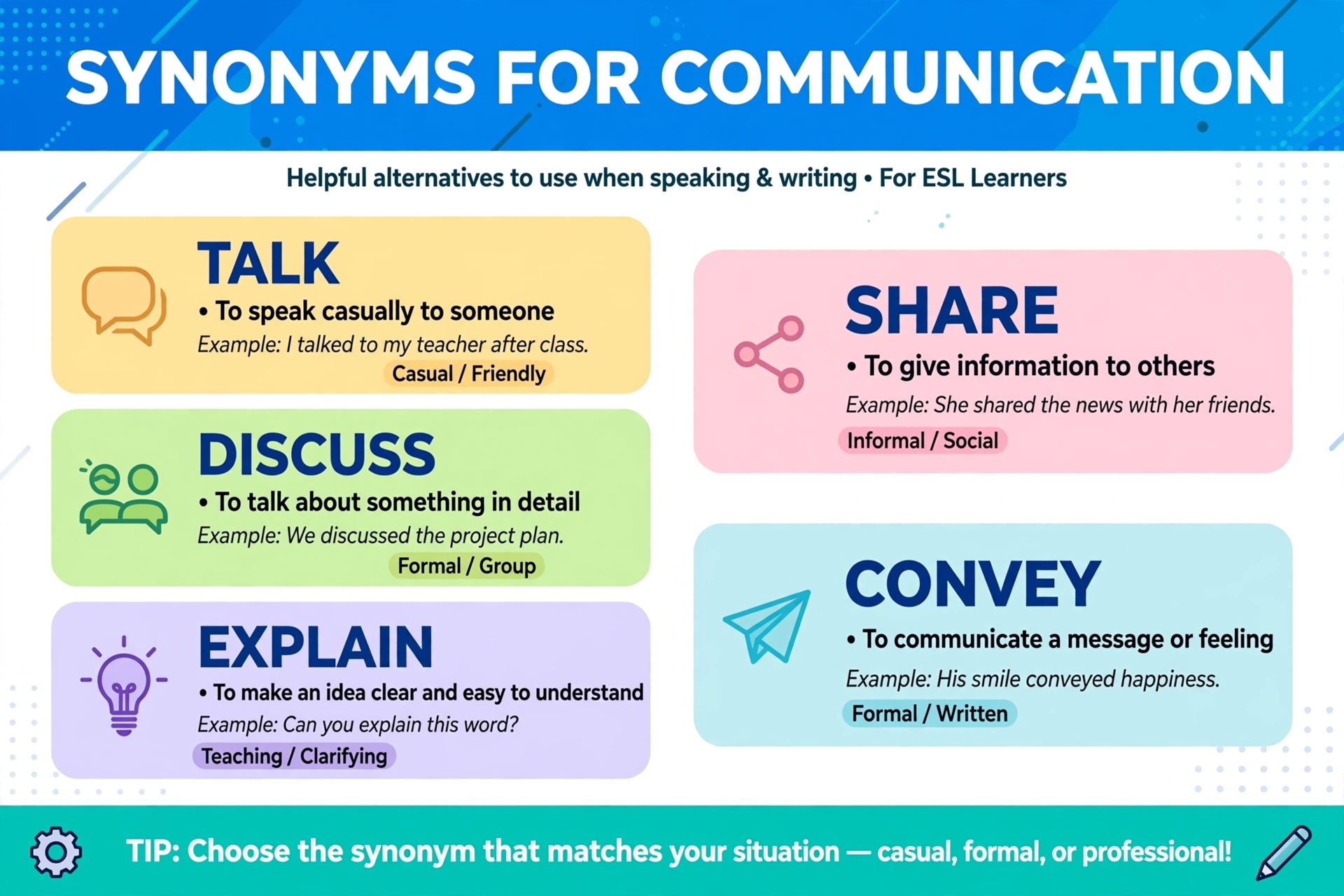
Strong synonyms for communication give you variety and precision. A casual chat is a conversation, a formal exchange is a dialogue, and a two-way sharing of ideas is an exchange. Each word fits a different moment, and choosing well makes you sound fluent and confident.
Think about how these words behave in real life. A manager who writes “we need better team interaction” sounds vague, but “we need open dialogue between departments” sounds decisive and specific. In essays, “the conversation around climate change” paints a lively public debate, while “the dialogue between the two countries” signals something serious and official. Once you feel these small differences, you stop reaching for the same tired word and start choosing the one that fits like a key in a lock.
In this guide, you will learn five powerful synonyms for communication, each with a clear meaning and natural example sentences.
Interaction
Meaning: The way people talk or act with each other; a simple form of communication.
Example: Friendly interaction between classmates makes school more enjoyable.
Example: The shop is known for warm, personal interaction with customers.
Example: Online classes reduce face-to-face interaction between teachers and students.
Conversation
Meaning: A casual talk between people where ideas and news are shared.
Example: We had a long conversation about our holiday plans last night.
Example: Good conversation is the heart of every strong friendship.
Example: Their phone conversations usually last for more than an hour.
Dialogue
Meaning: A serious or formal discussion between two or more people, often to solve a problem.
Example: The two leaders opened a dialogue to end the disagreement.
Example: Honest dialogue between parents and teens builds lasting trust.
Example: The company encourages open dialogue about salaries and promotions.
Discussion
Meaning: Talking about a topic to share ideas, opinions, or information.
Example: Our class discussion on climate change lasted the whole period.
Example: The family held a discussion about where to spend the holidays.
Example: After much discussion, the committee approved the new budget.
Exchange
Meaning: Communication where ideas, words, or information flow in both directions.
Example: There was a lively exchange of ideas during the team meeting.
Example: The two professors kept up a friendly exchange of letters for years.
Example: The debate turned into a heated exchange between the two candidates.
Quick Comparison Table
| Synonym | Best Used For |
|---|---|
| Interaction | General contact between people |
| Conversation | Casual, everyday talks |
| Dialogue | Serious or formal discussions |
| Discussion | Topic-focused sharing of ideas |
| Exchange | Two-way flow of ideas or words |
How to Use These Words
Choose based on tone and setting. Use interaction for general contact, conversation for casual talks, dialogue for serious or formal talks, discussion for topic-focused sharing, and exchange when ideas flow both ways. One more tip: in professional writing, “discussion” and “dialogue” carry more weight than “talk.” In writing, the right connector also keeps communication clean — since vs because shows how small words shape meaning. The right vocabulary keeps every message sharp.
Remember that these words also differ in who is involved. Conversation usually means two people talking, while discussion can include a whole group. Dialogue often suggests two sides working toward understanding, which is why it fits politics and negotiations so well. Interaction is the broadest word — it can even describe non-verbal contact, like a smile exchanged with a stranger. Exchange always promises two-way flow; do not use it for a one-sided announcement.
Common Mistakes to Avoid
- Calling a speech a “dialogue.” A speech is one person talking to many — there is no back-and-forth. Reserve “dialogue” for situations where both sides speak and listen.
- Using “discussion” for a casual chat. “We had a discussion about the weather” sounds stiff and overly formal. For light, everyday topics, “conversation” is the natural choice.
- Writing “exchange of views” in simple contexts. In casual writing this phrase sounds like a press release. “They talked about their opinions” is warmer and more natural for everyday topics.
- Confusing “interaction” with “interference.” Learners sometimes mix these up because they look similar. Interaction is neutral contact between people; interference is unwanted meddling. The meanings are worlds apart.
Quick Practice
Choose the best word from the list: interaction, conversation, dialogue, discussion, exchange.
- The two countries began a ___ to resolve the border dispute.
- We had a pleasant ___ with our neighbors over dinner.
- The teacher encouraged class ___ so every student could share ideas.
- Their argument turned into a heated ___ of insults.
Answer key: 1. dialogue 2. conversation 3. discussion (interaction also works) 4. exchange
Related Words Worth Learning
- Synonyms for Inspire — moving others with your words
- Synonyms for Importance — saying what matters most
- Synonyms for Concept — the ideas behind your words
FAQs
What is the best formal synonym for communication?
“Dialogue” and “discourse” are the most formal. “Dialogue” fits meetings and negotiations; “discourse” fits academic writing.
Is “conversation” too casual for work emails?
Not at all. “Conversation” is neutral and works in both casual and professional settings.
What is the difference between dialogue and discussion?
“Dialogue” suggests a deeper, often two-sided exchange aimed at understanding, while “discussion” is a broader term for talking about any topic.
Can “exchange” be used for arguments?
Yes. “A heated exchange” describes an argument where strong words go back and forth.
Is “dialogue” only for politics?
No. While it fits politics and business, “dialogue” also works for any serious two-way talk — between partners, doctors and patients, or teachers and parents.
What is the difference between talk and conversation?
They are near-twins, but “conversation” suggests a slightly longer, more meaningful exchange, while “talk” can be short and casual — “a quick talk” versus “a deep conversation.”
Conclusion
Good communication starts with good words. Interaction, conversation, dialogue, discussion, and exchange each describe a different way people connect. Learn them, use them, and watch your English become more natural, varied, and persuasive.

Thomas Allen is a language writer and editor who loves exploring the subtle differences between words. He creates clear, practical guides that help readers understand English better — one word pair at a time.