Comprehensive means covering everything completely — nothing important left out. It describes guides that answer every question, reports that include every detail, and knowledge that spans a whole subject. It is a favorite word in academic and professional writing, which is exactly why it gets overused.
Read any three course descriptions and you will likely find “comprehensive” in all of them. When every course is comprehensive, the word stops meaning anything. Writers who vary their language — calling one course “thorough,” another “in-depth,” and a third “all-inclusive” — sound more credible and keep readers engaged.
Powerful synonyms for comprehensive let you vary your language while keeping the same strong meaning. Whether you call a report thorough, exhaustive, or extensive, each choice adds a slightly different flavor. Precision like this impresses teachers, employers, and readers alike.
There is also a practical reason to learn these shades. Saying a report is “exhaustive” promises the reader that nothing more can be added — a bold claim that raises expectations. Saying it is “thorough” promises careful work without the same pressure. In job applications, “extensive experience” signals years of wide-ranging work, while “complete training” signals that nothing was skipped. The right word sets the right promise, and keeping your promises is what builds trust with readers.
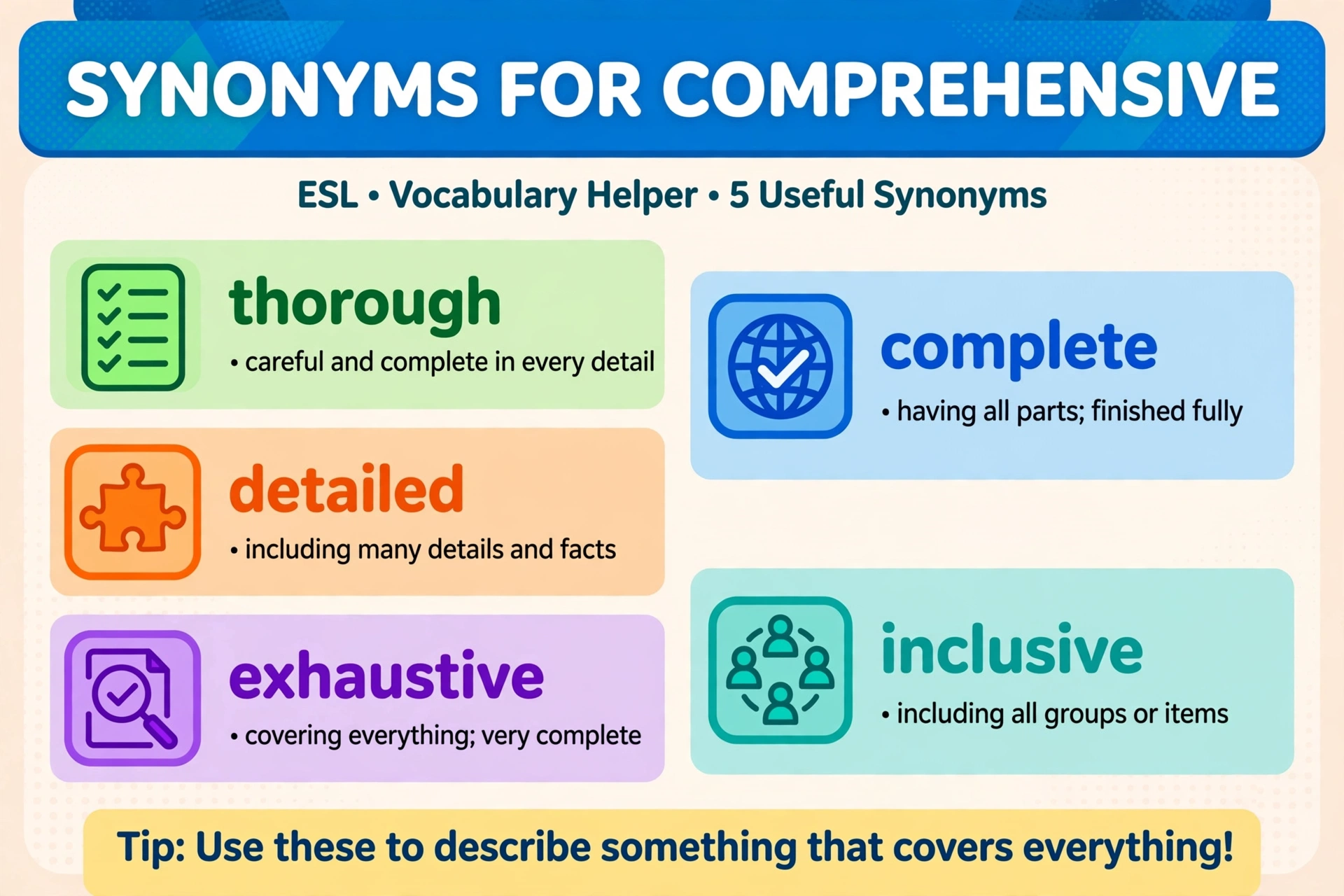
In this guide, you will learn five powerful synonyms for comprehensive, each with a clear meaning and natural example sentences.
Thorough
Meaning: Done completely and carefully, with attention to every detail.
Example: The mechanic gave the car a thorough inspection before the trip.
Example: She did thorough research before choosing a university.
Example: A thorough cleaning of the kitchen took the whole afternoon.
Complete
Meaning: Having all parts; nothing missing.
Example: Please submit a complete application with all required documents.
Example: The set comes complete with instructions and spare parts.
Example: Her report was complete — every section filled in and checked.
Exhaustive
Meaning: Covering every possible detail so thoroughly that nothing more can be added.
Example: The researchers carried out an exhaustive review of past studies.
Example: After an exhaustive search, they finally found the missing file.
Example: The lawyer prepared an exhaustive list of every document in the case.
Extensive
Meaning: Covering a large area, amount, or range; wide-reaching.
Example: She has extensive experience in customer service.
Example: The storm caused extensive damage across three counties.
Example: His extensive reading made him an interesting person to talk to.
All-inclusive
Meaning: Including everything that is needed, with no extras left out.
Example: The hotel offers an all-inclusive package with meals and activities.
Example: They chose an all-inclusive price so there would be no surprise fees.
Example: The gym membership is all-inclusive — pool, sauna, and all classes.
Quick Comparison Table
| Synonym | Best Used For |
|---|---|
| Thorough | Careful, detailed work |
| Complete | Nothing missing, all parts present |
| Exhaustive | Maximum possible detail |
| Extensive | Wide range or large amount |
| All-inclusive | Packages with everything included |
How to Use These Words
Match the word to the scale. Use thorough for careful work, complete when nothing is missing, exhaustive for the most detailed coverage, extensive for wide range, and all-inclusive for packages and offers. Watch out: “exhaustive” can sound like overkill for small tasks — a “thorough cleaning” sounds right, but an “exhaustive cleaning” sounds exhausting. Even a comprehensive guide needs correct word choices throughout — practice vs practise is one pair where careful spelling pays off. Thorough vocabulary makes thorough writing.
Also consider the context of money and marketing. All-inclusive almost always appears in commercial settings — travel, memberships, service packages — where the point is that the buyer pays one price. Using it for a school essay would sound strange. Complete is the most flexible of the five; it works for forms, collections, meals, and even people. Exhaustive and extensive are the most formal and belong in academic or professional writing. When in doubt, “thorough” is your safest everyday choice.
Common Mistakes to Avoid
- Promising “exhaustive” when you mean “thorough.” Exhaustive means nothing more can possibly be added. If your review covers ten sources but not every source ever written, call it thorough, not exhaustive — honesty keeps readers’ trust.
- Using “complete” for unfinished things. “The project is complete” means it is finished. Learners sometimes write “almost complete project,” which contradicts itself; say “nearly finished” instead.
- Confusing “extensive” with “expensive.” The words look alike but share no meaning. Extensive means wide-ranging; expensive means costly. Mixing them up changes the sentence completely.
- Calling a person “all-inclusive.” This word describes packages, prices, and plans — never people. For a person with wide interests, use “well-rounded” or “versatile.”
Quick Practice
Choose the best word from the list: thorough, complete, exhaustive, extensive, all-inclusive.
- The hotel package was ___ — flights, meals, and tours were all covered.
- The scientist did an ___ study of every published paper on the topic.
- She has ___ knowledge of European history, from ancient Rome to today.
- Please return the form ___ — do not leave any section blank.
Answer key: 1. all-inclusive 2. exhaustive 3. extensive 4. complete
Related Words Worth Learning
- Synonyms for Importance — covering what matters most
- Synonyms for Intelligent — describing sharp minds
- Synonyms for Efficient — doing things well
FAQs
Is “exhaustive” too strong for everyday use?
It can be. “Exhaustive” suggests the absolute maximum detail, so save it for research, reviews, and formal reports. “Thorough” fits everyday contexts better.
What is the difference between extensive and comprehensive?
“Extensive” emphasizes wide range or large amount, while “comprehensive” emphasizes completeness — nothing left out. A library can be extensive; a guide should be comprehensive.
Can “complete” describe a person?
It can describe someone’s skills (“a complete player”), but for people, words like “well-rounded” usually sound more natural.
Is “all-inclusive” only for travel?
Mostly, but it works anywhere something includes everything: “an all-inclusive fee” or “an all-inclusive plan.”
What is the difference between thorough and detailed?
They overlap, but “thorough” describes the care and completeness of the work, while “detailed” describes how much information is included. A report can be detailed without being thorough if it misses key points.
Can “complete” be used as a verb?
Yes. As a verb, “complete” means to finish something — “She completed the course in six months.” The adjective form describes the finished state.
Conclusion
When something covers everything, say so with style. Thorough, complete, exhaustive, extensive, and all-inclusive each capture completeness from a different angle. Add them to your vocabulary and your descriptions will sound fuller, sharper, and more professional.

James Reed is a writer and English language enthusiast with a passion for making vocabulary simple and fun. He writes about words, meanings, and everyday English to help learners speak and write with confidence.