Consistent means steady and unchanging — doing things the same good way again and again. Teachers praise consistent effort, employers value consistent workers, and readers trust consistent quality. It is a positive, powerful word, but repeating it in every paragraph weakens its impact.
Think of a performance review that calls an employee “consistent” five times. By the fifth mention, the praise sounds lazy rather than sincere. Replacing two of those with “steady” and “reliable” makes each compliment feel considered. Variety shows you actually noticed the person’s qualities instead of copying one word.
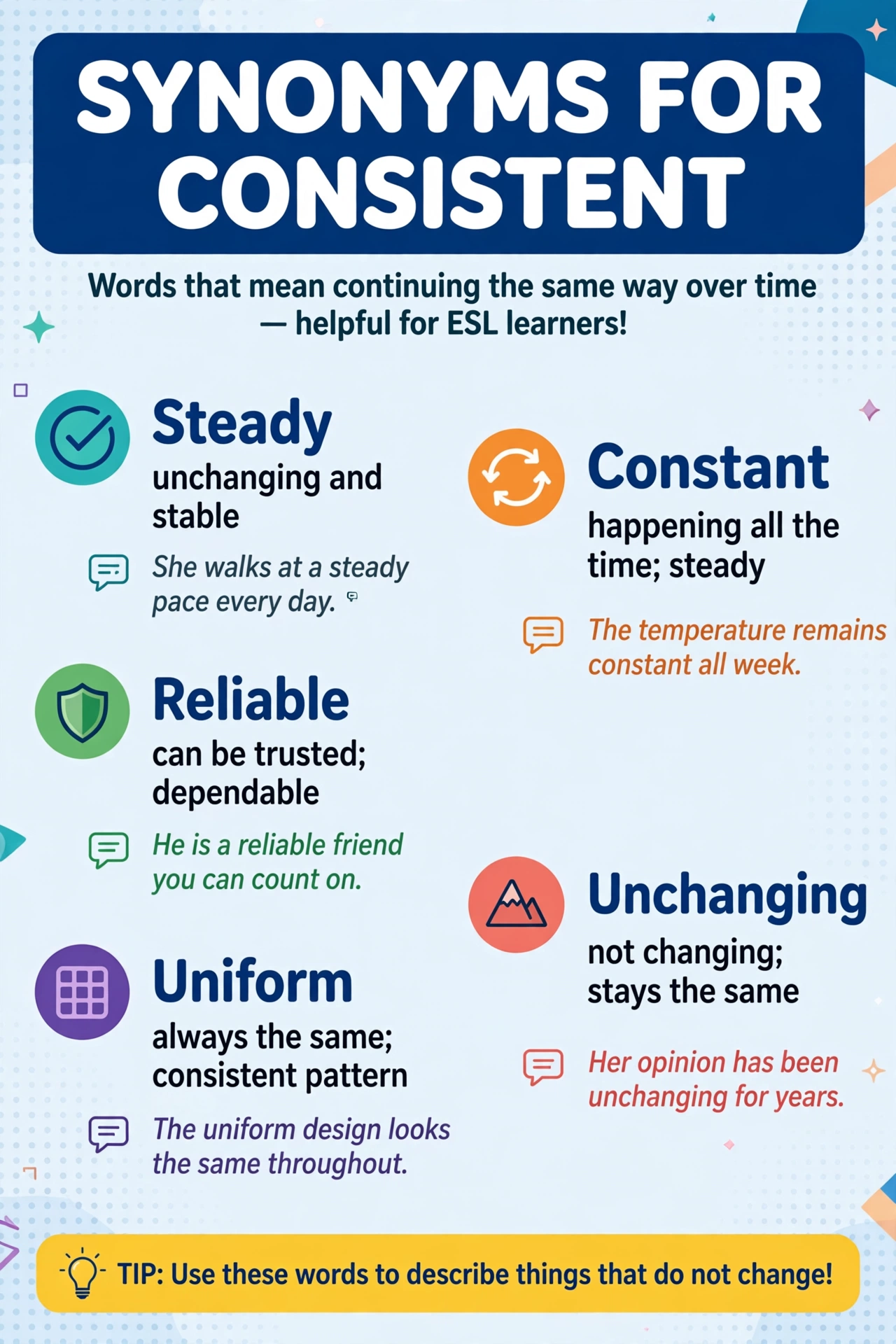
Good synonyms for consistent keep your praise fresh. “Steady” suggests calm reliability, “constant” means never stopping, “uniform” means the same everywhere, “regular” means happening on schedule, and “stable” means firmly balanced. Each one highlights a different side of reliability.
These distinctions matter more than learners expect. Telling a manager you want “stable income” is a serious life goal; asking for “constant income” sounds like you never want a day off. Praising a friend’s “steady improvement” feels warm and genuine, while “uniform improvement” sounds like a lab report. In performance reviews and recommendation letters, the exact word you choose can change how the reader feels about the person described — so learning all five is a real career skill.
In this guide, you will learn five powerful synonyms for consistent, each with a clear meaning and natural example sentences.
Steady
Meaning: Firm, calm, and reliable; not shaking or changing.
Example: She made steady progress in her English every single month.
Example: His steady hand made him an excellent surgeon.
Example: The company showed steady growth for five years in a row.
Constant
Meaning: Happening all the time without stopping or changing.
Example: The baby needed constant attention during the first weeks.
Example: The machine hummed with a constant, low sound all night.
Example: She faced constant pressure to finish the project before the deadline.
Uniform
Meaning: The same in all parts or at all times; not varying.
Example: The school requires a uniform dress code for all students.
Example: The paint dried to a smooth, uniform color.
Example: The new rules apply with uniform strictness in every branch office.
Regular
Meaning: Happening at fixed times or in a steady pattern.
Example: Regular exercise keeps both body and mind healthy.
Example: He is a regular customer at the corner bakery.
Example: The bus runs at regular intervals — every fifteen minutes.
Stable
Meaning: Firmly fixed and balanced; unlikely to change suddenly.
Example: After years of hard work, he finally found a stable job.
Example: The patient’s condition is now stable, the doctors said.
Example: A stable economy encourages people to start new businesses.
Quick Comparison Table
| Synonym | Best Used For |
|---|---|
| Steady | Calm, reliable progress or behavior |
| Constant | Nonstop, unchanging presence |
| Uniform | Sameness in all parts |
| Regular | Fixed schedules and patterns |
| Stable | Firm balance, unlikely to shift |
How to Use These Words
Pick the shade you need. Use steady for calm reliability, constant for nonstop presence, uniform for sameness everywhere, regular for scheduled patterns, and stable for firm balance. Be careful with “constant” — it can sound negative (“constant complaints”), so check your context. Consistent writing also means consistent word choices — practice vs practise rewards the same careful attention. Steady vocabulary builds steady, trustworthy English.
It also helps to know which nouns each word loves. We say “steady progress,” “steady income,” and “a steady hand.” We say “constant pressure,” “constant noise,” and “constant attention.” “Uniform” pairs with “rules,” “color,” and “quality.” “Regular” loves schedules — “regular meetings,” “regular exercise,” “regular intervals.” “Stable” belongs to serious states — “a stable job,” “a stable economy,” “stable health.” These partnerships are not random; using the right noun with the right adjective is what makes advanced English sound effortless.
Common Mistakes to Avoid
- Praising with “constant” carelessly. “Constant improvement” sounds fine, but “constant talking” is a complaint. Before writing “constant,” ask whether the nonstop quality is a good thing in this context.
- Using “uniform” for people. Do not call a person “uniform” — it suggests they are identical to everyone else, which sounds insulting. “Uniform” describes rules, colors, and quality, not individuals.
- Writing “regular” when you mean “normal.” “A regular day” is fine, but learners sometimes write “regular person” when they mean “normal person.” A “regular” is actually a frequent customer — so “he is a regular” means he comes often.
- Confusing “stable” with “staple.” The words look alike but “stable” means firmly balanced while “staple” is a basic food item or a metal fastener. “A staple job” is a common spelling slip for “a stable job.”
Quick Practice
Choose the best word from the list: steady, constant, uniform, regular, stable.
- The doctor said the baby’s condition was ___ after the operation.
- She goes jogging every morning — it is part of her ___ routine.
- The two shirts are identical in ___ color and size.
- His ___ efforts finally earned him a promotion.
Answer key: 1. stable 2. regular 3. uniform 4. steady (constant also works)
Related Words Worth Learning
- Synonyms for Efficient — steady and smart work
- Synonyms for Determination — staying the course
- Synonyms for Resilience — steady through storms
FAQs
Is “constant” always positive?
Not always. “Constant support” is positive, but “constant noise” is negative. The word itself is neutral — context decides.
What is the difference between steady and stable?
“Steady” describes smooth, continuous progress or behavior; “stable” describes firmness and balance, often for situations like jobs, health, or structures.
Can “regular” describe a person?
Yes — “a regular customer” or “a regular visitor” means someone who comes often and predictably.
Is “uniform” only about clothes?
No. A uniform is clothing, but “uniform” as an adjective means “the same throughout” — uniform rules, uniform color, uniform quality.
Can “steady” describe a relationship?
Yes. A “steady relationship” is calm, reliable, and long-lasting — a very positive description. It suggests trust built over time.
What is the opposite of stable?
“Unstable” — used for situations that may change suddenly, like “an unstable economy” or “unstable weather.” For people, “unsteady” often fits better: “he felt unsteady on his feet.”
Conclusion
Reliability deserves rich language. Steady, constant, uniform, regular, and stable each describe consistency from a fresh angle. Weave them into your essays, emails, and conversations, and your praise will sound as dependable as the people you describe.

James Reed is a writer and English language enthusiast with a passion for making vocabulary simple and fun. He writes about words, meanings, and everyday English to help learners speak and write with confidence.