Consequences are the results of actions — what happens because of what someone did. Every choice has consequences, good or bad, which is why the word appears constantly in essays, news, and daily conversation. But repeating “consequences” makes writing feel heavy and predictable.
Parents warn children about consequences, teachers discuss them in history class, and journalists analyze them after every election. Because the word carries a serious tone, overusing it can make even light topics feel grave. Varying it with “results,” “outcomes,” or “effects” keeps your tone balanced and your reader engaged.
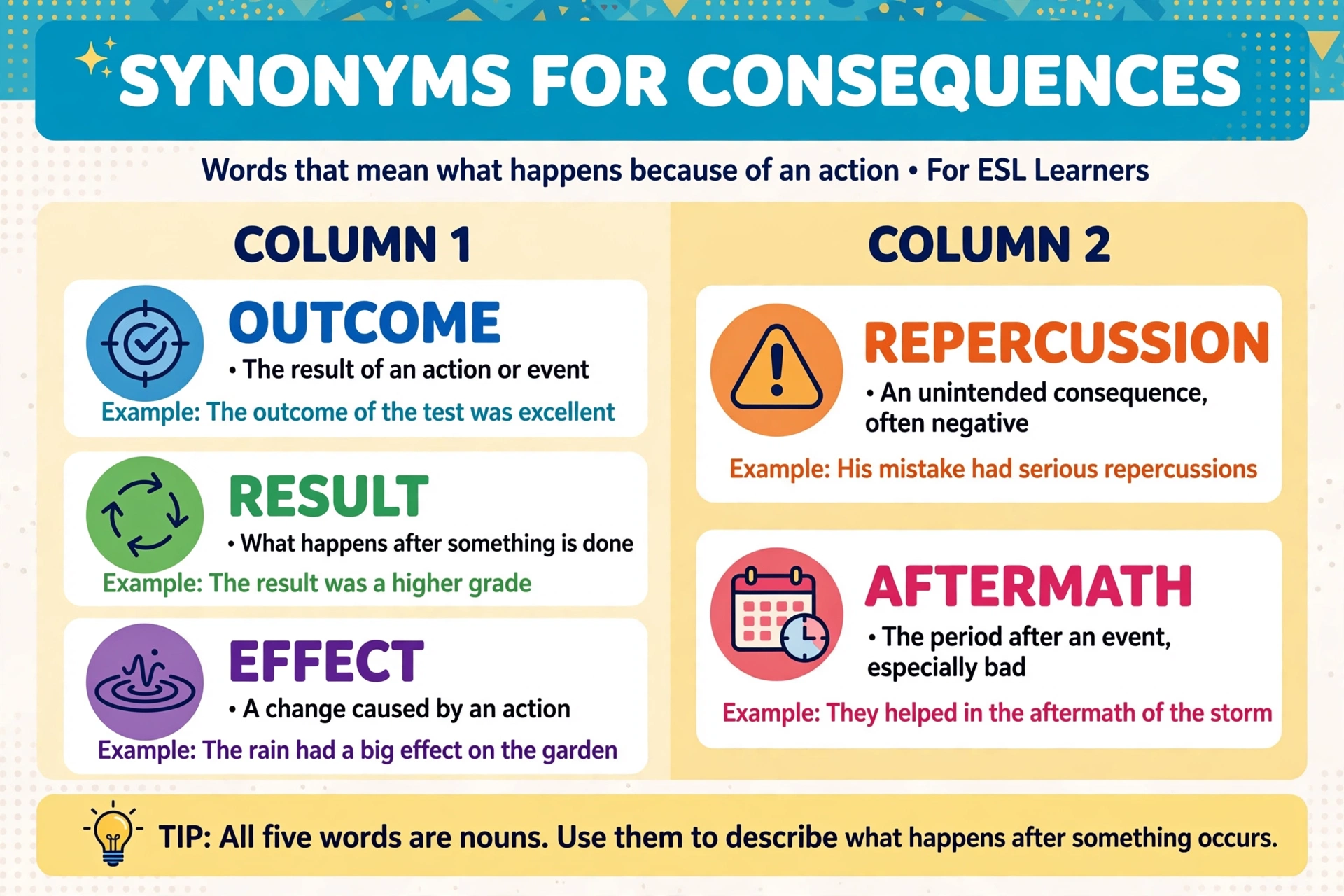
Strong synonyms for consequences add precision. “Results” are neutral, “effects” describe what follows a cause, “outcomes” fit formal contexts, “repercussions” suggest spreading impact, and “aftermath” describes what remains after big events. Each word tells the reader exactly what kind of result you mean.
This precision changes how persuasive you sound. A debater who says “the policy had terrible repercussions” sounds more informed than one who says “the policy had bad consequences” — the sharper word implies deeper analysis. In essays, “the experiment’s outcomes” reads like real science, while “the experiment’s consequences” reads like a warning. Even in daily talk, “the aftermath of the party” paints a funnier, more vivid picture than “the consequences of the party.” The word you choose frames the result before you describe it.
In this guide, you will learn five powerful synonyms for consequences, each with a clear meaning and natural example sentences.
Results
Meaning: The things that happen because of an action or event; neutral and general.
Example: The results of the experiment surprised the whole team.
Example: Hard work brought excellent results in her final exams.
Example: The election results were announced late at night.
Effects
Meaning: Changes or outcomes produced by a cause; what follows an action.
Example: The new policy had positive effects on employee morale.
Example: Scientists are still studying the long-term effects of the diet.
Example: The medicine had no side effects, which pleased the doctors.
Outcomes
Meaning: The final results of a process, often used in formal or academic contexts.
Example: The study examined the health outcomes of daily exercise.
Example: Two very different outcomes were possible after the vote.
Example: The program improved learning outcomes for thousands of students.
Repercussions
Meaning: Indirect or spreading effects of an action, often negative and wider than expected.
Example: The company’s decision had serious repercussions for small suppliers.
Example: He never imagined the repercussions of a single careless post.
Example: The trade war had global repercussions for farmers everywhere.
Aftermath
Meaning: The situation that remains after an important or damaging event.
Example: Volunteers helped clean up in the aftermath of the storm.
Example: In the aftermath of the scandal, three officials resigned.
Example: The city slowly recovered in the aftermath of the earthquake.
Quick Comparison Table
| Synonym | Best Used For |
|---|---|
| Results | General, neutral outcomes |
| Effects | What directly follows a cause |
| Outcomes | Formal or academic results |
| Repercussions | Spreading, often negative impact |
| Aftermath | What remains after major events |
How to Use These Words
Choose by scope and tone. Use results for general neutral outcomes, effects for what follows a cause, outcomes in formal writing, repercussions for spreading (often negative) impact, and aftermath for what remains after major events. A simple guide: small everyday results are “results,” scientific findings are “effects” or “outcomes,” scandals create “repercussions,” and disasters leave an “aftermath.” Every consequence has a cause — stating it correctly with since vs because makes your reasoning clear. Precise words make cause and effect easy to follow.
Also learn the verbs that travel with each word. We “announce” results, “study” effects, “measure” outcomes, “face” repercussions, and “recover in” the aftermath. These collocations are the difference between English that sounds translated and English that sounds native. A learner who writes “the aftermath of my birthday” will get a puzzled look — aftermath demands a serious event. Matching each noun to its natural verbs and contexts is a skill that examiners notice and reward.
Common Mistakes to Avoid
- Using “aftermath” for happy events. Aftermath belongs to disasters, scandals, and conflicts. “The aftermath of the wedding” sounds like something went wrong — for happy events, use “following” or “after.”
- Calling small effects “repercussions.” Repercussions spread wide and hit hard. A late homework assignment has consequences, not repercussions — save the big word for big impact.
- Mixing up “effect” and “affect.” This is one of English’s classic traps: “effect” is usually the noun (the result), “affect” is usually the verb (to influence). Writing “the affects of the policy” is a common and costly error.
- Using “outcomes” in casual chat. “What were the outcomes of the picnic?” sounds like a research paper. In everyday talk, “how did it go” or “what happened” is far more natural.
Quick Practice
Choose the best word from the list: results, effects, outcomes, repercussions, aftermath.
- The ___ of the blood test came back negative, to everyone’s relief.
- In the ___ of the flood, hundreds of volunteers arrived to help.
- The new law had unexpected ___ for small businesses across the country.
- Researchers studied the long-term ___ of the vaccine on children.
Answer key: 1. results 2. aftermath 3. repercussions 4. effects
Related Words Worth Learning
- Synonyms for Determination — owning your choices
- Synonyms for Resilience — facing what follows
- Synonyms for Importance — weighing what matters
FAQs
Are consequences always negative?
No. “Consequences” can be positive, negative, or neutral — though people often use it for negative results. “Results” and “outcomes” sound more neutral.
What is the difference between effects and consequences?
They overlap heavily. “Effects” emphasizes what directly follows a cause, while “consequences” often suggests results of someone’s actions or decisions.
Is “repercussions” formal?
Yes, it is somewhat formal and usually describes serious, spreading negative effects. It works well in news and academic writing.
When should I use “aftermath”?
Use it for the period after a major event — storms, accidents, elections, or conflicts — when describing what is left behind.
What is the difference between result and outcome?
They are near-twins, but “result” is the everyday word for what happened, while “outcome” sounds more formal and final — the end point of a process. “The result of the game” and “the outcome of the trial” show the natural split.
Can “effects” be positive?
Absolutely. Effects are neutral — they simply describe what follows a cause. “The positive effects of exercise” and “the harmful effects of smoking” are both perfectly natural.
Conclusion
Every action echoes, and now you have five ways to describe the echo. Results, effects, outcomes, repercussions, and aftermath each capture what follows an action with its own shade of meaning. Use them precisely, and your writing about cause and effect will feel confident and clear.

James Reed is a writer and English language enthusiast with a passion for making vocabulary simple and fun. He writes about words, meanings, and everyday English to help learners speak and write with confidence.