“Development” is everywhere — in business reports, school essays, and everyday conversation. It can mean a child’s growth, a company’s expansion, or a new housing project, which is exactly why repeating it gets tiring fast.
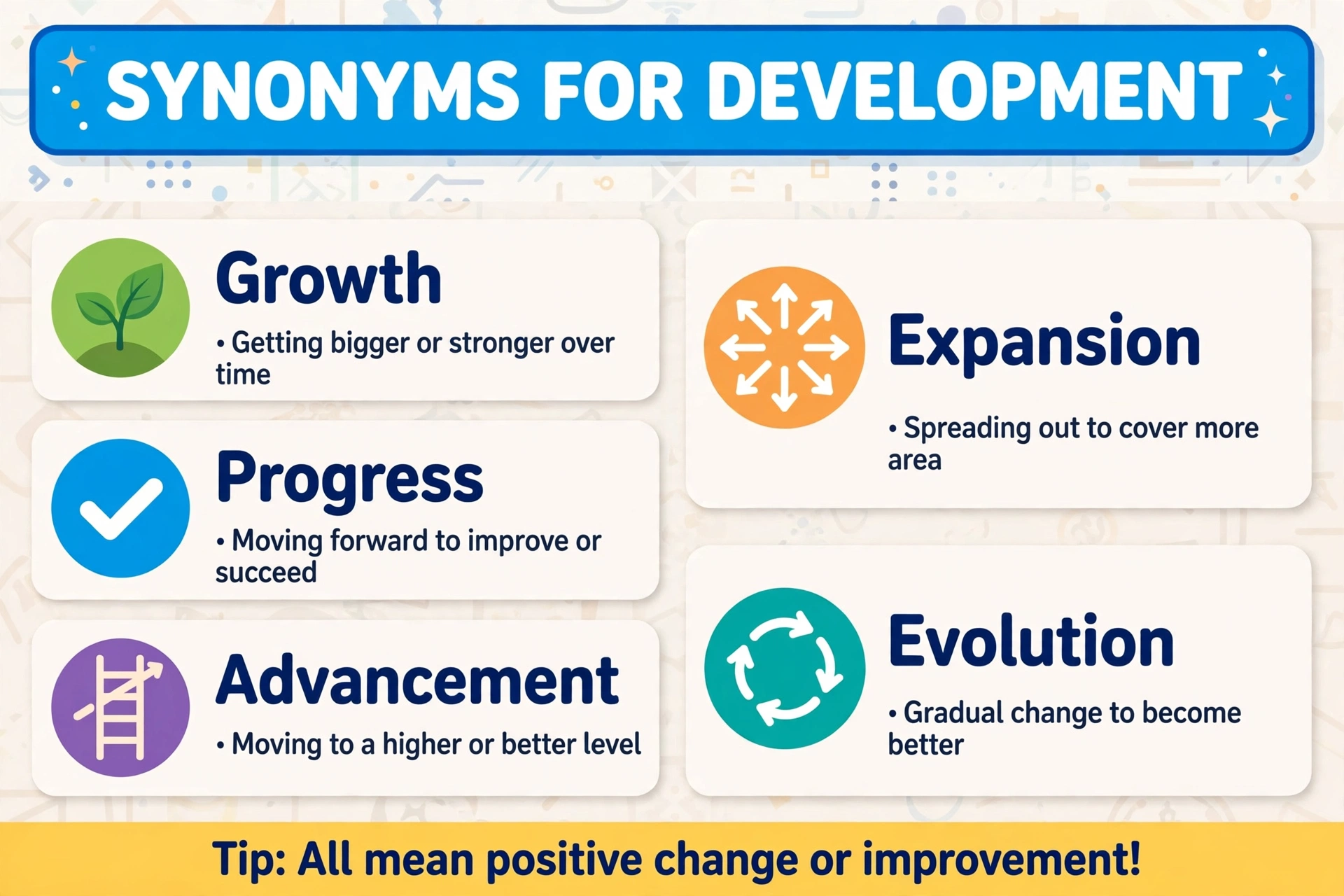
Each synonym below captures a different flavor of development: steady growth, forward movement, rising levels, or gradual change. Here are five powerful alternatives with clear meanings and practical examples.
Every success story is a development story: skills growing, businesses expanding, ideas evolving. The nouns below help you narrate that journey with variety, so your essays and reports never sound repetitive.
There is another reason to learn these words well: “development” is one of the most common nouns in academic and professional English. IELTS and TOEFL essays, business reports, and university applications all lean on it heavily. Writers who can rotate through “growth,” “progress,” “advancement,” “improvement,” and “evolution” automatically sound more advanced — because variety is one of the clearest signals of a strong vocabulary.
Growth
Meaning: The process of becoming bigger, stronger, or more mature.
Example: Regular reading led to steady growth in her vocabulary.
Example: The startup reported impressive growth in its first year of business.
Progress
Meaning: Forward movement toward a goal, step by step.
Example: The team is making real progress on the new app.
Example: Despite the delays, the peace talks are finally showing progress.
Advancement
Meaning: Movement to a higher or more advanced level.
Example: His hard work earned him quick advancement at the company.
Example: The advancement of medical science has saved millions of lives.
Improvement
Meaning: The act of becoming better than before.
Example: There has been clear improvement in her test scores.
Example: Daily practice brought a noticeable improvement in his pronunciation.
Evolution
Meaning: Gradual change and development over a long period.
Example: The evolution of smartphones changed how we communicate.
Example: Scientists continue to study the evolution of language in early humans.
At a Glance
| Word | Use it when… |
|---|---|
| Growth | Becoming bigger, stronger, more mature |
| Progress | Step-by-step movement toward a goal |
| Advancement | Rising to a higher level |
| Improvement | Becoming better than before |
| Evolution | Slow change over a long period |
How to Use These Words
Choose by context. Growth suits living things, skills, and businesses; progress fits projects moving toward goals; advancement implies rising to a higher level, often in careers or science. Use improvement when something gets better, and evolution for slow, long-term change. Two spelling guides pair well with this topic: analize or analyze — you analyze data to measure development — and practice vs practise, since practising a skill is how personal development happens.
Pay attention to the verbs and adjectives that naturally partner with each noun: “steady growth,” “rapid growth”; “make progress,” “show progress”; “career advancement,” “technological advancement”; “marked improvement,” “room for improvement”; “the evolution of” something over time. These partnerships, called collocations, are what make your English sound fluent rather than translated — memorize them as whole phrases.
Common Mistakes to Avoid
- “Progresses” as a plural noun: “Progress” is uncountable — you cannot say “many progresses.” For the plural idea, say “steps of progress” or “signs of progress.” (The verb “progresses” exists — “work progresses” — but the noun stays singular.)
- “Evolution” for fast change: A company doubling its sales in a month experienced “growth,” not “evolution.” Evolution is slow and gradual by definition — using it for overnight success sounds wrong to native ears.
- “Advancement” vs. “advance”: “Advancement” is the noun for rising to a higher level (“career advancement”). “Advance” as a noun usually means money paid early (“a cash advance”) or forward movement of troops. Keep them separate.
- “Improvement” without direction: “Improvement” needs to say what got better — “improvement in sales,” “an improvement on last year.” The bare sentence “There is improvement” feels unfinished; always add “in” or “on” plus the detail.
Quick Practice
Choose the best word for each sentence: growth, progress, advancement, improvement, evolution.
- The _____ of electric cars over the last decade has been remarkable.
- Doctors are pleased with the _____ in the patient’s condition.
- Personal _____ requires patience, practice, and honest feedback.
- She celebrated her _____ from assistant to team leader.
Answer key: 1. evolution — slow, long-term change. 2. improvement — getting better. 3. growth — becoming stronger and more mature. 4. advancement — rising to a higher level.
Related Words Worth Learning
- Synonyms for Determination — determination drives steady development.
- Synonyms for Inspire — great mentors inspire other people’s development.
- Synonyms for Efficient — efficient habits speed up your development.
FAQs
What is the most common synonym for “development”?
“Growth” and “progress” are the most common. “Growth” emphasizes getting bigger or stronger, while “progress” emphasizes moving forward toward a goal. Between the two, ‘growth’ is slightly more conversational and ‘progress’ slightly more formal.
What is the difference between “growth” and “development”?
“Growth” usually means increasing in size or strength. “Development” is broader — it includes growth but also improvement, maturation, and qualitative change. A child grows taller (growth) while also learning new skills (development) — the two often happen together.
Can “evolution” replace “development” in business writing?
Sometimes, but carefully. “Evolution” suggests slow, natural change over time. For planned business expansion, “growth” or “advancement” is usually more accurate. Save ‘evolution’ for stories of gradual adaptation, like how a small shop slowly became a brand.
Is “improvement” a good synonym for “development”?
Yes, when development means getting better. “Improvement in sales” and “development of sales” overlap, though “improvement” stresses the positive change more directly. It is especially useful in feedback, where the goal is to highlight positive change rather than the process itself.
What is the verb form of “development”?
“Develop” — as in “She developed strong leadership skills over the summer.” The verb is wonderfully flexible: you can develop a skill, a habit, a photograph, a piece of land, or even an illness. Its adjective “developed” describes advanced economies (“developed countries”), while “developing” describes those still growing (“developing nations”) — useful, precise vocabulary for essays about the world.
Can “growth” have a negative meaning?
Yes. “Growth” usually sounds positive, but it can describe harmful increase too: “the growth of pollution,” “tumor growth,” or “the growth of online scams.” Context decides the feeling. In business writing it is almost always positive, but in news and science writing, always check what is actually growing before assuming it is good news.
Conclusion
Development is a journey, and now you can name every stage of it. Growth for getting bigger, progress for moving forward, advancement for rising higher, improvement for getting better, and evolution for slow transformation — five words that turn a vague noun into a precise picture. Match the word to the journey, and your writing will move with real purpose.
Journeys need good narration. These five nouns will carry your reader from the first small step to the final transformation — in essays, reports, and stories alike.

James Reed is a writer and English language enthusiast with a passion for making vocabulary simple and fun. He writes about words, meanings, and everyday English to help learners speak and write with confidence.