“Destruction” names the act or result of destroying — but not all destruction looks the same. A planned building demolition, a storm’s aftermath, and the slow decay of an old house are different stories, and one word cannot tell them all.
Noun synonyms for destruction let you name the exact kind of ruin you mean: who caused it, how complete it was, and what remains. Here are five powerful alternatives with clear meanings and practical examples.
From news headlines to history books, destruction is described every day. The nouns you choose decide whether your reader pictures a construction crew, a natural disaster, or a slow decline. Precision here is not decoration — it is clarity.
This matters more than many learners realize. In exams, essays, and journalism, the noun you pick signals that you understand the event — not just that it was bad, but how and why. A “demolition” tells a story of planning; a “collapse” tells a story of sudden failure. These five nouns give you the vocabulary to tell each story correctly.
Damage
Meaning: Harm that makes something less useful, safe, or valuable than before.
Example: The storm caused serious damage to several houses.
Example: The insurance company agreed to pay for the damage to our car.
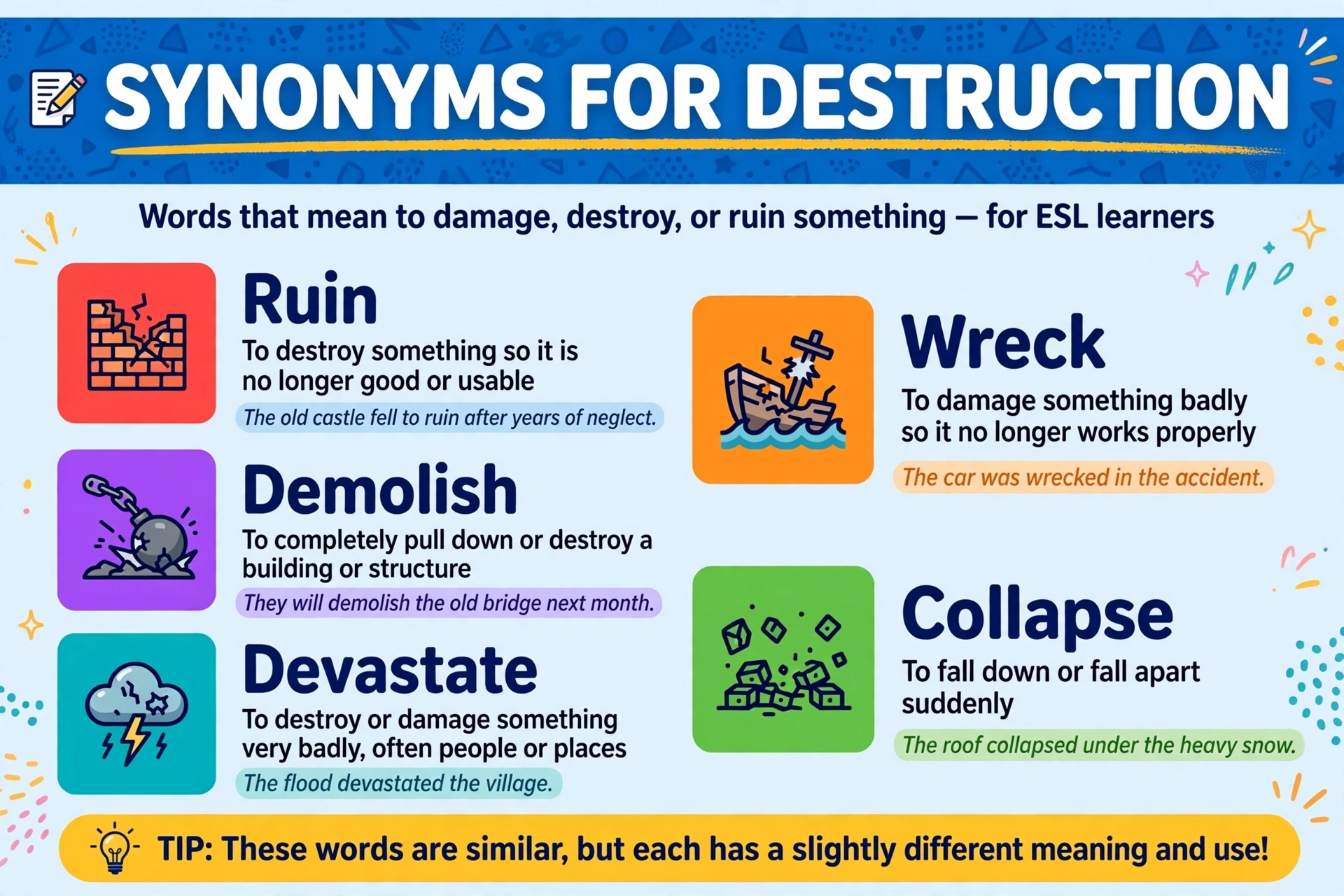
Ruin
Meaning: A state of severe damage in which something can no longer be used normally.
Example: The ancient castle now lies in ruin on the hilltop.
Example: After the factory closed, the whole neighborhood fell into ruin.
Devastation
Meaning: Widespread, severe damage affecting a large area or many people.
Example: The earthquake left a trail of devastation across the region.
Example: News photos showed the full devastation caused by the wildfire.
Demolition
Meaning: The deliberate, planned tearing down of a building or structure.
Example: The demolition of the old factory took three weeks.
Example: Residents watched the demolition of the tower from a safe distance.
Collapse
Meaning: The sudden falling down or complete failure of a structure or system.
Example: The collapse of the bridge shocked the entire town.
Example: The sudden collapse of the company left hundreds of workers jobless.
At a Glance
| Word | Use it when… |
|---|---|
| Damage | Partial harm to things or property |
| Ruin | Severe decay; no longer usable |
| Devastation | Widespread, shocking damage |
| Demolition | Planned, deliberate tearing down |
| Collapse | Sudden falling or complete failure |
How to Use These Words
Ask two questions: was it deliberate, and how complete was it? Demolition is always planned; collapse is sudden and unplanned. Damage is partial, ruin is severe, and devastation is large-scale. Two related guides help with nearby vocabulary: bursted or burst for the verb forms of sudden breaking, and crises or crisis — because destruction often leaves a crisis behind, and the singular/plural trips up many writers.
Notice the useful fixed phrases each noun appears in: “in ruins” (lying in ruins, left in ruins), “a trail of devastation,” “the demolition of” a building, “the collapse of” talks or a market, and “damage to” property. Learning these little partnerships — called collocations — is what makes advanced English sound natural instead of translated.
Common Mistakes to Avoid
- “A demolition” of a plan: “Demolition” is for buildings and structures, not for plans or hopes. A failed plan is a “collapse” (“the collapse of the peace talks”) or simply a “failure.” Keep “demolition” in the construction zone.
- “Devastation” for minor damage: A scratched table is damaged, not devastated. “Devastation” needs real scale — a town, a region, a community. Using it for small things is the fastest way to sound melodramatic.
- “Ruin” as a countable thing you can hold: You cannot buy “a ruin” at a shop — well, unless you mean an ancient building! “Ruin” usually appears in phrases like “in ruins” or “the ruin of.” The plural “ruins” describes what is left: “the ruins of the old fort.”
- Mixing up “collapse” with slow decline: “Collapse” is always sudden. A company that slowly lost money for ten years did not “collapse” — it “declined.” Reserve “collapse” for the moment everything falls at once.
Quick Practice
Choose the best word for each sentence: damage, ruin, devastation, demolition, collapse.
- The _____ of the peace talks surprised every diplomat in the room.
- Firefighters are still assessing the _____ caused by last night’s storm.
- The _____ of the old cinema will begin in March.
- Satellite images revealed the full _____ left behind by the hurricane.
Answer key: 1. collapse — sudden, complete failure. 2. damage — partial harm to property. 3. demolition — planned tearing down. 4. devastation — widespread, shocking damage.
Related Words Worth Learning
- Synonyms for Destroy — the verb form: five powerful ways to say “destroy.”
- Synonyms for Dramatic — devastation is often described with dramatic language.
- Synonyms for Vulnerable — places left in ruin become vulnerable to further harm.
FAQs
What is the difference between “destruction” and “devastation”?
“Destruction” is the general act or result of destroying. “Devastation” is stronger — it emphasizes widespread, shocking damage, often with emotional impact on people. If a headline wants shock and sympathy, it chooses ‘devastation’; for neutral reporting, ‘destruction’ does the job.
Is “demolition” always deliberate?
Yes. “Demolition” specifically means planned tearing down, usually of buildings. Accidental ruin is never called demolition. That is why you will see it in city planning documents but never in accident reports.
Can “collapse” describe non-physical things?
Yes — systems, plans, and economies can collapse too. “The talks collapsed” means negotiations failed completely and suddenly. The key idea is suddenness — a slow decline is never called a collapse.
What is the difference between “damage” and “ruin”?
“Damage” is partial harm — the thing still exists and may be repaired. “Ruin” means damage so severe the thing is effectively finished, as in “the building is a ruin.” Insurance reports live on this distinction: ‘damage’ can be repaired and claimed, ‘ruin’ usually cannot.
Is “destruction” countable or uncountable?
Both, depending on use. “Destruction” as a general concept is uncountable: “The war brought destruction to the region.” But you can count specific acts: “The storm caused widespread destructions” is rare — native speakers usually keep it uncountable and say “acts of destruction” or “scenes of destruction” when they need a plural feeling.
Which noun do historians prefer?
Historians favor precise, neutral terms. They write about “the destruction of” a city, “the demolition of” walls, or “the collapse of” an empire — each chosen for accuracy, not drama. “Devastation” appears in historical writing too, but usually when the author wants the reader to feel the human cost, not just see the facts.
Conclusion
Ruin is never one-size-fits-all, and your nouns should not be either. Damage for partial harm, ruin for severe decay, devastation for large-scale shock, demolition for planned teardown, and collapse for sudden failure — five nouns that describe destruction with the accuracy it deserves. Use them precisely, and your writing will show readers exactly what happened.
Clear nouns build clear pictures. Choose the word that matches the scale and cause, and your reader will see the scene exactly as you intend.

James Reed is a writer and English language enthusiast with a passion for making vocabulary simple and fun. He writes about words, meanings, and everyday English to help learners speak and write with confidence.