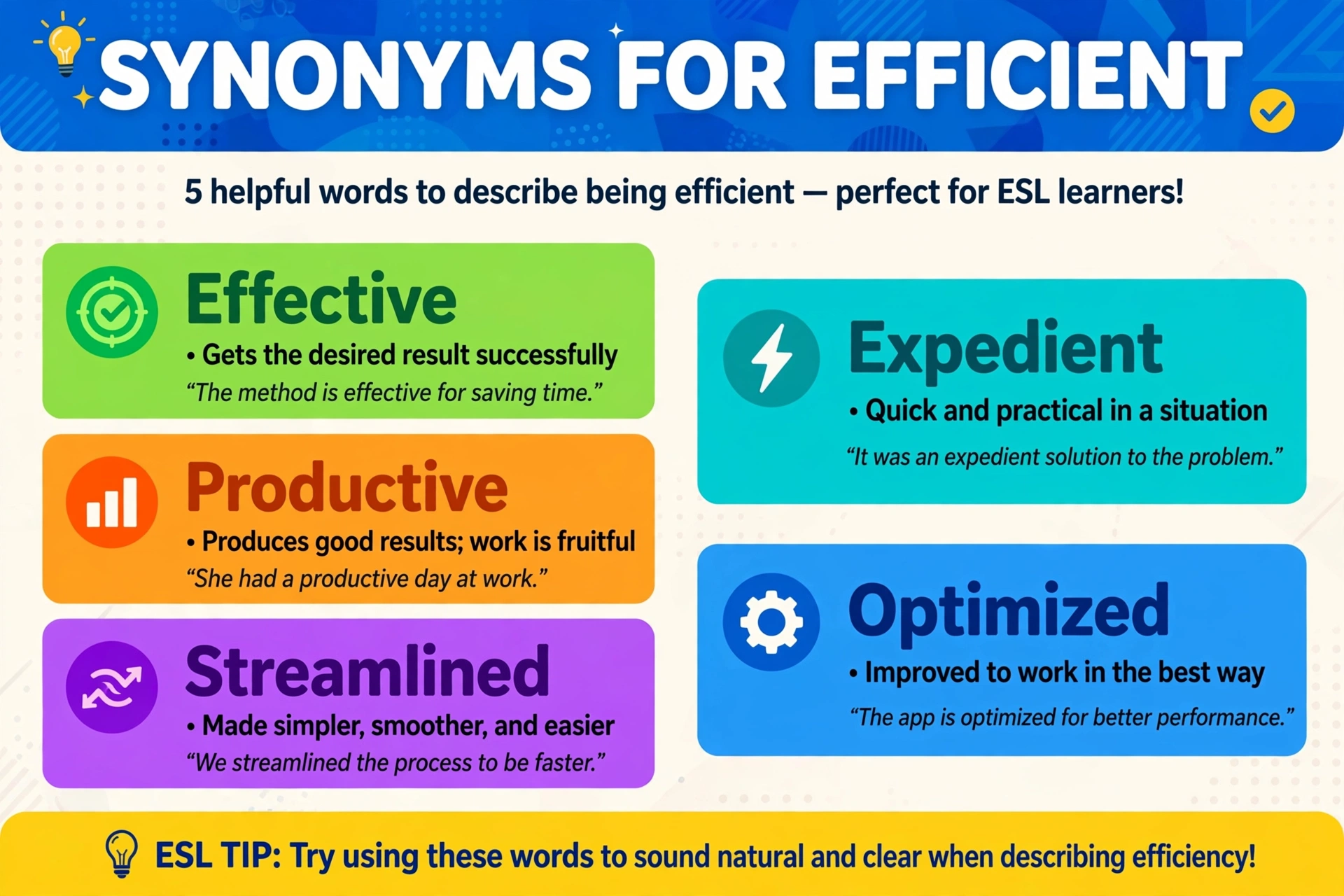
Efficient is the go-to word for workplaces, resumes, and productivity advice — which is precisely the problem. When every employee is “efficient” and every process is “efficient,” the word becomes wallpaper. Hiring managers skim past it, and readers stop believing it. Specific synonyms do the real work: they show exactly how someone or something performs well.
The five words below split efficiency into its true meanings: producing results, working fast, staying organized, and solving problems smartly. Pick the one that matches your evidence.
These five were selected because efficiency is not one thing: productive measures output, effective measures results, capable and proficient measure skill, and resourceful measures cleverness under limits. Most learners blur these together, so the examples below are built around workplaces and studies — the places where you will actually need these words. Watch which noun each word naturally pairs with.
Another useful lens is measurement. Productive is measured in output — pages written, calls made, tasks cleared. Effective is measured in outcomes — the goal reached or missed. Proficient is measured in tests passed or years practiced. Resourceful is measured in problems solved despite limits. When you can name how a word is measured, you will never confuse it with its neighbors again.
Productive
Meaning: Producing a large amount of useful work or results in a given time.
Example: She had a remarkably productive morning and cleared her entire inbox.
Example: The brainstorming session was productive, generating twelve usable ideas.
Effective
Meaning: Producing the intended result; successful in achieving a goal.
Example: The new study schedule proved highly effective before the final exams.
Example: The advertisement was effective — sales doubled within a month.
Capable
Meaning: Having the ability and qualities needed to do something well.
Example: The junior developer proved capable of leading the whole project alone.
Example: She felt capable of handling whatever the new role demanded.
Proficient
Meaning: Skilled through practice and experience; competent at a high level.
Example: After six months of lessons, he became proficient in conversational Spanish.
Example: The surgeon was proficient with both traditional and robotic tools.
Resourceful
Meaning: Good at finding clever ways to solve problems with limited means.
Example: The resourceful nurse fixed the broken equipment with supplies on hand.
Example: The resourceful campers built a shelter from fallen branches.
How to Use These Words
Ask what kind of efficiency you mean. If the point is output volume, productive is the honest word. If the point is achieving the goal, choose effective — note that an effective method can still be slow. For people’s abilities, capable is general while proficient stresses trained skill. Resourceful is special: use it only when someone solves problems cleverly with little to work with. On resumes, pair the word with proof — “productive” means little without numbers or results beside it.
Watch out for one more trap: efficient and its synonyms describe how work is done, not how hard. “He worked efficiently” says nothing about effort — a lazy person can be efficient by finishing quickly. If you want to praise hard work itself, use diligent or tireless instead.
Common Mistakes to Avoid
- Calling a busy day “effective.” Busy means productive, not effective. A day packed with meetings can be highly productive yet completely ineffective if nothing got decided.
- Writing “proficient” without a skill. Proficient needs an object — proficient in Excel, proficient at negotiating. Standing alone, it sounds unfinished.
- Praising a system as “resourceful.” Resourceful describes people who improvise, not machines or processes. For a well-designed system, use streamlined or optimized instead.
Quick Practice
Choose the best word for each blank: productive, effective, capable, proficient, resourceful.
- The marketing campaign was so __________ that revenue tripled in six weeks.
- After a year abroad, she became __________ in three regional dialects.
- With no budget left, the __________ volunteers repaired the stage from scrap wood.
Answer key: 1. effective 2. proficient 3. resourceful
Put Them Into Practice
Put these words to work where they belong: real tasks. First, review your last week and write one sentence about your most productive day and one about your most effective decision — notice how the two words refuse to swap. Second, describe a skill you are learning with proficient and a person you admire with resourceful. Third, rewrite three vague resume-style lines (‘hardworking employee’) using capable, productive, or proficient plus one concrete detail. Finally, ask a friend to guess which of the five words fits five new sentences you write — teaching the distinction to someone else will cement it for you.
Quick self-test: Write five quick job-interview sentences, one each with productive, effective, capable, proficient, and resourceful — each backed by a concrete detail or number. Then read them aloud and cut any sentence where the word could be swapped without changing the meaning. If no word swaps cleanly, your precision is interview-ready.
Related Words Worth Learning
Keep building your vocabulary with these closely connected word sets:
- Synonyms for Flexible: 5 precise words for adapting well, from adaptable to agile.
- Synonyms for Intelligent: 5 exact words for smart thinking, from clever to astute.
- Synonyms for Importance: 5 sharp words for what matters, from priority to significance.
FAQs
What is the difference between efficient and effective?
Efficient means doing things with minimum waste of time or effort; effective means achieving the desired result. A fast but wrong answer is efficient without being effective.
Which synonym is best for a resume?
Productive, proficient, and resourceful impress most on resumes, because each hints at evidence. “Proficient in Python” or “resourceful problem-solver” sound concrete and believable.
Can “capable” sound like faint praise?
Sometimes. “Capable” can read as merely adequate in performance reviews. If you mean outstanding, choose proficient or pair capable with a strong example.
Is “resourceful” only for people?
Mostly, yes. Resourceful describes people who improvise well. For processes and systems, streamlined or optimized are better choices.
What is the difference between proficient and skilled?
They overlap heavily, but proficient stresses tested competence — you can prove it. Skilled is looser praise. “Proficient in French” implies you could pass an exam; “skilled at cooking” is simply a compliment.
Can “productive” describe land or factories?
Yes. Productive farmland yields rich harvests, and a productive factory turns out goods steadily. The core idea — large useful output — works far beyond office work.
Conclusion
Efficient is a fine word, but it is overworked. Productive, effective, capable, proficient, and resourceful each say something sharper about how well work gets done. Choose the word that matches your meaning, back it with a concrete detail, and your writing — and your resume — will stand out immediately. Keep this list near your desk, and let every future claim of efficiency carry the proof it deserves. Small word swaps bring big credibility gains, starting with your very next email.

James Reed is a writer and English language enthusiast with a passion for making vocabulary simple and fun. He writes about words, meanings, and everyday English to help learners speak and write with confidence.